 Ban dino nga? Kiis
 Xeexu dino
 Rawante dino
 Fo yu ndaw yu dino
 Albomu sitikeer
 Limu TOP yu dino
 Bett ma!
Qianxisaurus
Qianxisaurus was a marine reptile that swam in the warm seas of China about 238 million years ago. It had a long body, a long tail, and a snout longer than the rest of its skull. This creature was not a dinosaur, but a type of eosauropterygian, a group of ancient sea reptiles.1
Kañ la dundoon?
Naka la réyoon?
Naka la guddoon?
 gudd ni 1,5 muusu kër, bakkan ba geen🍌gudd ni 4 banaana yu ñu topp-toppale🏊mënoon na féey guddaayu pisin bu mag (50 m) ci 26 segond
Naka la Qianxisaurus réyoon, bu ñu ko méngalee ak YAW?
Ay kalkil rekk ci sa navigatëer. Dara du ñu denc, dara du ñu yónne fenn.
Naka la gaawoon?


Xibaar yu neex
Qianxisaurus had 28 back vertebrae and four sacral vertebrae, which is unusual for early sauropterygians.1
Its skull was only 7.6 cm (3 inches) long, but the whole animal was over 80 cm (2 feet 7 inches) in length.1
The name Qianxisaurus comes from 'Qianxi', meaning western Guizhou in Chinese, and 'saurus' meaning lizard.1
Qianxisaurus had a very small supratemporal fenestra, a hole in the skull roof, which was only slightly larger than a foramen in the parietal bone.1
Its dorsal ribs had a longitudinal groove on the upper-back surface, a feature shared with some other early marine reptiles like Corosaurus and Sanchiaosaurus.1
The only known fossil of Qianxisaurus was discovered in 2006 near the Huangnihe River in Xingyi, Guizhou, and is now kept at the National Museum of Natural Science in Taiwan.1
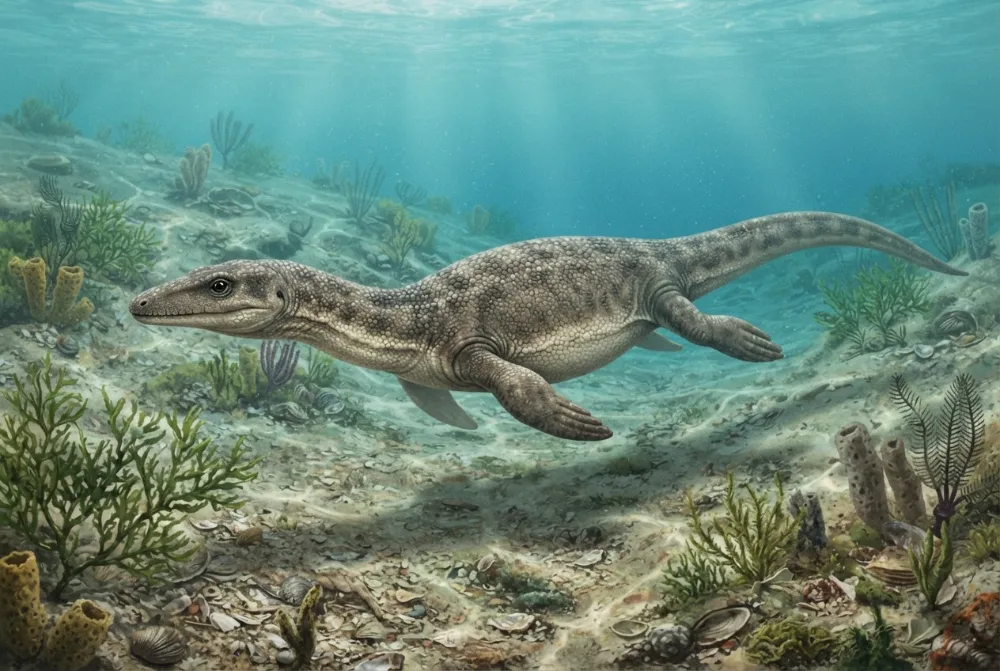
Ngir ñi xam dino lool
- Turu xam-xam
- Qianxisaurus
- Ku ko tudde
- Cheng et al. 20122
- Kurél
- Reptil yu géej
- Njaboot / klad
- Eosauropterygia2
- Klasifikasiyoŋ
- Sauropterygia2
- Màggaayu doj yi
- 241 ba 237 milyoŋ at (Ladinian)2
- Formasiyoŋi doj
- Falang2
- Réew yi
- Siin2
- Fosil yu ñu gis
- 1 ci The Paleobiology Database2
- Gisees
- Qianxisaurus was named by Yen-Nien Cheng, Xiao-Chun Wu, Tamaki Sato and Hsi-Yin Shan in 2012 based on a nearly complete skeleton found in the Zhuganpo Member of the Falang Formation in Guizhou, China.1
- Ñu ngi koy werante ba tey
- Scientists are not sure whether Qianxisaurus was a pachypleurosaur or a more basal eosauropterygian, and its exact relationships within the group are still debated.1
Fa xibaar yi jóge
- Qianxisaurus (en.wikipedia.org)
- Qianxisaurus in The Paleobiology Database (CC BY 4.0): at, béréb yi, formasiyoŋi doj, klasifikasiyoŋ.
Bépp xibaar ci xët wii am na lim bu wone fa mu jóge. Su nu juumee, baal nu, nun ñu bëgg dino lanu, du ab sërnaalu xam-xam. Wax nu ko ci [email protected] nu defar ko.
 Rex xiif na! Dino Wiki, mbiru ab baay la ngir doomam ju góor ju bëgg dinosoor, ci neen te amul kaamuñaate, amul tracker. Mag ñi mën nañu jox Rex tuuti ñam ngir dimbali ko mu des ci internet.Dundal Rex
 Nothosaurus
 Placodus
 Lariosaurus
 Cyamodus
 Cymatosaurus
 Proneusticosaurus
 Chonespondylus
 Cymbospondylus
 Phalarodon
 Mixosaurus
 Chaohusaurus
 Chensaurus