 Ban dino nga? Kiis
 Xeexu dino
 Rawante dino
 Fo yu ndaw yu dino
 Albomu sitikeer
 Limu TOP yu dino
 Bett ma!
Rhinorex
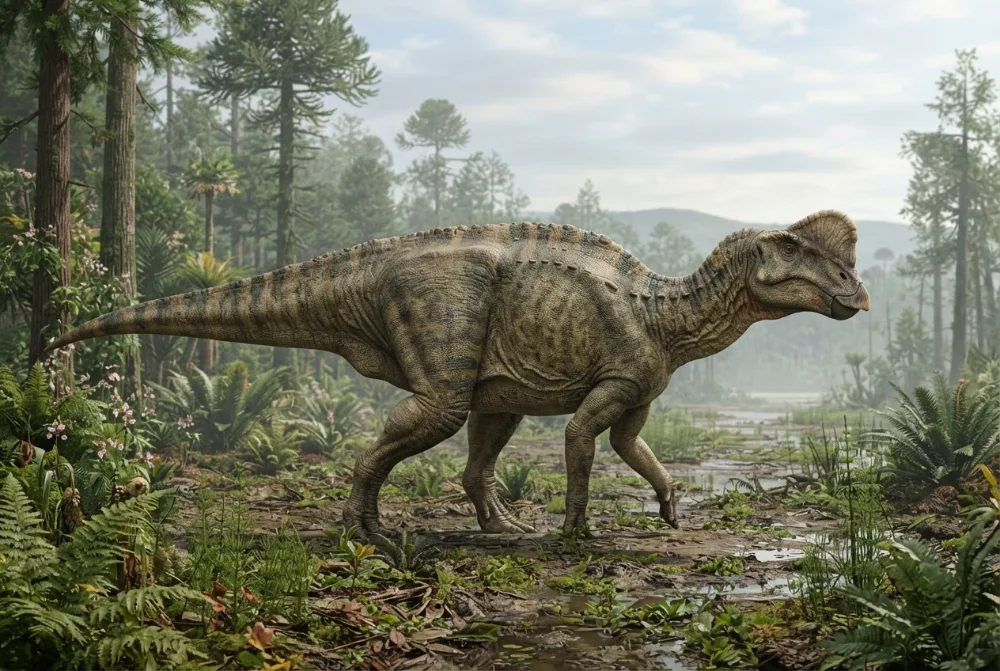
Rhinorex was a duck-billed dinosaur with a huge, bony nose that made it look like a giant bulldog. It lived in swampy forests near the coast of ancient Utah about 75 million years ago. This gentle plant-eater used its big nose to impress friends or smash plants, but scientists are still sniffing out the real reason!12
Kañ la dundoon?
Naka la réyoon?
Naka la guddoon?
Naka la kawewoon?
jortu
Naka la diisoon?
 gudd ni 2 oto yu ñu taxawal ci benn rëdd🍌gudd ni 50 banaana yu ñu topp-toppale
 diis ni 190 xaj🍉diis ni 770 xaal🎒diis ni 5 klaas yu mat yu xale yu lekkool🐻❄️diis ni 9 uurs yu weex🏃mënoon na daw 100 meetar ci 16 segond (nit ki gën a gaaw dafay soxla 9,6)
Naka la Rhinorex réyoon, bu ñu ko méngalee ak YAW?
Ay kalkil rekk ci sa navigatëer. Dara du ñu denc, dara du ñu yónne fenn.
Naka la gaawoon?


Xibaar yu neex
Rhinorex's fossil was first dug up in the 1990s, but it sat in storage for years because scientists were more interested in its well-preserved skin impressions than its bones.1
Unlike many other duck-billed dinosaurs, Rhinorex did not have a crest on top of its head. Instead, it had a huge, bony nose that gave it a very unique face.1
Rhinorex lived in an estuary, a swampy area where a river meets the sea, about 50 miles from the coast. This is different from its relative Gryposaurus, which lived further inland.1
Scientists are not sure why Rhinorex had such a big nose. It might have been used to attract mates, to recognize other members of its species, or as a base for a strong, plant-smashing beak.1
Rhinorex is the only complete hadrosaur fossil ever found in the Neslen Formation, making it a very important discovery for understanding Utah's ancient environments.1
Laaj yi ñu gën a laaj ci Rhinorex
?How big was Rhinorex?
About 9 metres (30 feet) long and weighed over 3,850 kilograms (8,500 lbs).1
?Why did Rhinorex have a big nose?
Scientists are not sure yet. It might have been used to attract mates, recognize its own species, or as a base for a strong beak to smash plants.1
?Is Rhinorex a dinosaur?
Yes, it is a duck-billed dinosaur called a hadrosaur.4
Ku tas léeb yu dul dëgg
Léeb: Rhinorex was a fierce predator with a horn on its nose.
Dëgg: Rhinorex was a gentle plant-eating hadrosaur, not a predator. Its 'nose' was a bony bump, not a horn, and it used its beak to eat plants.2
Ngir ñi xam dino lool
- Turu xam-xam
- Rhinorex
- Ku ko tudde
- Gates and Scheetz 20145
- Kurél
- Gémmiñu kanaar
- Njaboot / klad
- Hadrosauridae5
- Klasifikasiyoŋ
- Ornithischia > Ornithopoda > Iguanodontia > Hadrosauridae5
- Màggaayu doj yi
- 84 ba 72 milyoŋ at (Campanian)5
- Formasiyoŋi doj
- Nelsen5
- Réew yi
- Amerig5
- Fosil yu ñu gis
- 1 ci The Paleobiology Database5
- Gisees
- Rhinorex was discovered by two geology students from the University of California, Riverside in 1992 while they were mapping the Book Cliffs in eastern Utah. It was later named and described by paleontologists Terry Gates and Rodney Scheetz in 2014 after they found the fossil in storage at Brigham Young University.12
- Ñu ngi koy werante ba tey
- Scientists are still debating whether Rhinorex lived at exactly the same time as its close relative Gryposaurus, or if it lived a bit later. This would change whether they shared the same habitat or if Rhinorex evolved from Gryposaurus.2
Fa xibaar yi jóge
- New Hadrosaur Noses into Spotlight | NC State News (news.ncsu.edu)
- New Dinosaur Rhinorex Raises Cretaceous Quandary (nationalgeographic.com)
- New dinosaur species with giant nose discovered in Utah - Utah Geological Survey (geology.utah.gov)
- Rhinorex (en.wikipedia.org)
- Rhinorex in The Paleobiology Database (CC BY 4.0): at, béréb yi, formasiyoŋi doj, klasifikasiyoŋ.
Bépp xibaar ci xët wii am na lim bu wone fa mu jóge. Su nu juumee, baal nu, nun ñu bëgg dino lanu, du ab sërnaalu xam-xam. Wax nu ko ci [email protected] nu defar ko.
 Rex xiif na! Dino Wiki, mbiru ab baay la ngir doomam ju góor ju bëgg dinosoor, ci neen te amul kaamuñaate, amul tracker. Mag ñi mën nañu jox Rex tuuti ñam ngir dimbali ko mu des ci internet.Dundal Rex
 Parasaurolophus
 Edmontosaurus
 Saurolophus
 Hypacrosaurus
 Corythosaurus
 Kritosaurus
 Tyrannosaurus
 Triceratops
 Velociraptor
 Spinosaurus
 Ankylosaurus
 Pteranodon