 Ban dino nga? Kiis
 Xeexu dino
 Rawante dino
 Fo yu ndaw yu dino
 Albomu sitikeer
 Limu TOP yu dino
 Bett ma!
Kañ la dundoon?

Naka la réyoon?
Naka la guddoon?
Naka la kawewoon?
Naka la diisoon?
 gudd ni 5 xaj, bakkan ba geen🍌gudd ni 29 banaana yu ñu topp-toppale🍉diis ni 82 xaal🧸diis ni 22 xale yu maternel🎒diis ni 13 xale yu lekkool🏃mënoon na daw 100 meetar ci 8,2 segond (nit ki gën a gaaw dafay soxla 9,6)
Naka la Rugops réyoon, bu ñu ko méngalee ak YAW?
Ay kalkil rekk ci sa navigatëer. Dara du ñu denc, dara du ñu yónne fenn.
Naka la gaawoon?


Xibaar yu neex
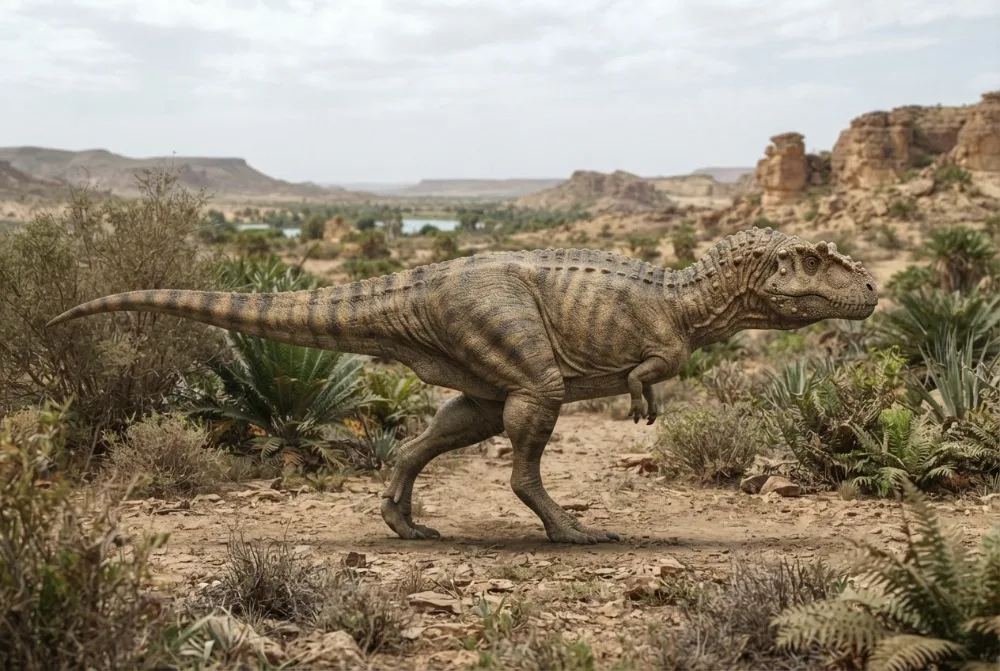
Rugops is known from only a partial skull, which is about 31.5 centimetres (12.4 inches) long.2
The top of its skull had many pits and bumps, which would have supported scales and a tough, armour-like skin on its snout.2
Rows of holes in the skull may mean Rugops had a crest or some kind of display structure on its head.1
Rugops lived alongside other huge predators like Carcharodontosaurus and Spinosaurus.2
The type specimen might have been a subadult, because its skull bones were not fully fused together.2
Rugops was one of the earliest abelisaurids, a group of horned, short-snouted theropods that lived in the southern continents.2
Laaj yi ñu gën a laaj ci Rugops
?How big was Rugops?
Scientists estimate Rugops was about 4.4 to 5.3 metres (14 to 17 feet) long and weighed around 410 kilograms (900 pounds). Some earlier estimates suggested it was up to 6 metres (20 feet) long and 750 kilograms (1,650 pounds).2
?What did Rugops eat?
Rugops was a carnivore, meaning it ate meat. Its delicate skull suggests it was a scavenger that fed on dead animals rather than a hunter that killed its own prey.13
?Where did Rugops live?
Rugops lived in what is now Niger, Africa, about 95 million years ago. Its fossils were found in the Echkar Formation, which was a river and lake environment.2
?Did Rugops have feathers?
Nobody knows for sure. Rugops is known only from a skull, and no feathers or feather impressions have been found with it. Its skull had pits and bumps that supported scales, not feathers.2
?Why is it called Rugops?
Rugops means 'wrinkle face' in Latin and Greek. It was named for the wrinkled, bumpy texture on its skull bones.2
?Was Rugops bigger than T. rex?
No, Rugops was much smaller. Rugops was about 4.4 to 5.3 metres (14 to 17 feet) long, while T. rex was over 12 metres (40 feet) long.2
Ngir ñi xam dino lool
- Turu xam-xam
- Rugops
- Ku ko tudde
- Sereno et al. 20044
- Kurél
- Dino yuy lekk yàpp
- Njaboot / klad
- Abelisauridae4
- Klasifikasiyoŋ
- Theropoda > Ceratosauria > Abelisauridae4
- Màggaayu doj yi
- 100 ba 94 milyoŋ at (Cenomanian)4
- Formasiyoŋi doj
- Echkar4
- Réew yi
- Niseer4
- Fosil yu ñu gis
- 1 ci The Paleobiology Database4
- Gisees
- Rugops was named in 2004 by paleontologist Paul Sereno and his team, based on a partial skull found in the Echkar Formation of Niger during an expedition funded by the National Geographic Society.2
- Ñu ngi koy werante ba tey
- Scientists are not sure exactly how Rugops is related to other abelisaurids; some studies place it as the most primitive, while others put it in a group with several other genera.2
Fa xibaar yi jóge
- Rugops | Natural History Museum (nhm.ac.uk)
- Rugops (en.wikipedia.org)
- Discoveries | Paul Sereno - Paleontologist | The University of Chicago (paulsereno.uchicago.edu)
- Rugops in The Paleobiology Database (CC BY 4.0): at, béréb yi, formasiyoŋi doj, klasifikasiyoŋ.
Bépp xibaar ci xët wii am na lim bu wone fa mu jóge. Su nu juumee, baal nu, nun ñu bëgg dino lanu, du ab sërnaalu xam-xam. Wax nu ko ci [email protected] nu defar ko.
 Rex xiif na! Dino Wiki, mbiru ab baay la ngir doomam ju góor ju bëgg dinosoor, ci neen te amul kaamuñaate, amul tracker. Mag ñi mën nañu jox Rex tuuti ñam ngir dimbali ko mu des ci internet.Dundal Rex
 Allosaurus
 Carnotaurus
 Dilophosaurus
 Giganotosaurus
 Compsognathus
 Paronychodon
 Tyrannosaurus
 Triceratops
 Velociraptor
 Spinosaurus
 Ankylosaurus
 Parasaurolophus