 Ban dino nga? Kiis
 Xeexu dino
 Rawante dino
 Fo yu ndaw yu dino
 Albomu sitikeer
 Limu TOP yu dino
 Bett ma!
Sclerocormus
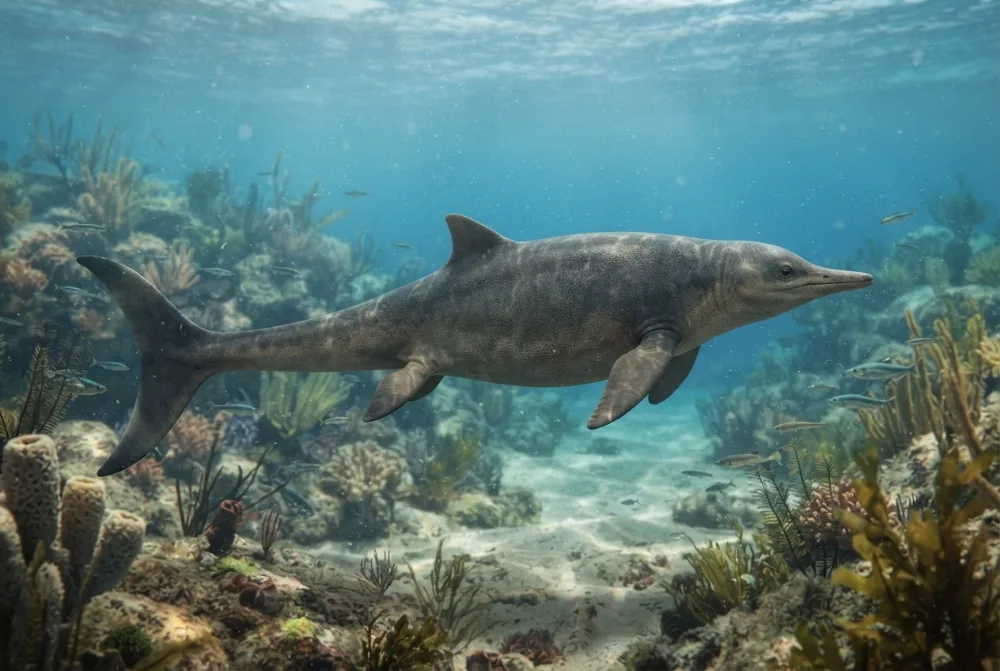
Sclerocormus was an early marine reptile that lived in the sea, not a dinosaur. It had a very tiny head and a long tail without a fluke, making it look different from later ichthyosaurs.1
Kañ la dundoon?
Naka la réyoon?
Naka la guddoon?
Naka la diisoon?
 gudd ni 3 muusu kër, bakkan ba geen🍌gudd ni 9 banaana yu ñu topp-toppale🍌diis ni 120 banaana🏊mënoon na féey guddaayu pisin bu mag (50 m) ci 6,2 segond
Naka la Sclerocormus réyoon, bu ñu ko méngalee ak YAW?
Ay kalkil rekk ci sa navigatëer. Dara du ñu denc, dara du ñu yónne fenn.
Naka la gaawoon?


Xibaar yu neex
Sclerocormus had an extremely small head that was only about 6.25% of its total body length, much smaller than other early marine reptiles like Chaohusaurus.1
Its tail was very long, making up about 58% of its total length, and it did not have a fluke like later ichthyosaurs.1
Sclerocormus had a heavily built body with flattened, overlapping belly ribs that formed a tight basket, similar to hupehsuchians.1
It lived during the Early Triassic period, about 248 to 247 million years ago, soon after the end-Permian mass extinction.41
Sclerocormus is one of the earliest known ichthyosauriforms, and its discovery shows that these marine reptiles evolved quickly within the first million years of their history.1
This reptile had large eyes with scleral plates, which are bony rings that help support the eye, like in many ichthyosaurs.1
Laaj yi ñu gën a laaj ci Sclerocormus
?How big was Sclerocormus?
Sclerocormus was about 1.6 metres (5.2 feet) long and weighed more than 15 kilograms (33 pounds).2
?What did Sclerocormus eat?
Sclerocormus was a suction feeder that used its narrow, toothless snout to suck in soft-bodied prey. Because its head and jaws were so small, it could only eat prey much smaller than itself.2
?Could Sclerocormus swim fast?
No, Sclerocormus was probably a slow swimmer. Its heavy build and body shape suggest it lived in shallow waters.2
?Is Sclerocormus a dinosaur?
No, Sclerocormus is not a dinosaur. It is an ichthyosauriform, a type of marine reptile that lived in the sea.2
Ngir ñi xam dino lool
- Turu xam-xam
- Sclerocormus
- Ku ko tudde
- Jiang et al. 20164
- Kurél
- Iktiyosoor yi
- Njaboot / klad
- Omphalosauridae4
- Klasifikasiyoŋ
- Ichthyosauromorpha4
- Màggaayu doj yi
- 249 ba 247 milyoŋ at ()4
- Formasiyoŋi doj
- Nanlinghu4
- Réew yi
- Siin4
- Fosil yu ñu gis
- 1 ci The Paleobiology Database4
- Gisees
- Sclerocormus was named by Jiang and colleagues in 2016 based on a single fossil skeleton found in the Nanlinghu Formation in Anhui, China.41
- Ñu ngi koy werante ba tey
- Scientists are not sure exactly what Sclerocormus ate, because it had no teeth, but they think it may have been a suction feeder.1
Fa xibaar yi jóge
- A large aberrant stem ichthyosauriform indicating early rise and demise of ichthyosauromorphs in the wake of the end-Permian extinction | Scientific Reports (nature.com)
- Sclerocormus (en.wikipedia.org)
- A large aberrant stem ichthyosauriform indicating early rise and demise of ichthyosauromorphs in the wake of the end-Permian extinction | Scientific Reports (preview-www.nature.com)
- Sclerocormus in The Paleobiology Database (CC BY 4.0): at, béréb yi, formasiyoŋi doj, klasifikasiyoŋ.
Bépp xibaar ci xët wii am na lim bu wone fa mu jóge. Su nu juumee, baal nu, nun ñu bëgg dino lanu, du ab sërnaalu xam-xam. Wax nu ko ci [email protected] nu defar ko.
 Rex xiif na! Dino Wiki, mbiru ab baay la ngir doomam ju góor ju bëgg dinosoor, ci neen te amul kaamuñaate, amul tracker. Mag ñi mën nañu jox Rex tuuti ñam ngir dimbali ko mu des ci internet.Dundal Rex
 Ichthyosaurus
 Platypterygius
 Stenopterygius
 Khudiakovia
 Ophthalmosaurus
 Chonespondylus
 Corosaurus