 Ban dino nga? Kiis
 Xeexu dino
 Rawante dino
 Fo yu ndaw yu dino
 Albomu sitikeer
 Limu TOP yu dino
 Bett ma!
Seitaad
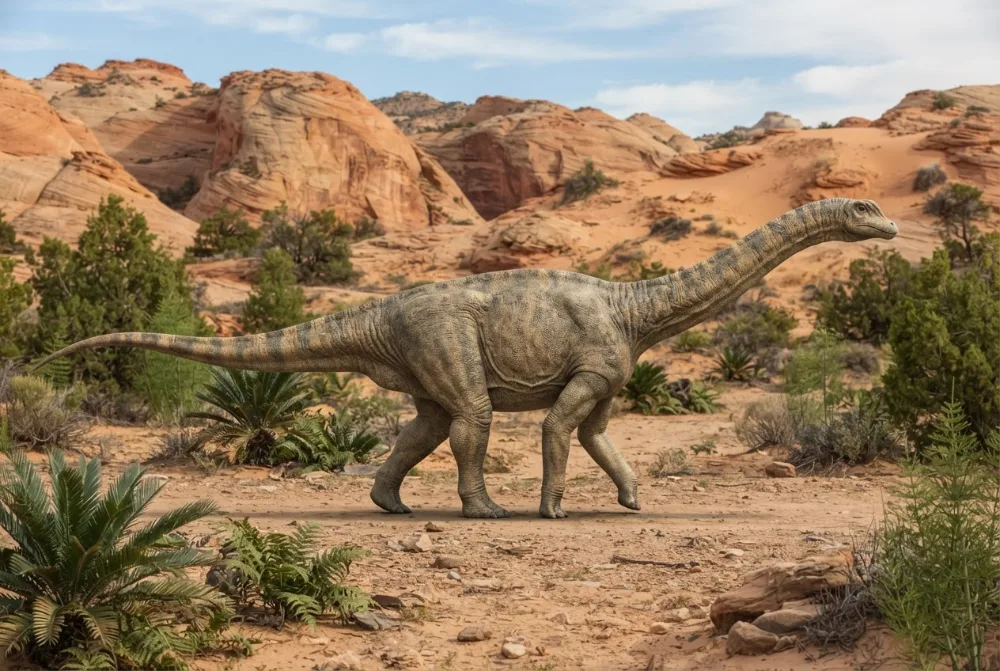
Seitaad was an early long-necked dinosaur that lived about 190 million years ago. It was a plant-eater that walked on two legs and could also use all fours. This dinosaur is one of the most complete fossils ever found in the Navajo Sandstone of Utah.31
Kañ la dundoon?
Naka la réyoon?
Naka la guddoon?
Naka la kawewoon?
Naka la diisoon?
 gudd ni 4 xaj, bakkan ba geen🍌gudd ni 25 banaana yu ñu topp-toppale🍉diis ni 18 xaal🧸diis ni 5 xale yu maternel🎒diis ni 3 xale yu lekkool🏃mënoon na daw 100 meetar ci 8,8 segond (nit ki gën a gaaw dafay soxla 9,6)
Naka la Seitaad réyoon, bu ñu ko méngalee ak YAW?
Ay kalkil rekk ci sa navigatëer. Dara du ñu denc, dara du ñu yónne fenn.
Naka la gaawoon?


Xibaar yu neex
Seitaad's name comes from a Navajo legend about a sand monster that buried its victims in dunes.1
The only known fossil of Seitaad was found at the base of a collapsed sand dune, which may have buried the animal after it died.1
Seitaad is one of the few early sauropodomorph dinosaurs known from North America.1
The species name ruessi honors Everett Ruess, a young artist and explorer who disappeared in southern Utah in 1934.1
Seitaad had a plate-like bone on its shoulder blade that helped support its arm.1
This dinosaur lived during the Early Jurassic period, when the climate was warm and deserts covered much of the area.1
Laaj yi ñu gën a laaj ci Seitaad
?How big was Seitaad?
About 3 to 4.5 metres long and 1 metre tall at the hips. It weighed around 70 to 90 kilograms, about the size of a large human.2
?What did Seitaad eat?
Seitaad ate plants. It had leaf-shaped teeth and a small head, just like its later giant relatives the sauropods.2
?Could Seitaad walk on two legs?
Yes, Seitaad could walk on two legs or on all fours. It had a long neck and tail, and a large curved claw on its thumb.2
?When did Seitaad live?
Seitaad lived during the Early Jurassic Period, about 183 to 190 million years ago. That is millions of years before the famous giant sauropods like Diplodocus.2
Ngir ñi xam dino lool
- Turu xam-xam
- Seitaad
- Ku ko tudde
- Sertich and Loewen 20103
- Kurél
- Baat yu gudd
- Njaboot / klad
- Sauropodiformes3
- Klasifikasiyoŋ
- Sauropodomorpha3
- Màggaayu doj yi
- 193 ba 175 milyoŋ at (Pliensbachian / Toarcian)3
- Formasiyoŋi doj
- Navajo Sandstone3
- Réew yi
- Amerig3
- Fosil yu ñu gis
- 1 ci The Paleobiology Database3
- Gisees
- Seitaad was named by scientists Joseph Sertich and Michael Loewen in 2010. The partial skeleton was found in the Navajo Sandstone of southern Utah, near a cliff dwelling called Eagle's Nest.31
- Ñu ngi koy werante ba tey
- Scientists are not sure exactly how Seitaad is related to other early sauropodomorphs, because its fossils do not give a clear family tree.1
Fa xibaar yi jóge
- pone.0009789 1..17 (journals.plos.org)
- New Dinosaur from Utah’s Red Rocks – UNews Archive (archive.unews.utah.edu)
- Seitaad in The Paleobiology Database (CC BY 4.0): at, béréb yi, formasiyoŋi doj, klasifikasiyoŋ.
Bépp xibaar ci xët wii am na lim bu wone fa mu jóge. Su nu juumee, baal nu, nun ñu bëgg dino lanu, du ab sërnaalu xam-xam. Wax nu ko ci [email protected] nu defar ko.
 Rex xiif na! Dino Wiki, mbiru ab baay la ngir doomam ju góor ju bëgg dinosoor, ci neen te amul kaamuñaate, amul tracker. Mag ñi mën nañu jox Rex tuuti ñam ngir dimbali ko mu des ci internet.Dundal Rex
 Brachiosaurus
 Diplodocus
 Brontosaurus
 Argentinosaurus
 Camarasaurus
 Morosaurus
 Dilophosaurus
 Stenopterygius
 Dorygnathus
 Scutellosaurus
 Sinosaurus
 Temnodontosaurus