 Ban dino nga? Kiis
 Xeexu dino
 Rawante dino
 Fo yu ndaw yu dino
 Albomu sitikeer
 Limu TOP yu dino
 Bett ma!
Shenzhousaurus
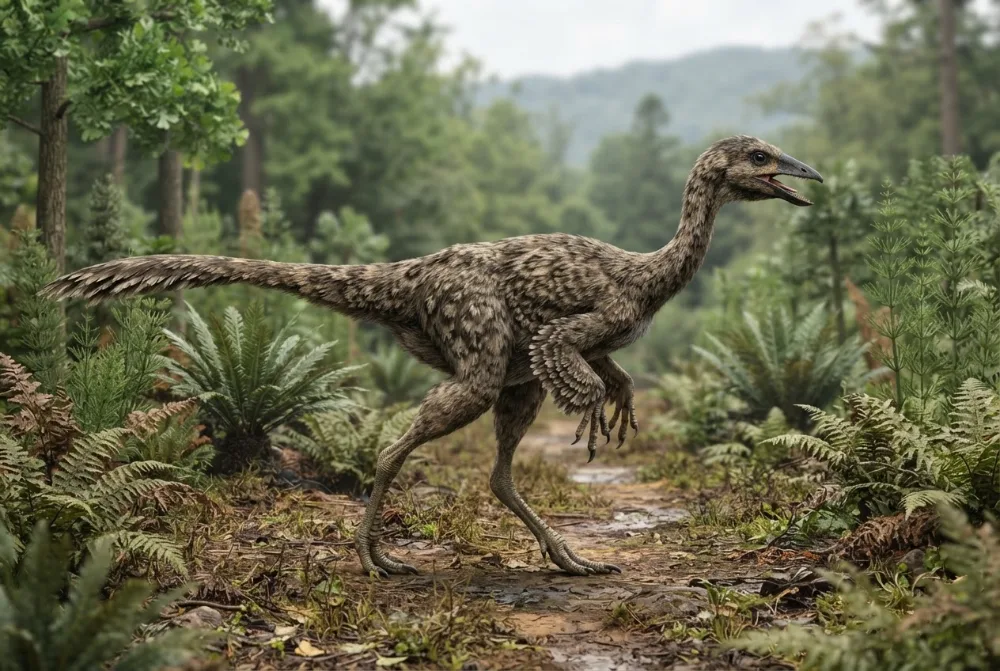
Shenzhousaurus was an early ostrich-like dinosaur that lived in what is now China. It had small teeth only at the front of its mouth, unlike later ostrich dinosaurs that had no teeth at all. This speedy dinosaur probably ate plants and small animals.12
Kañ la dundoon?
Naka la gaawoon?


Xibaar yu neex
Shenzhousaurus is one of the earliest known ostrich-like dinosaurs, living about 126 million years ago during the Early Cretaceous.2
Its name comes from 'Shenzhou', an ancient name for China, and 'saurus' meaning lizard.1
Unlike later ostrich dinosaurs that had no teeth, Shenzhousaurus had small teeth only at the front of its lower jaw.1
The only known fossil of Shenzhousaurus was found in a 'death pose' with its head above its body.2
Its first finger bone (metacarpal I) was only half the length of its second finger bone, a primitive feature.2
Shenzhousaurus had a straight ischium (a hip bone), while more advanced ostrich dinosaurs had a curved one.1
Laaj yi ñu gën a laaj ci Shenzhousaurus
?How big was Shenzhousaurus?
Scientists are not sure of its total size because the only fossil is missing parts of the legs and tail. Its skull was about 185 mm (7.3 inches) long.2
?What did Shenzhousaurus eat?
It probably ate both plants and small animals. Pebbles found in its chest area may have been gastroliths (stomach stones) to help grind up food.23
?Did Shenzhousaurus have feathers?
The fossil does not show feathers, but many close relatives of Shenzhousaurus had simple, hair-like feathers, so it might have had them too.2
?When did Shenzhousaurus live?
It lived about 126 million years ago, during the Early Cretaceous Period.2
Ngir ñi xam dino lool
- Turu xam-xam
- Shenzhousaurus
- Ku ko tudde
- Ji et al. 20033
- Kurél
- Dino yu niru otris
- Njaboot / klad
- Ornithomimosauria3
- Klasifikasiyoŋ
- Theropoda > Ornithomimosauria3
- Màggaayu doj yi
- 126 ba 120 milyoŋ at (Barremian / Aptian)3
- Formasiyoŋi doj
- Yixian3
- Réew yi
- Siin3
- Fosil yu ñu gis
- 1 ci The Paleobiology Database3
- Gisees
- Shenzhousaurus was named in 2003 by a team of scientists including Qiang Ji, Mark Norell, and Peter Makovicky. The only fossil was found at the Sihetun site in Liaoning, China.32
- Ñu ngi koy werante ba tey
- Scientists are not sure exactly what Shenzhousaurus ate, but the pebbles found in its chest may have been gastroliths for grinding food.2
Fa xibaar yi jóge
- An early ostrich dinosaur and implications for ornithomimosaur phylogeny (ia803404.us.archive.org)
- Shenzhousaurus (en.wikipedia.org)
- Shenzhousaurus in The Paleobiology Database (CC BY 4.0): at, béréb yi, formasiyoŋi doj, klasifikasiyoŋ.
Bépp xibaar ci xët wii am na lim bu wone fa mu jóge. Su nu juumee, baal nu, nun ñu bëgg dino lanu, du ab sërnaalu xam-xam. Wax nu ko ci [email protected] nu defar ko.
 Rex xiif na! Dino Wiki, mbiru ab baay la ngir doomam ju góor ju bëgg dinosoor, ci neen te amul kaamuñaate, amul tracker. Mag ñi mën nañu jox Rex tuuti ñam ngir dimbali ko mu des ci internet.Dundal Rex
 Gallimimus
 Ornithomimus
 Struthiomimus
 Deinocheirus
 Dromiceiomimus
 Archaeornithomimus
 Stegosaurus
 Iguanodon
 Archaeopteryx
 Giganotosaurus
 Microraptor
 Deinonychus