 Ban dino nga? Kiis
 Xeexu dino
 Rawante dino
 Fo yu ndaw yu dino
 Albomu sitikeer
 Limu TOP yu dino
 Bett ma!
Kañ la dundoon?

Naka la réyoon?
Naka la guddoon?
Naka la kawewoon?
Naka la diisoon?
 lu tollu ci diisaayu muusu kër🍌diis ni 29 banaana🪑tuuti ba mën a dox ci suufu siis🏃mënoon na daw 100 meetar ci 12 segond (nit ki gën a gaaw dafay soxla 9,6)
Naka la Shuvuuia réyoon, bu ñu ko méngalee ak YAW?
Ay kalkil rekk ci sa navigatëer. Dara du ñu denc, dara du ñu yónne fenn.
Naka la gaawoon?


Xibaar yu neex
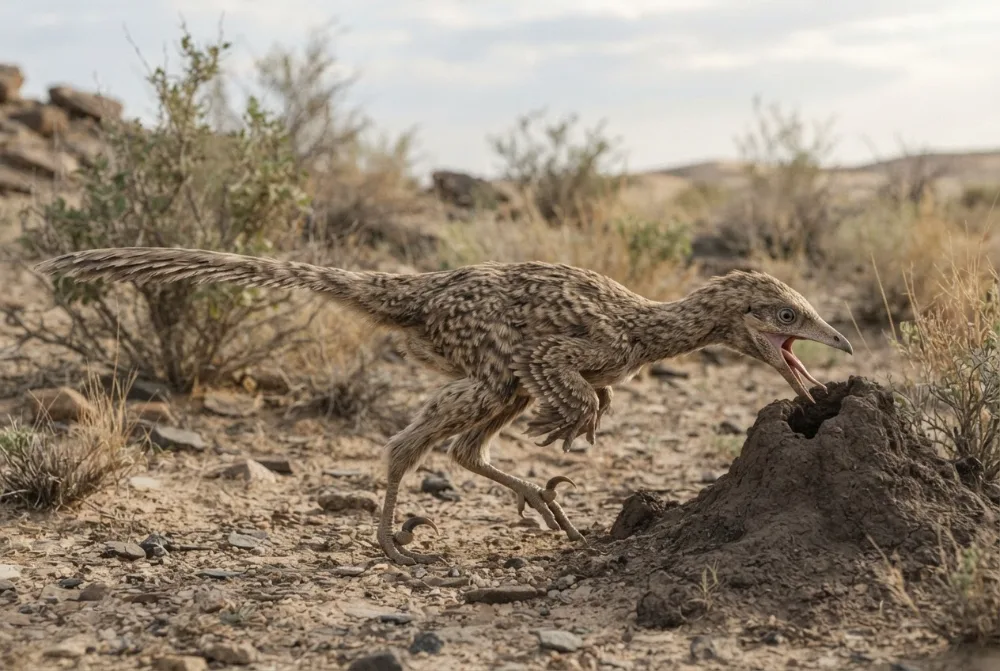
Shuvuuia is known from two beautifully preserved skulls, which are the first skulls ever found for its group, the Alvarezsauridae.2
Its lower jaw was not locked to the skull, so its mouth could open very wide to catch larger prey.1
Shuvuuia lived in the Late Cretaceous period, about 75 to 81 million years ago, in what is now the Gobi Desert of Mongolia.1
Scientists think Shuvuuia may have eaten termites, because its skull and jaw look like those of modern animals that eat insects.1
The name Shuvuuia means 'bird' in Mongolian, because its skull shows features that link it to birds.1
Laaj yi ñu gën a laaj ci Shuvuuia
?How big was Shuvuuia?
Shuvuuia was very small, about 1 metre (3.3 feet) long and weighed around 3.5 kilograms (7.7 pounds). It is one of the smallest known non-avian dinosaurs.4
?Did Shuvuuia have feathers?
Yes, scientists think Shuvuuia had a coat of feathers. Fossils show tiny tube-like structures that contain the same proteins found in modern bird feathers.4
?What did Shuvuuia eat?
Shuvuuia probably ate insects and small animals. It may have used its strong arms to dig into insect nests and its flexible jaw to catch prey like termites or small mammals.41
?Could Shuvuuia see in the dark?
Some scientists think Shuvuuia had excellent night vision and hearing, like an owl, and could hunt in complete darkness. However, a 2025 study disagreed and said its hearing was more like a chicken's.4
Ngir ñi xam dino lool
- Turu xam-xam
- Shuvuuia
- Ku ko tudde
- Chiappe et al. 19985
- Kurél
- Dino yu am dun yu doy waar
- Njaboot / klad
- Alvarezsauridae5
- Klasifikasiyoŋ
- Theropoda > Alvarezsauridae5
- Màggaayu doj yi
- 84 ba 72 milyoŋ at (Campanian)5
- Formasiyoŋi doj
- Djadokhta5
- Réew yi
- Mongoli5
- Fosil yu ñu gis
- 3 ci The Paleobiology Database5
- Gisees
- Shuvuuia was named by Luis Chiappe, Mark Norell, and James Clark in 1998. The first fossils were found at Ukhaa Tolgod in Mongolia.25
- Ñu ngi koy werante ba tey
- Scientists are still debating whether Shuvuuia was more closely related to birds or to other dinosaurs like therizinosaurs and oviraptorosaurs.2
Fa xibaar yi jóge
- Shuvuuia | Natural History Museum (nhm.ac.uk)
- The skull of a relative of the stem-group bird Mononykus | Nature (nature.com)
- Shuvuuia Fact Sheet - Enchanted Learning (enchantedlearning.com)
- Shuvuuia (en.wikipedia.org)
- Shuvuuia in The Paleobiology Database (CC BY 4.0): at, béréb yi, formasiyoŋi doj, klasifikasiyoŋ.
Bépp xibaar ci xët wii am na lim bu wone fa mu jóge. Su nu juumee, baal nu, nun ñu bëgg dino lanu, du ab sërnaalu xam-xam. Wax nu ko ci [email protected] nu defar ko.
 Rex xiif na! Dino Wiki, mbiru ab baay la ngir doomam ju góor ju bëgg dinosoor, ci neen te amul kaamuñaate, amul tracker. Mag ñi mën nañu jox Rex tuuti ñam ngir dimbali ko mu des ci internet.Dundal Rex
 Therizinosaurus
 Oviraptor
 Chirostenotes
 Citipes
 Leptorhynchos
 Avimimus
 Tyrannosaurus
 Triceratops
 Velociraptor
 Spinosaurus
 Ankylosaurus
 Parasaurolophus