 Ban dino nga? Kiis
 Xeexu dino
 Rawante dino
 Fo yu ndaw yu dino
 Albomu sitikeer
 Limu TOP yu dino
 Bett ma!
Sibirotitan
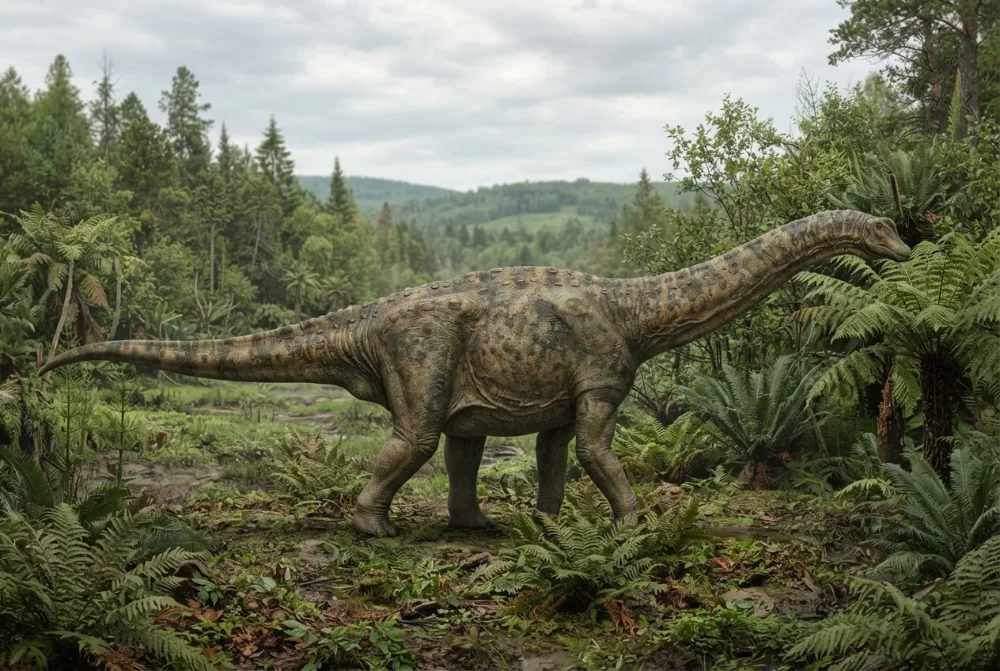
Sibirotitan was a huge, long-necked plant-eater that lived in what is now Siberia, Russia. It was one of the very first giant titanosaur relatives to appear in Asia, and its name means 'Siberian titan' after the mighty giants of Greek myths.1
Kañ la dundoon?
Naka la réyoon?
Naka la diisoon?

 diis ni 13 oto🍉diis ni 4000 xaal🎒diis ni 25 klaas yu mat yu xale yu lekkool🐻❄️diis ni 44 uurs yu weex🏃mënoon na daw 100 meetar ci 30 segond (nit ki gën a gaaw dafay soxla 9,6)
Naka la Sibirotitan réyoon, bu ñu ko méngalee ak YAW?
Ay kalkil rekk ci sa navigatëer. Dara du ñu denc, dara du ñu yónne fenn.
Naka la gaawoon?


Xibaar yu neex
It had a special star-shaped sacrum (hip bone) where the ribs spread out like rays of a star. That is why its species name is astrosacralis, meaning 'star sacred bone'.1
Unlike most of its close relatives, Sibirotitan had only five vertebrae in its sacrum instead of six. Scientists think this was an evolutionary reversal, not a sign of youth.1
Sibirotitan lived about 125 to 113 million years ago, during the Early Cretaceous period.3
The first sauropod bones from this dinosaur were found in 1994 and 1995, but it was not named until 2018.1
Before it got its official name, newspapers called it 'Sibirosaurus'.1
Laaj yi ñu gën a laaj ci Sibirotitan
Ngir ñi xam dino lool
- Turu xam-xam
- Sibirotitan
- Ku ko tudde
- Averianov et al. 20183
- Kurél
- Baat yu gudd
- Njaboot / klad
- Somphospondyli3
- Klasifikasiyoŋ
- Sauropodomorpha > Sauropoda > Macronaria3
- Màggaayu doj yi
- 126 ba 113 milyoŋ at (Barremian / Aptian)3
- Formasiyoŋi doj
- Ilek3
- Réew yi
- Riisi3
- Fosil yu ñu gis
- 4 ci The Paleobiology Database3
- Gisees
- Sibirotitan was named in 2018 by paleontologist Alexander Averianov and his team. They studied bones found over many years at Shestakovo 1 in Siberia, including a foot described in 2002 and a neck bone from a different young animal.12
- Ñu ngi koy werante ba tey
- Scientists are not sure exactly how big Sibirotitan was. The only size estimate comes from one neck bone, which suggests it might have weighed as much as 20 tonnes, but that is a rough guess.1
Fa xibaar yi jóge
- Sibirotitan (en.wikipedia.org)
- A new sauropod dinosaur from the Lower Cretaceous Ilek Formation, Western Siberia, Russia › SPbU Researchers Portal (pureportal.spbu.ru)
- Sibirotitan in The Paleobiology Database (CC BY 4.0): at, béréb yi, formasiyoŋi doj, klasifikasiyoŋ.
Bépp xibaar ci xët wii am na lim bu wone fa mu jóge. Su nu juumee, baal nu, nun ñu bëgg dino lanu, du ab sërnaalu xam-xam. Wax nu ko ci [email protected] nu defar ko.
 Rex xiif na! Dino Wiki, mbiru ab baay la ngir doomam ju góor ju bëgg dinosoor, ci neen te amul kaamuñaate, amul tracker. Mag ñi mën nañu jox Rex tuuti ñam ngir dimbali ko mu des ci internet.Dundal Rex
 Brachiosaurus
 Diplodocus
 Brontosaurus
 Argentinosaurus
 Camarasaurus
 Morosaurus
 Stegosaurus
 Iguanodon
 Archaeopteryx
 Giganotosaurus
 Microraptor
 Deinonychus