 Ban dino nga? Kiis
 Xeexu dino
 Rawante dino
 Fo yu ndaw yu dino
 Albomu sitikeer
 Limu TOP yu dino
 Bett ma!
Sulcusuchus
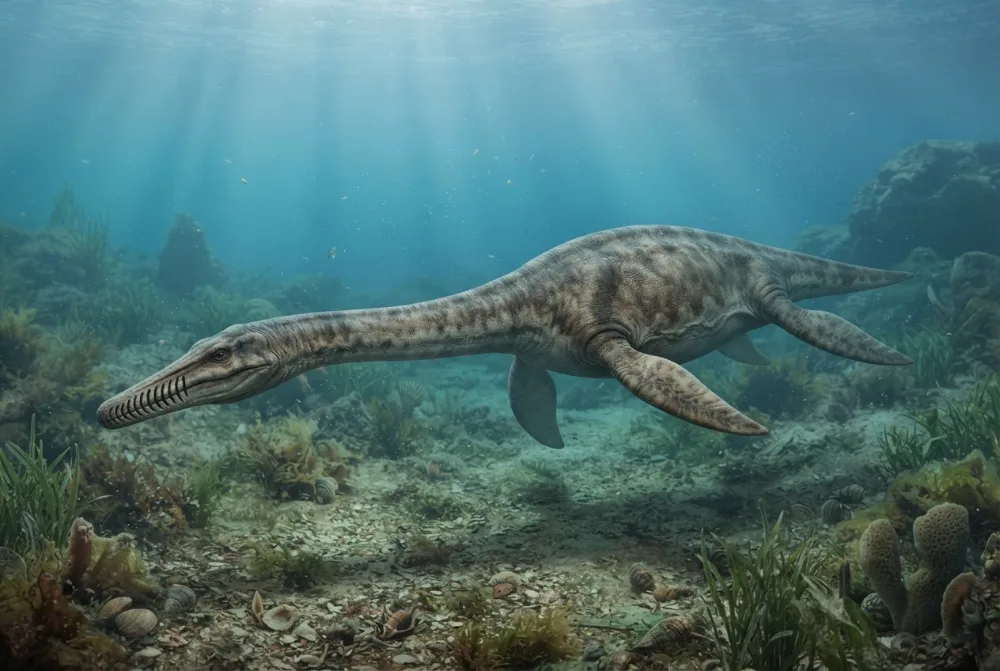
Sulcusuchus was a marine reptile that lived in the seas of ancient Argentina. It had deep grooves in its snout and jaw that might have helped it sense food hiding in the mud, like a dolphin does.2
Kañ la dundoon?
Naka la gaawoon?


Xibaar yu neex
Sulcusuchus was first thought to be a crocodile, but scientists later realized it was a plesiosaur, a type of marine reptile.1
Its name means 'trough crocodile' because of the deep, groove-like channels on its jaw bones.1
The grooves on its snout and jaw may have held special organs that could detect electricity or movement, helping it find prey in murky water.2
One fossil of Sulcusuchus contained 95 gastroliths, or stomach stones, which may have helped it digest food or control its buoyancy.1
Sulcusuchus lived during the very end of the Age of Dinosaurs, about 69 to 66 million years ago.1
It is the only polycotylid plesiosaur from the Southern Hemisphere whose skull and lower jaw are known.2
Laaj yi ñu gën a laaj ci Sulcusuchus
?Was Sulcusuchus a dinosaur?
No, Sulcusuchus was a plesiosaur, a type of marine reptile, not a dinosaur. It lived in the seas of ancient Argentina.13
?How big was Sulcusuchus?
Scientists don't know its full size, but one fossil jaw fragment is about half a meter long. That suggests the whole animal was several meters long, but no exact estimate is given.1
Ku tas léeb yu dul dëgg
Léeb: Some people think Sulcusuchus was a dinosaur.
Dëgg: Sulcusuchus was a plesiosaur, a marine reptile that lived in the ocean, not a dinosaur.1
Ngir ñi xam dino lool
- Turu xam-xam
- Sulcusuchus
- Ku ko tudde
- Gasparini and Spalletti 19903
- Kurél
- Plesiyosoor yi
- Njaboot / klad
- Polycotylidae3
- Klasifikasiyoŋ
- Plesiosauria > Sauropterygia3
- Màggaayu doj yi
- 84 ba 66 milyoŋ at (Campanian / Maastrichtian)3
- Formasiyoŋi doj
- La Colonia, Los Alamitos3
- Réew yi
- Arsantin3
- Fosil yu ñu gis
- 6 ci The Paleobiology Database3
- Gisees
- Sulcusuchus was named in 1990 by Zulma Gasparini and Luis Spalletti. The first fossil was a piece of lower jaw found in the Coli Toro Formation of Argentina.13
- Ñu ngi koy werante ba tey
- Scientists are not sure what the deep grooves in its snout and jaw were for. They might have held glands or electro-sensing organs, but no one knows for sure.2
Fa xibaar yi jóge
- Sulcusuchus (en.wikipedia.org)
- Revision of Sulcusuchus erraini (Sauropterygia, Polycotylidae) from the Upper Cretaceous of Patagonia, Argentina (tandfonline.com)
- Sulcusuchus in The Paleobiology Database (CC BY 4.0): at, béréb yi, formasiyoŋi doj, klasifikasiyoŋ.
Bépp xibaar ci xët wii am na lim bu wone fa mu jóge. Su nu juumee, baal nu, nun ñu bëgg dino lanu, du ab sërnaalu xam-xam. Wax nu ko ci [email protected] nu defar ko.
 Rex xiif na! Dino Wiki, mbiru ab baay la ngir doomam ju góor ju bëgg dinosoor, ci neen te amul kaamuñaate, amul tracker. Mag ñi mën nañu jox Rex tuuti ñam ngir dimbali ko mu des ci internet.Dundal Rex
 Elasmosaurus
 Pliosaurus
 Plesiosaurus
 Cimoliasaurus
 Colymbosaurus
 Trinacromerum
 Tyrannosaurus
 Triceratops
 Velociraptor
 Spinosaurus
 Ankylosaurus
 Parasaurolophus