 Ban dino nga? Kiis
 Xeexu dino
 Rawante dino
 Fo yu ndaw yu dino
 Albomu sitikeer
 Limu TOP yu dino
 Bett ma!
Taniwhasaurus
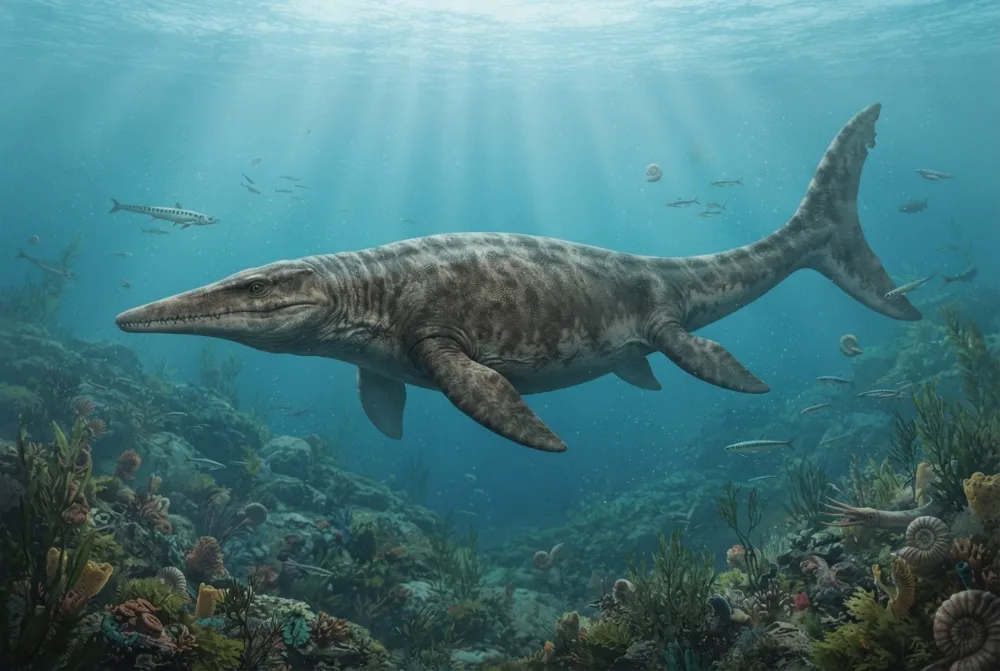
Taniwhasaurus was a fierce marine lizard that swam in the oceans during the time of dinosaurs. It had a long, toothless snout like a spear and used it to hunt fish and other sea creatures. This mosasaur lived near New Zealand, Antarctica, Japan, and South Africa.12
Kañ la dundoon?
Naka la réyoon?
Naka la guddoon?
 gudd ni 7 xaj, bakkan ba geen🍌gudd ni 37 banaana yu ñu topp-toppale🏊mënoon na féey guddaayu pisin bu mag (50 m) ci 4,9 segond
Naka la Taniwhasaurus réyoon, bu ñu ko méngalee ak YAW?
Ay kalkil rekk ci sa navigatëer. Dara du ñu denc, dara du ñu yónne fenn.
Naka la gaawoon?


Xibaar yu neex
Taniwhasaurus belongs to a group called tylosaurines, which had a long, toothless tip on their upper jaw like a bony spear.1
The first fossils of Taniwhasaurus were found in the 1860s at Haumuri Bluff in New Zealand, and named by James Hector in 1874.1
One species, Taniwhasaurus antarcticus, was originally named Lakumasaurus after a sea spirit from the mythology of the Yahgan people of South America.1
A nearly complete skull of Taniwhasaurus antarcticus was discovered on James Ross Island in Antarctica in 2000, measuring 72 centimeters (28 inches) long.1
Taniwhasaurus lived between about 86 and 66 million years ago, during the Late Cretaceous period.2
The species Taniwhasaurus oweni was named in honor of the famous paleontologist Richard Owen, who first described marine reptiles from New Zealand.1
Taniwhasaurus fossils have been found in marine rocks that were once part of ancient seabeds, alongside ammonites, sharks, and other mosasaurs.1
Laaj yi ñu gën a laaj ci Taniwhasaurus
?How big was Taniwhasaurus?
It was a medium-sized mosasaur, reaching about 6.7 metres (22 feet) long.1
?Could Taniwhasaurus swim?
Yes. Its powerful paddles and flexible spine helped it swim, and its tail gave the main push forward.1
?What did Taniwhasaurus eat?
It hunted fish and other sea creatures. It may have used an electro-sensitive snout to find prey.1
?Is Taniwhasaurus a dinosaur?
No, it is a mosasaur, which is a group of extinct marine lizards that lived alongside dinosaurs.1
?When did Taniwhasaurus go extinct?
It lived during the Late Cretaceous period and died out about 66 million years ago.1
Ku tas léeb yu dul dëgg
Léeb: Some people think Taniwhasaurus was a dinosaur.
Dëgg: Taniwhasaurus was a mosasaur, a type of marine lizard, not a dinosaur. Mosasaurs are reptiles that lived in the sea and are more closely related to modern snakes and monitor lizards.1
Ngir ñi xam dino lool
- Turu xam-xam
- Taniwhasaurus
- Ku ko tudde
- Hector 18743
- Kurél
- Mosasoor yi
- Njaboot / klad
- Mosasauridae3
- Klasifikasiyoŋ
- Mosasauroidea3
- Màggaayu doj yi
- 86 ba 66 milyoŋ at (Coniacian / Maastrichtian)3
- Formasiyoŋi doj
- Conway, Snow Hill Island, Conway Siltstone3
- Réew yi
- Nuwel Selaand, Antarktik, Sapoŋ, Afrig di Sid3
- Fosil yu ñu gis
- 11 ci The Paleobiology Database3
- Gisees
- The first fossils of Taniwhasaurus were found in the 1860s at Haumuri Bluff, New Zealand. Scottish naturalist James Hector named the genus in 1874, calling it Taniwhasaurus oweni after the Māori taniwha and honoring Richard Owen.1
- Ñu ngi koy werante ba tey
- Scientists are not sure if the species Taniwhasaurus mikasaensis from Japan is really a separate species, because its fossils are very incomplete.1
Fa xibaar yi jóge
- Taniwhasaurus (en.wikipedia.org)
- PBDB Taxon (paleobiodb.org)
- Taniwhasaurus in The Paleobiology Database (CC BY 4.0): at, béréb yi, formasiyoŋi doj, klasifikasiyoŋ.
Bépp xibaar ci xët wii am na lim bu wone fa mu jóge. Su nu juumee, baal nu, nun ñu bëgg dino lanu, du ab sërnaalu xam-xam. Wax nu ko ci [email protected] nu defar ko.
 Rex xiif na! Dino Wiki, mbiru ab baay la ngir doomam ju góor ju bëgg dinosoor, ci neen te amul kaamuñaate, amul tracker. Mag ñi mën nañu jox Rex tuuti ñam ngir dimbali ko mu des ci internet.Dundal Rex
 Mosasaurus
 Prognathodon
 Tylosaurus
 Platecarpus
 Clidastes
 Globidens
 Tyrannosaurus
 Triceratops
 Velociraptor
 Spinosaurus
 Ankylosaurus
 Parasaurolophus