 Ban dino nga? Kiis
 Xeexu dino
 Rawante dino
 Fo yu ndaw yu dino
 Albomu sitikeer
 Limu TOP yu dino
 Bett ma!
Tongnanlong
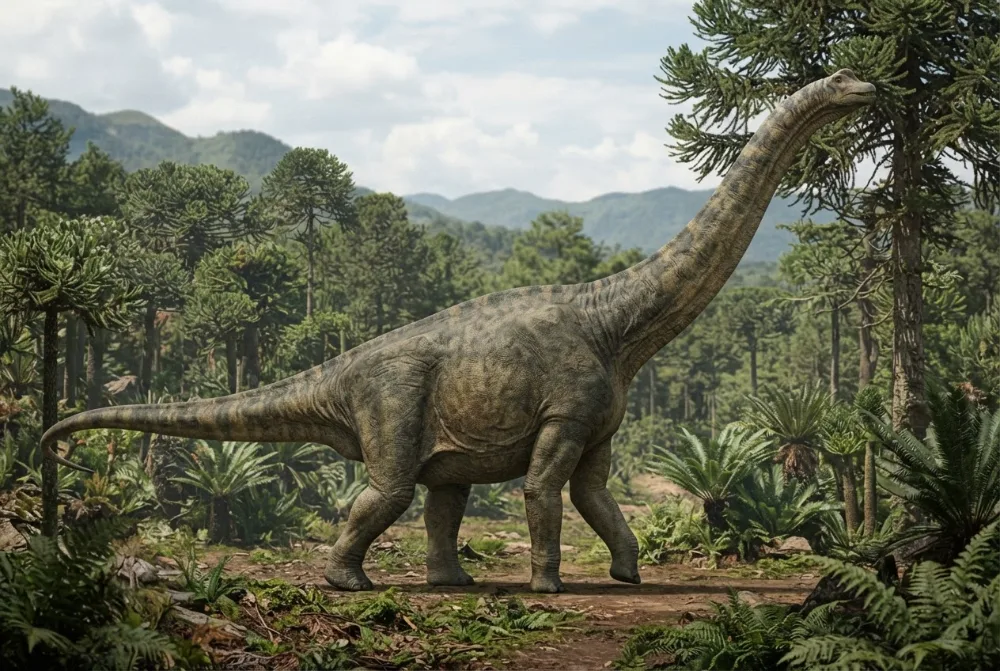
Tongnanlong was a gigantic, long-necked plant-eater that lived in what is now China. It was one of the biggest dinosaurs of its time, with a body as long as a basketball court! Scientists think it used its huge size to reach high leaves that other dinosaurs couldn't eat.1
Kañ la dundoon?
Naka la réyoon?
Naka la guddoon?
Naka la kawewoon?
jortu
 gudd ni 6 oto yu ñu taxawal ci benn rëdd🍌gudd ni 140 banaana yu ñu topp-toppale🏢kawe ba mën a xool ci palanteer bu nekk ci eta 2🏃mënoon na daw 100 meetar ci 40 segond (nit ki gën a gaaw dafay soxla 9,6)
Naka la Tongnanlong réyoon, bu ñu ko méngalee ak YAW?
Ay kalkil rekk ci sa navigatëer. Dara du ñu denc, dara du ñu yónne fenn.
Naka la gaawoon?


Xibaar yu neex
Tongnanlong's name honors the famous Chinese paleontologist Dong Zhiming, who studied many dinosaurs from the Sichuan Basin.1
The only known fossil includes three back vertebrae, six tail vertebrae, a shoulder blade, and some leg bones.1
Its shoulder blade and coracoid (a shoulder bone) are huge, showing it was an extremely large sauropod.1
Tongnanlong lived during the Late Jurassic period, about 161 to 143 million years ago.3
The fossil was found in purplish red sandstone, which was once a lakeshore or shallow lake environment.1
Tongnanlong is a mamenchisaurid, a group of long-necked sauropods that were common in Asia during the Jurassic.1
Laaj yi ñu gën a laaj ci Tongnanlong
Ngir ñi xam dino lool
- Turu xam-xam
- Tongnanlong
- Ku ko tudde
- Wei et al. 20253
- Kurél
- Baat yu gudd
- Njaboot / klad
- Mamenchisauridae3
- Klasifikasiyoŋ
- Sauropodomorpha > Sauropoda3
- Màggaayu doj yi
- 162 ba 143 milyoŋ at (Oxfordian / Tithonian)3
- Formasiyoŋi doj
- Suining3
- Réew yi
- Siin3
- Fosil yu ñu gis
- 1 ci The Paleobiology Database3
- Gisees
- Tongnanlong was discovered in 1998 at a building site in Tongnan District, Chongqing, China. It was named in 2025 by a team of scientists led by Xuefang Wei.1
- Ñu ngi koy werante ba tey
- Scientists are not sure whether the Suining Formation, where Tongnanlong was found, belongs to the Late Jurassic or the Early Cretaceous. Most evidence points to the Late Jurassic.1
Fa xibaar yi jóge
- A new mamenchisaurid from the Upper Jurassic Suining Formation of the Sichuan Basin in China and its implication on sauropod gigantism | Scientific Reports (nature.com)
- Tongnanlong (en.wikipedia.org)
- Tongnanlong in The Paleobiology Database (CC BY 4.0): at, béréb yi, formasiyoŋi doj, klasifikasiyoŋ.
Bépp xibaar ci xët wii am na lim bu wone fa mu jóge. Su nu juumee, baal nu, nun ñu bëgg dino lanu, du ab sërnaalu xam-xam. Wax nu ko ci [email protected] nu defar ko.
 Rex xiif na! Dino Wiki, mbiru ab baay la ngir doomam ju góor ju bëgg dinosoor, ci neen te amul kaamuñaate, amul tracker. Mag ñi mën nañu jox Rex tuuti ñam ngir dimbali ko mu des ci internet.Dundal Rex
 Brachiosaurus
 Diplodocus
 Brontosaurus
 Argentinosaurus
 Camarasaurus
 Morosaurus
 Allosaurus
 Compsognathus
 Camptosaurus
 Nanosaurus
 Rhamphorhynchus
 Ceratosaurus