 Ban dino nga? Kiis
 Xeexu dino
 Rawante dino
 Fo yu ndaw yu dino
 Albomu sitikeer
 Limu TOP yu dino
 Bett ma!
Traskasaura
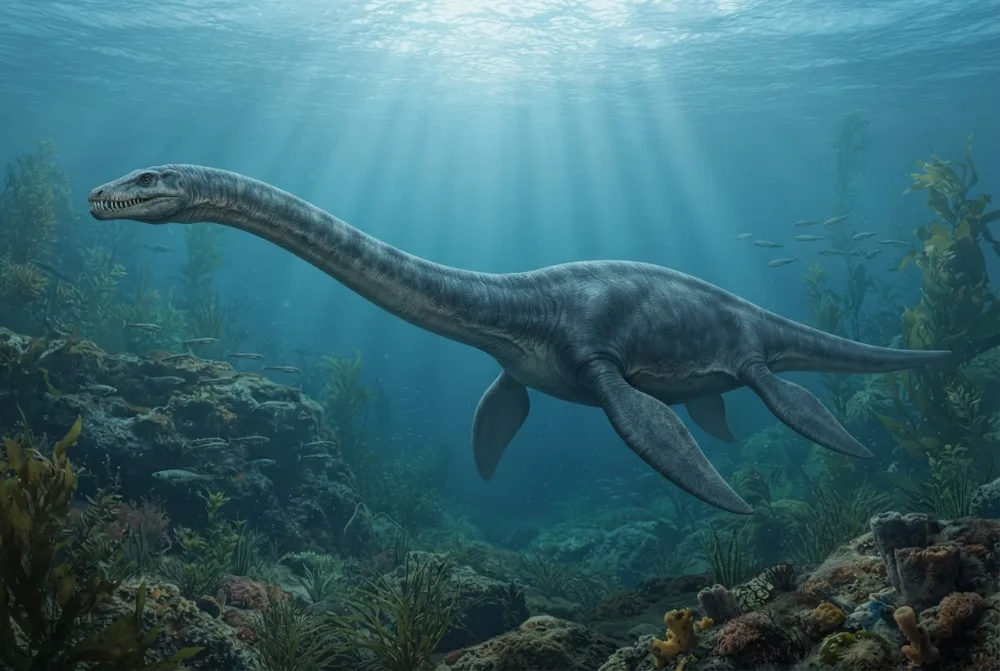
Traskasaura was a long-necked marine reptile that lived in the ocean around Vancouver Island, Canada, about 85 million years ago. It was a fierce predator with strong, sharp teeth that could crush the shells of its prey. This ancient sea monster is the official fossil of British Columbia!12
Kañ la dundoon?
Naka la réyoon?
Naka la guddoon?
 gudd ni 2,5 oto yu ñu taxawal ci benn rëdd🍌gudd ni 67 banaana yu ñu topp-toppale🏊mënoon na féey guddaayu pisin bu mag (50 m) ci 9 segond
Naka la Traskasaura réyoon, bu ñu ko méngalee ak YAW?
Ay kalkil rekk ci sa navigatëer. Dara du ñu denc, dara du ñu yónne fenn.
Naka la gaawoon?


Xibaar yu neex
Traskasaura had a very long neck with at least 50 bones, making it one of the longest-necked elasmosaurs.2
This marine reptile could swim downwards to dive on its prey from above, a hunting style that was unusual for elasmosaurs.2
The first Traskasaura fossil was found in 1988 by Michael Trask and his daughter Heather along the Puntledge River.1
Traskasaura was named the official Provincial Fossil of British Columbia in 2023, even before it got its scientific name.12
Scientists think Traskasaura had a strange mix of features from both early elasmosaurs and a later group called aristonectines.1
Three Traskasaura specimens have been found, including a nearly complete adult skeleton and a well-preserved juvenile.1
Laaj yi ñu gën a laaj ci Traskasaura
?How big was Traskasaura?
About 12 metres (39 feet) long. That is roughly as long as a large bus.2
?What did Traskasaura eat?
It likely ate ammonites, shelled sea creatures that lived in the same ocean. Its strong, sharp teeth were perfect for crushing their shells.2
?Is Traskasaura a dinosaur?
No, it is a plesiosaur, a type of marine reptile that lived in the sea. It is not a dinosaur.1
Ngir ñi xam dino lool
- Turu xam-xam
- Traskasaura
- Ku ko tudde
- O’Keefe et al. 20253
- Kurél
- Plesiyosoor yi
- Njaboot / klad
- Elasmosauridae3
- Klasifikasiyoŋ
- Plesiosauria > Elasmosauridae > Sauropterygia3
- Màggaayu doj yi
- 86 ba 84 milyoŋ at (Santonian)3
- Formasiyoŋi doj
- Haslam3
- Réew yi
- Kanadaa3
- Fosil yu ñu gis
- 3 ci The Paleobiology Database3
- Gisees
- The first Traskasaura skeleton was discovered in 1988 by Michael Trask and his daughter Heather on the bank of the Puntledge River near Courtenay, British Columbia. It was officially named Traskasaura sandrae in 2025 by paleontologist F. Robin O'Keefe and colleagues.1
- Ñu ngi koy werante ba tey
- Scientists debate whether Traskasaura was a very early aristonectine or if its similar features evolved separately.1
Fa xibaar yi jóge
- Traskasaura (en.wikipedia.org)
- Mystery of “very odd” elasmosaur finally solved: one of North America’s most famous fossils identified as new species - Taylor & Francis Newsroom (newsroom.taylorandfrancisgroup.com)
- Traskasaura in The Paleobiology Database (CC BY 4.0): at, béréb yi, formasiyoŋi doj, klasifikasiyoŋ.
Bépp xibaar ci xët wii am na lim bu wone fa mu jóge. Su nu juumee, baal nu, nun ñu bëgg dino lanu, du ab sërnaalu xam-xam. Wax nu ko ci [email protected] nu defar ko.
 Rex xiif na! Dino Wiki, mbiru ab baay la ngir doomam ju góor ju bëgg dinosoor, ci neen te amul kaamuñaate, amul tracker. Mag ñi mën nañu jox Rex tuuti ñam ngir dimbali ko mu des ci internet.Dundal Rex
 Elasmosaurus
 Pliosaurus
 Plesiosaurus
 Cimoliasaurus
 Colymbosaurus
 Trinacromerum
 Tyrannosaurus
 Triceratops
 Velociraptor
 Spinosaurus
 Ankylosaurus
 Parasaurolophus