 Ban dino nga? Kiis
 Xeexu dino
 Rawante dino
 Fo yu ndaw yu dino
 Albomu sitikeer
 Limu TOP yu dino
 Bett ma!
Tuarangisaurus
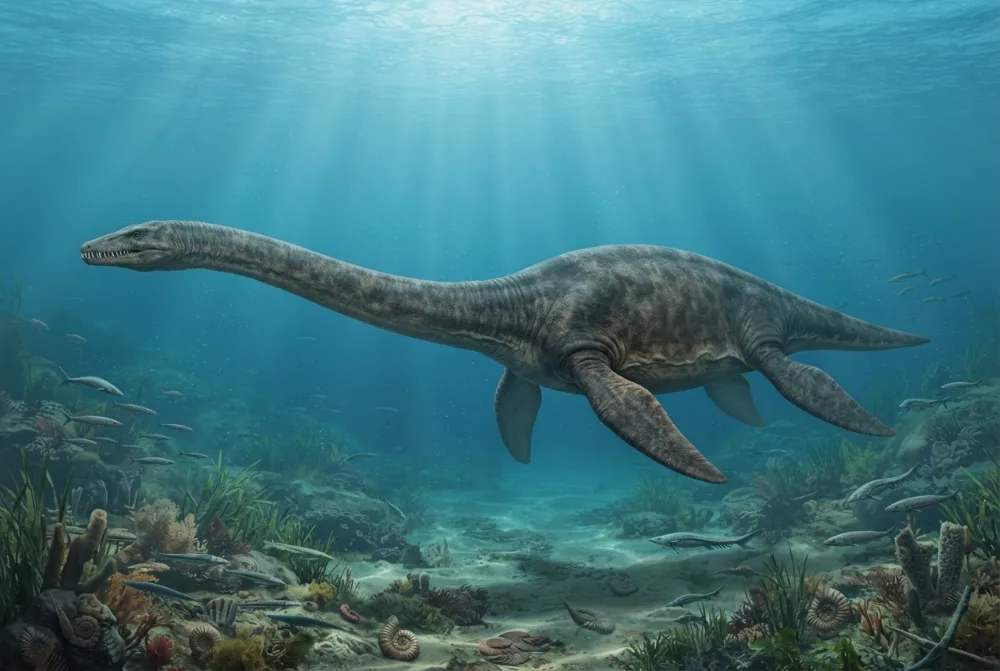
Tuarangisaurus was a long-necked marine reptile that swam in the seas around New Zealand 83 to 66 million years ago. It was not a dinosaur, but a plesiosaur, and it used its four flippers to paddle through the water. With a skull full of sharp teeth, it was a fierce hunter of fish and other sea creatures.51
Kañ la dundoon?
Naka la réyoon?
Naka la guddoon?
 gudd ni 8 xaj, bakkan ba geen🍌gudd ni 44 banaana yu ñu topp-toppale🏊mënoon na féey guddaayu pisin bu mag (50 m) ci 7,5 segond
Naka la Tuarangisaurus réyoon, bu ñu ko méngalee ak YAW?
Ay kalkil rekk ci sa navigatëer. Dara du ñu denc, dara du ñu yónne fenn.
Naka la gaawoon?


Xibaar yu neex
Tuarangisaurus had a skull that was 37 centimetres (about 15 inches) long, with fused premaxillary bones and a low ridge on top.2
It had five large teeth in the upper jaw (premaxilla) and about 15 smaller teeth in the maxilla, plus 19 to 20 teeth in the lower jaw.2
The name Tuarangisaurus means 'ancient lizard' in the Māori language, reflecting its New Zealand discovery.1
Fossils of Tuarangisaurus have been found in marine rocks that were once part of a shallow sea, showing it lived in coastal waters.2
Scientists think Tuarangisaurus gave birth to live young, like other plesiosaurs, because it could not crawl onto land to lay eggs.2
The first fossils of Tuarangisaurus were found in the Mangahouanga Stream on the North Island of New Zealand, and included both adult and juvenile skull material.1
Tuarangisaurus is part of a group called elasmosaurids, which were plesiosaurs with very long necks.5
Laaj yi ñu gën a laaj ci Tuarangisaurus
?How big was Tuarangisaurus?
Tuarangisaurus was a medium sized plesiosaur, measuring over 8 metres long, about the length of a school bus.43
?When did Tuarangisaurus live?
Tuarangisaurus lived during the Late Cretaceous period, about 78 million years ago, in the seas around New Zealand.4
?Was Tuarangisaurus a dinosaur?
No, Tuarangisaurus was not a dinosaur. It was a plesiosaur, a type of marine reptile with a very long neck, related to other elasmosaurids like Elasmosaurus.4
?What did Tuarangisaurus eat?
Tuarangisaurus was a hunter with sharp teeth, and it likely ate fish and other sea creatures, as mentioned in the page intro.3
Ngir ñi xam dino lool
- Turu xam-xam
- Tuarangisaurus
- Ku ko tudde
- Wiffen and Moisley 19865
- Kurél
- Plesiyosoor yi
- Njaboot / klad
- Elasmosauridae5
- Klasifikasiyoŋ
- Plesiosauria > Elasmosauridae > Sauropterygia5
- Màggaayu doj yi
- 84 ba 66 milyoŋ at (Campanian / Maastrichtian)5
- Formasiyoŋi doj
- Tahora, Mocuio, Conway5
- Réew yi
- Nuwel Selaand, Angolaa, Arsantin5
- Fosil yu ñu gis
- 7 ci The Paleobiology Database5
- Gisees
- Tuarangisaurus was named in 1986 by Joan Wiffen and W. L. Moisley based on fossils found in the Mangahouanga Stream, North Island, New Zealand. The type species is Tuarangisaurus keyesi.51
- Ñu ngi koy werante ba tey
- Scientists are still debating exactly how Tuarangisaurus is related to other elasmosaurids, and whether fossils from Argentina and Angola belong to the same species.52
Fa xibaar yi jóge
- Late Cretaceous reptiles (Families Elasmosauridae and Pliosauridae) from the Mangahouanga Stream, North Island, New Zealand (tandfonline.com)
- PBDB Taxon (paleobiodb.org)
- Tuarangisaurus (Wikipedia) (Wikipedia)
- Tuarangisaurus Facts for Kids (kids.kiddle.co)
- Tuarangisaurus in The Paleobiology Database (CC BY 4.0): at, béréb yi, formasiyoŋi doj, klasifikasiyoŋ.
Bépp xibaar ci xët wii am na lim bu wone fa mu jóge. Su nu juumee, baal nu, nun ñu bëgg dino lanu, du ab sërnaalu xam-xam. Wax nu ko ci [email protected] nu defar ko.
 Rex xiif na! Dino Wiki, mbiru ab baay la ngir doomam ju góor ju bëgg dinosoor, ci neen te amul kaamuñaate, amul tracker. Mag ñi mën nañu jox Rex tuuti ñam ngir dimbali ko mu des ci internet.Dundal Rex
 Elasmosaurus
 Pliosaurus
 Plesiosaurus
 Cimoliasaurus
 Colymbosaurus
 Trinacromerum
 Tyrannosaurus
 Triceratops
 Velociraptor
 Spinosaurus
 Ankylosaurus
 Parasaurolophus