 Ban dino nga? Kiis
 Xeexu dino
 Rawante dino
 Fo yu ndaw yu dino
 Albomu sitikeer
 Limu TOP yu dino
 Bett ma!
Kañ la dundoon?

Naka la réyoon?
Naka la guddoon?
Naka la diisoon?
 gudd ni 2 oto yu ñu taxawal ci benn rëdd🍌gudd ni 56 banaana yu ñu topp-toppale
 diis ni 1,5 ñey🍉diis ni 2000 xaal🎒diis ni 12 klaas yu mat yu xale yu lekkool🐻❄️diis ni 22 uurs yu weex🏃mënoon na daw 100 meetar ci 17 segond (nit ki gën a gaaw dafay soxla 9,6)
Naka la Vitakridrinda réyoon, bu ñu ko méngalee ak YAW?
Ay kalkil rekk ci sa navigatëer. Dara du ñu denc, dara du ñu yónne fenn.
Naka la gaawoon?


Xibaar yu neex
Vitakridrinda was named by Pakistani paleontologist M. Sadiq Malkani in 2004.1
Its fossils were found in the Vitakri Member of the Pab Formation, which is about 72 to 66 million years old.13
A rostrum (snout) of Vitakridrinda was discovered with bite marks, punctures, and even a tooth embedded in it, showing it fought with another dinosaur.2
The snout of Vitakridrinda had pits and grooves on its surface, a feature that links it to the abelisaurid group of theropods.2
Vitakridrinda lived alongside titanosaur sauropods, and scientists think it may have scavenged or preyed on them.2
This dinosaur is part of a group called Vitakrisauridae, which includes other dinosaurs from Pakistan.1
The fossils of Vitakridrinda were found in red, maroon, and greenish-grey mudstones, which were deposited in a river environment.3
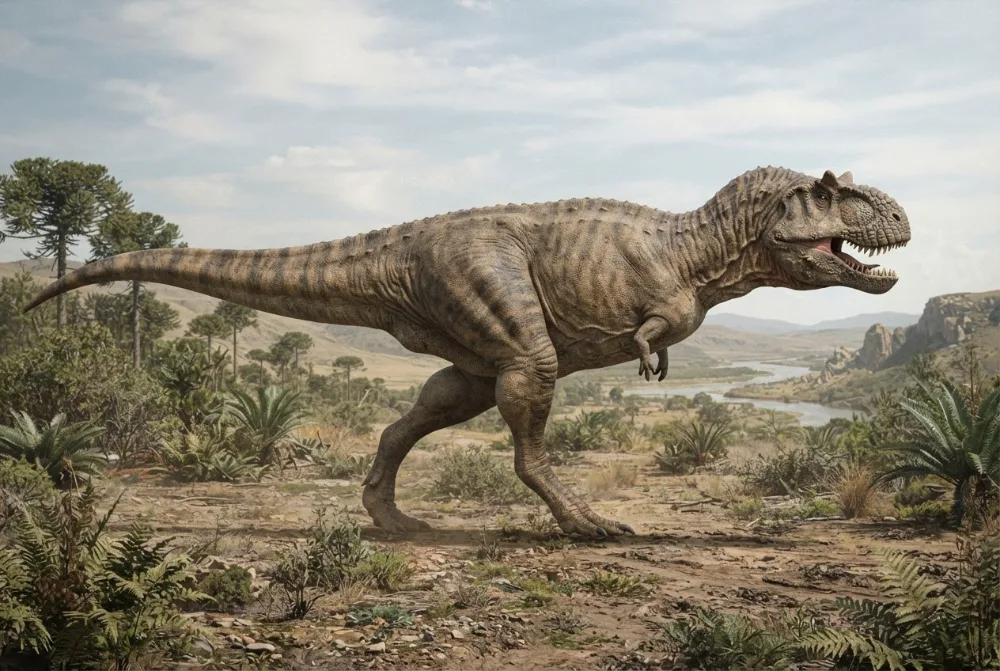
Laaj yi ñu gën a laaj ci Vitakridrinda
?How big was Vitakridrinda?
Nobody knows for sure because only a few bones are known. The fossils suggest it was a large-bodied theropod, but no exact size estimate has been published.56
?What did Vitakridrinda eat?
Vitakridrinda was a meat-eater, as shown by its sharp teeth and the fact that it is classified as a theropod. It likely hunted or scavenged titanosaurs, since its fossils were found with them.62
?Did Vitakridrinda fight with other dinosaurs?
Yes. Its snout has bite marks, punctures, and even a tooth embedded in it, showing it fought with another dinosaur, possibly of the same species.25
?Why did Vitakridrinda have pits and grooves on its snout?
The pits and grooves are a feature of abelisaurid theropods, but scientists don't know exactly what they were for. They might have been for display or for supporting a tough covering.2
?When did Vitakridrinda live?
Vitakridrinda lived during the latest Cretaceous, about 72 to 66 million years ago, in the Maastrichtian age.6
?Where was Vitakridrinda found?
Its fossils were found in the Vitakri Member of the Pab Formation in Balochistan, Pakistan.26
?Is Vitakridrinda a dinosaur?
Yes, Vitakridrinda is a theropod dinosaur, a meat-eating dinosaur that walked on two legs.6
?What does the name Vitakridrinda mean?
The name Vitakridrinda comes from the Vitakri Member where it was found, and 'drinda' may relate to a local word. It was named by paleontologist M. Sadiq Malkani in 2004.6
Ngir ñi xam dino lool
- Turu xam-xam
- Vitakridrinda
- Ku ko tudde
- Malkani 20046
- Kurél
- Dino yuy lekk yàpp
- Njaboot / klad
- Vitakrisauridae6
- Klasifikasiyoŋ
- Theropoda > Ceratosauria6
- Màggaayu doj yi
- 72 ba 66 milyoŋ at (Maastrichtian)6
- Formasiyoŋi doj
- Vitakri6
- Réew yi
- Pakistaan6
- Fosil yu ñu gis
- 8 ci The Paleobiology Database6
- Gisees
- Vitakridrinda was named by M. Sadiq Malkani in 2004 based on fossils found in the Vitakri area of Balochistan, Pakistan. The first rostrum (snout) was discovered later in the Alam Kali Kakor locality.12
- Ñu ngi koy werante ba tey
- Scientists are not sure exactly how big Vitakridrinda was, because only partial fossils like a snout and leg bones have been found.12
Fa xibaar yi jóge
- PBDB Taxon (paleobiodb.org)
- First rostrum of carnivorous Vitakridrinda (Abelisaurid Theropod Dinosaur) found from the latest Cretaceous Dinosaur Beds (Vitakri) Member of PAB formation, Alam Kali Kakor Locality of Vitakri area, Barkhan District, Balochistan, Pakistan (sujo.usindh.edu.pk)
- PBDB Collection (paleobiodb.org)
- Theropods, Mesoeucrocodiles and Pterosaurs Found from the Latest Maastrichtian Vitakri Formation of Balochistan, Pakistan; Description with Large Photographs and Comparison with Coeval Taxa from Indo-Pakistan Subcontinent (scirp.net)
- Vitakridrinda (Vitakrisauridae, Theropoda) from the latest Cretaceous of Pakistan | Journal of Earth Science | Springer Nature Link (link.springer.com)
- Vitakridrinda in The Paleobiology Database (CC BY 4.0): at, béréb yi, formasiyoŋi doj, klasifikasiyoŋ.
Bépp xibaar ci xët wii am na lim bu wone fa mu jóge. Su nu juumee, baal nu, nun ñu bëgg dino lanu, du ab sërnaalu xam-xam. Wax nu ko ci [email protected] nu defar ko.
 Rex xiif na! Dino Wiki, mbiru ab baay la ngir doomam ju góor ju bëgg dinosoor, ci neen te amul kaamuñaate, amul tracker. Mag ñi mën nañu jox Rex tuuti ñam ngir dimbali ko mu des ci internet.Dundal Rex
 Allosaurus
 Carnotaurus
 Dilophosaurus
 Giganotosaurus
 Compsognathus
 Paronychodon
 Tyrannosaurus
 Triceratops
 Velociraptor
 Spinosaurus
 Ankylosaurus
 Parasaurolophus