 Ban dino nga? Kiis
 Xeexu dino
 Rawante dino
 Fo yu ndaw yu dino
 Albomu sitikeer
 Limu TOP yu dino
 Bett ma!
Wulatelong
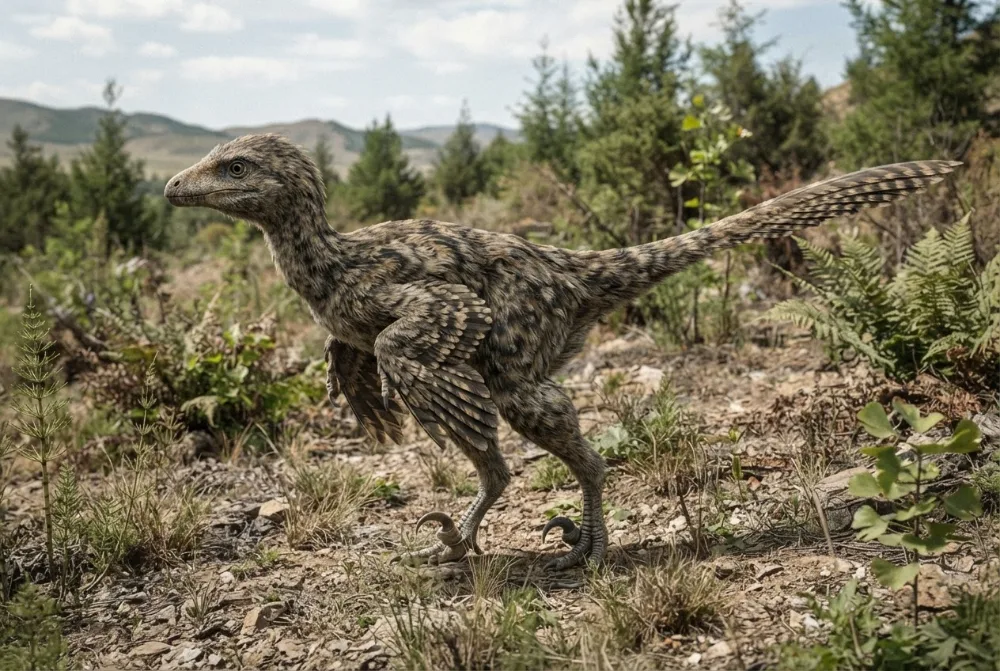
Wulatelong was a bird-like dinosaur with a toothless, parrot-like beak. It lived in the Late Cretaceous period, about 83 to 72 million years ago, in what is now China. It probably used its beak to eat plants and small animals.15
Kañ la dundoon?
Naka la réyoon?
Naka la diisoon?

Naka la Wulatelong réyoon, bu ñu ko méngalee ak YAW?
Ay kalkil rekk ci sa navigatëer. Dara du ñu denc, dara du ñu yónne fenn.
Naka la gaawoon?


Xibaar yu neex
Wulatelong had a toothless, parrot-like beak, which is unusual for a theropod dinosaur.1
It is known from a nearly complete skeleton, which is rare for oviraptorid dinosaurs.1
Wulatelong lived alongside famous dinosaurs like Velociraptor and Protoceratops.1
Its name comes from the Wulate area in China, where it was found, and 'long' means dragon in Chinese.1
Ku tas léeb yu dul dëgg
Léeb: Some people think Wulatelong was a bird because it had feathers and a beak.
Dëgg: Wulatelong was a dinosaur, not a bird, even though it was bird-like and related to birds.1
Ngir ñi xam dino lool
- Turu xam-xam
- Wulatelong
- Ku ko tudde
- Xu et al. 20135
- Kurél
- Dino yu am dun yu doy waar
- Njaboot / klad
- Oviraptoridae5
- Klasifikasiyoŋ
- Theropoda > Oviraptorosauria5
- Màggaayu doj yi
- 84 ba 72 milyoŋ at (Campanian)5
- Formasiyoŋi doj
- Wulansuhai5
- Réew yi
- Siin5
- Fosil yu ñu gis
- 1 ci The Paleobiology Database5
- Gisees
- The fossils were discovered in 2009 in the Bayan Mandahu area of Inner Mongolia, China. It was named by Xu Xing and colleagues in 2013.12
- Ñu ngi koy werante ba tey
- Scientists are still debating whether Wulatelong was more closely related to other oviraptorids or to more basal oviraptorosaurs.12
Fa xibaar yi jóge
- Wulatelong (en.wikipedia.org)
- A new oviraptorid from the Upper Cretaceous of Nei Mongol, China, and its stratigraphic implications (vertpala.ac.cn)
- A New Oviraptorid Dinosaur:<em>Wulatelong gobiensis</em>----Institute of Vertebrate Paleontology and Paleoanthropology, Chinese Academy of Sciences (english.ivpp.cas.cn)
- A new oviraptorid from the Upper Cretaceous of Nei Mongol, China, and its stratigraphic implications (ivpp.cas.cn)
- Wulatelong in The Paleobiology Database (CC BY 4.0): at, béréb yi, formasiyoŋi doj, klasifikasiyoŋ.
Bépp xibaar ci xët wii am na lim bu wone fa mu jóge. Su nu juumee, baal nu, nun ñu bëgg dino lanu, du ab sërnaalu xam-xam. Wax nu ko ci [email protected] nu defar ko.
 Rex xiif na! Dino Wiki, mbiru ab baay la ngir doomam ju góor ju bëgg dinosoor, ci neen te amul kaamuñaate, amul tracker. Mag ñi mën nañu jox Rex tuuti ñam ngir dimbali ko mu des ci internet.Dundal Rex
 Therizinosaurus
 Oviraptor
 Chirostenotes
 Citipes
 Leptorhynchos
 Avimimus
 Tyrannosaurus
 Triceratops
 Velociraptor
 Spinosaurus
 Ankylosaurus
 Parasaurolophus