 Ban dino nga? Kiis
 Xeexu dino
 Rawante dino
 Fo yu ndaw yu dino
 Albomu sitikeer
 Limu TOP yu dino
 Bett ma!
Kañ la dundoon?

Naka la réyoon?
Naka la guddoon?
Naka la kawewoon?
jortu
Naka la diisoon?
 gudd ni 2 muusu kër, bakkan ba geen🍌gudd ni 6 banaana yu ñu topp-toppalelu tollu ci diisaayu muusu kër🍌diis ni 50 banaana🪑tuuti ba mën a dox ci suufu siis🏃mënoon na daw 100 meetar ci 15 segond (nit ki gën a gaaw dafay soxla 9,6)
Naka la Xuanhuaceratops réyoon, bu ñu ko méngalee ak YAW?
Ay kalkil rekk ci sa navigatëer. Dara du ñu denc, dara du ñu yónne fenn.
Naka la gaawoon?


Xibaar yu neex
Xuanhuaceratops is one of the earliest known horned dinosaurs, living about 150 million years ago in the Late Jurassic.1
It was very small, only about 1 metre (3.3 feet) long and weighed as much as a large cat, around 6 kilograms (13 pounds).1
The first fossil was discovered in the 1970s by a man named Nie Rongzhen near Yanjiagou, China.1
Xuanhuaceratops had a unique feature: a single tooth in the premaxilla (the front part of the upper jaw).1
Its upper arm bones were very slender, only 4 centimetres (1.6 inches) long, suggesting it could walk on two legs when needed.1
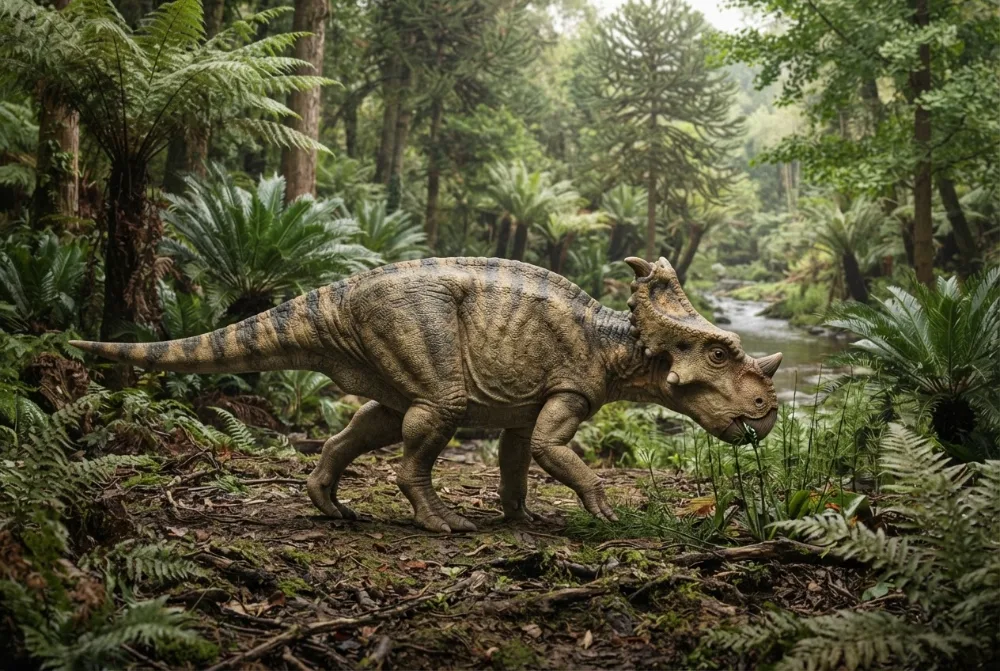
Laaj yi ñu gën a laaj ci Xuanhuaceratops
?What did Xuanhuaceratops eat?
It was an herbivore, meaning it ate plants. It used its beak to nibble on plants.13
?How big was Xuanhuaceratops?
About 1 metre (3.3 feet) long and weighed around 6 kilograms (13 pounds), about the size of a large dog.1
?When did Xuanhuaceratops live?
It lived during the Late Jurassic Period, about 150 to 145 million years ago.1
Ngir ñi xam dino lool
- Turu xam-xam
- Xuanhuaceratops
- Ku ko tudde
- Zhao et al. 20063
- Kurél
- Dino yu am béjjén
- Njaboot / klad
- Chaoyangsauridae3
- Klasifikasiyoŋ
- Ornithischia > Ceratopsia3
- Màggaayu doj yi
- 152 ba 133 milyoŋ at (Kimmeridgian / Valanginian)3
- Formasiyoŋi doj
- Tuchengzi3
- Réew yi
- Siin3
- Fosil yu ñu gis
- 1 ci The Paleobiology Database3
- Gisees
- The first fragmentary skeleton was found in the 1970s by Nie Rongzhen near Yanjiagou, China. It was named Xuanhuaceratops niei in 2006 by Zhao Xijin, Cheng Zhengwu, Xu Xing, and Peter J. Makovicky.1
- Ñu ngi koy werante ba tey
- Scientists are not sure exactly how Xuanhuaceratops is related to other early ceratopsians because its fossils are incomplete.2
Fa xibaar yi jóge
- Xuanhuaceratops (en.wikipedia.org)
- A New Taxon of Basal Ceratopsian from China and the Early Evolution of Ceratopsia | PLOS One (journals.plos.org)
- Xuanhuaceratops in The Paleobiology Database (CC BY 4.0): at, béréb yi, formasiyoŋi doj, klasifikasiyoŋ.
Bépp xibaar ci xët wii am na lim bu wone fa mu jóge. Su nu juumee, baal nu, nun ñu bëgg dino lanu, du ab sërnaalu xam-xam. Wax nu ko ci [email protected] nu defar ko.
 Rex xiif na! Dino Wiki, mbiru ab baay la ngir doomam ju góor ju bëgg dinosoor, ci neen te amul kaamuñaate, amul tracker. Mag ñi mën nañu jox Rex tuuti ñam ngir dimbali ko mu des ci internet.Dundal Rex
 Triceratops
 Protoceratops
 Ojoceratops
 Tatankaceratops
 Psittacosaurus
 Centrosaurus
 Stegosaurus
 Iguanodon
 Archaeopteryx
 Giganotosaurus
 Microraptor
 Deinonychus