 Ban dino nga? Kiis
 Xeexu dino
 Rawante dino
 Fo yu ndaw yu dino
 Albomu sitikeer
 Limu TOP yu dino
 Bett ma!
Kañ la dundoon?

Naka la réyoon?
Naka la guddoon?
Naka la kawewoon?
 gudd ni 3 oto yu ñu taxawal ci benn rëdd🍌gudd ni 72 banaana yu ñu topp-toppale🏃mënoon na daw 100 meetar ci 20 segond (nit ki gën a gaaw dafay soxla 9,6)
Naka la Yunnanosaurus réyoon, bu ñu ko méngalee ak YAW?
Ay kalkil rekk ci sa navigatëer. Dara du ñu denc, dara du ñu yónne fenn.
Naka la gaawoon?


Xibaar yu neex
Yunnanosaurus had more than sixty spoon-shaped teeth that were self-sharpening because they wore against each other as the animal fed.1
Its teeth were advanced for an early sauropodomorph and looked like those of later giant sauropods, but scientists think this similarity evolved separately.1
The largest species, Yunnanosaurus youngi, reached about 13 metres (42 feet) long, as big as a school bus.1
The first fossils were discovered by Chinese paleontologist Yang Zhongjian (also known as C. C. Young) in the early 1940s.1
Yunnanosaurus lived between about 201 and 183 million years ago, during the Early Jurassic Period.12
It could walk on two legs or on all fours, making it a versatile mover through its ancient environment.1
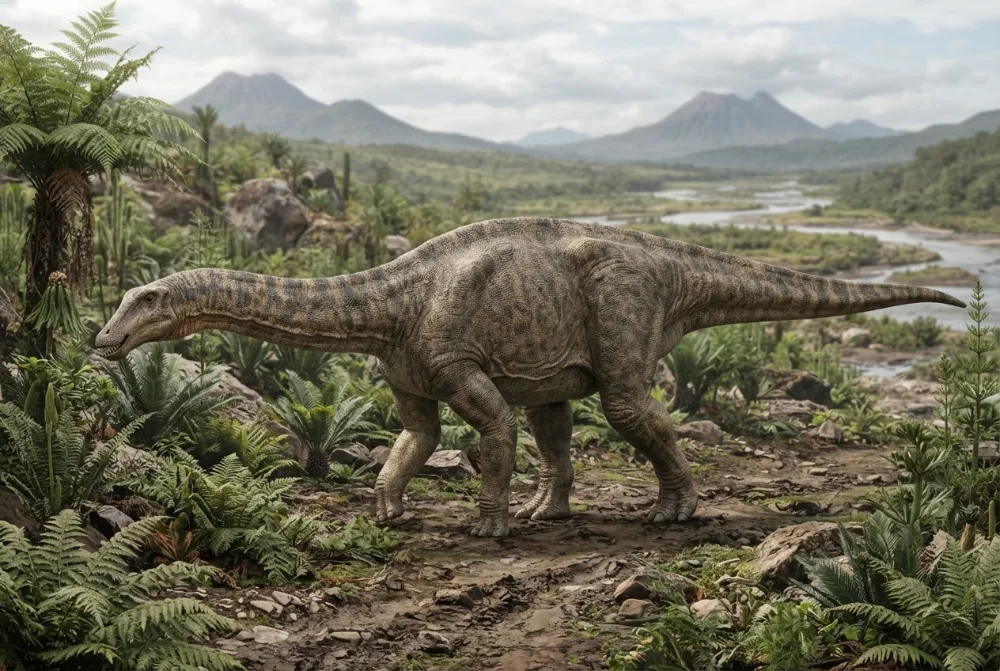
Laaj yi ñu gën a laaj ci Yunnanosaurus
?How big was Yunnanosaurus?
The smallest species, Y. huangi, was about 7 metres (23 feet) long, while the largest, Y. youngi, reached about 13 metres (43 feet) long, roughly the size of a school bus.13
?What did Yunnanosaurus eat?
It was a herbivore that ate plants. Its spoon-shaped teeth were self-sharpening, and it fed on softer, less fibrous plants than later giant sauropods.13
?When did Yunnanosaurus live?
Yunnanosaurus lived during the Early Jurassic Period, about 201 to 183 million years ago.13
?Where was Yunnanosaurus found?
Its fossils were found in Yunnan Province, China. The first skeletons were discovered in the Lufeng Formation.1
?Did Yunnanosaurus have feathers?
No known fossils show feathers on Yunnanosaurus. It is not related to feathered dinosaurs like birds.1
?Could Yunnanosaurus walk on two legs?
Yes, it could walk on two legs or on all fours. It was a versatile mover that could switch between bipedal and quadrupedal walking.1
Ku tas léeb yu dul dëgg
Léeb: Yunnanosaurus is often called a prosauropod, meaning it was a direct ancestor of sauropods.
Dëgg: Scientists now place Yunnanosaurus in a group called Sauropodiformes, which is closer to true sauropods but not a direct ancestor.1
Ngir ñi xam dino lool
- Turu xam-xam
- Yunnanosaurus
- Ku ko tudde
- Young 19404
- Kurél
- Baat yu gudd
- Njaboot / klad
- Sauropodiformes4
- Klasifikasiyoŋ
- Sauropodomorpha4
- Màggaayu doj yi
- 201 ba 184 milyoŋ at (Hettangian / Pliensbachian)4
- Formasiyoŋi doj
- Lufeng, Fengjiahe4
- Réew yi
- Siin4
- Fosil yu ñu gis
- 17 ci The Paleobiology Database4
- Gisees
- Chinese paleontologist C. C. Young (Yang Zhongjian) named Yunnanosaurus in 1942 after finding many skeletons in Yunnan, China. The type species is Yunnanosaurus huangi.1
- Ñu ngi koy werante ba tey
- Scientists are not sure whether Yunnanosaurus robustus is a separate species or just a larger individual of Yunnanosaurus huangi.1
Fa xibaar yi jóge
- Yunnanosaurus (en.wikipedia.org)
- PBDB Taxon (paleobiodb.org)
- Yunnanosaurus | Natural History Museum (nhm.ac.uk)
- Yunnanosaurus in The Paleobiology Database (CC BY 4.0): at, béréb yi, formasiyoŋi doj, klasifikasiyoŋ.
Bépp xibaar ci xët wii am na lim bu wone fa mu jóge. Su nu juumee, baal nu, nun ñu bëgg dino lanu, du ab sërnaalu xam-xam. Wax nu ko ci [email protected] nu defar ko.
 Rex xiif na! Dino Wiki, mbiru ab baay la ngir doomam ju góor ju bëgg dinosoor, ci neen te amul kaamuñaate, amul tracker. Mag ñi mën nañu jox Rex tuuti ñam ngir dimbali ko mu des ci internet.Dundal Rex
 Brachiosaurus
 Diplodocus
 Brontosaurus
 Argentinosaurus
 Camarasaurus
 Morosaurus
 Dilophosaurus
 Stenopterygius
 Dorygnathus
 Scutellosaurus
 Sinosaurus
 Temnodontosaurus