 Ban dino nga? Kiis
 Xeexu dino
 Rawante dino
 Fo yu ndaw yu dino
 Albomu sitikeer
 Limu TOP yu dino
 Bett ma!
Kañ la dundoon?

Naka la gaawoon?


Xibaar yu neex
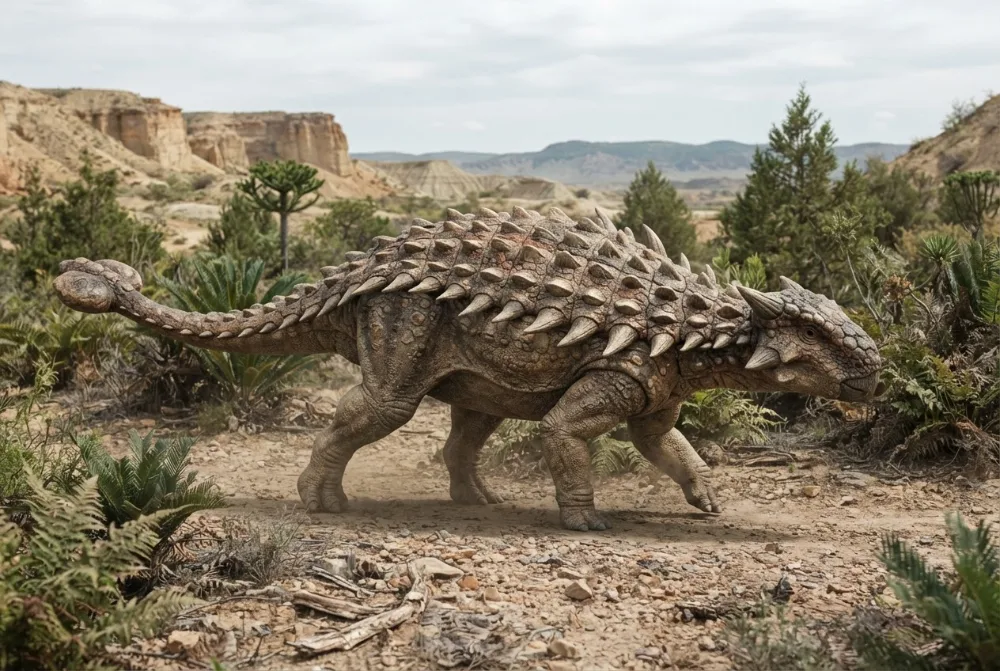
Zaraapelta's skull was covered in bumpy armour plates called osteoderms, and it had an especially fancy pattern of bumps and grooves behind its eye.12
The horns on the back of its skull had a smooth ridge on top, which is different from any other ankylosaur.13
Scientists think the fancy skull ornaments might have been used to attract mates, like a peacock's tail feathers.2
The only known fossil is a skull missing the snout tip, and it probably belonged to a young adult.1
Laaj yi ñu gën a laaj ci Zaraapelta
?How big was Zaraapelta?
The only known skull is about 40 centimetres long, so Zaraapelta was a medium-sized ankylosaur.1
?What did Zaraapelta eat?
It was a herbivore, eating plants.1
?Who discovered Zaraapelta?
It was discovered in 2000 by a team led by Phil Currie, and named in 2014 by Victoria Arbour.12
?What was Zaraapelta's closest relative?
Its closest known relative is Tarchia, another ankylosaur from Mongolia.1
Ku tas léeb yu dul dëgg
Léeb: Some people think all armoured dinosaurs had tail clubs.
Dëgg: Zaraapelta is known only from a skull, so scientists don't know if it had a tail club. Many ankylosaurs did, but not all.1
Ngir ñi xam dino lool
- Turu xam-xam
- Zaraapelta
- Ku ko tudde
- Arbour et al. 20144
- Kurél
- Dino yu am kiiraay
- Njaboot / klad
- Ankylosauridae4
- Klasifikasiyoŋ
- Ornithischia > Ankylosauria > Ankylosauridae > Thyreophora4
- Màggaayu doj yi
- 100 ba 84 milyoŋ at (Cenomanian / Santonian)4
- Formasiyoŋi doj
- Baynshire4
- Réew yi
- Mongoli4
- Fosil yu ñu gis
- 1 ci The Paleobiology Database4
- Gisees
- The skull was found in 2000 by a team led by Phil Currie in the Gobi Desert. In 2014, Victoria Arbour, Philip Currie, and Demchig Badamgarav named it Zaraapelta nomadis.12
- Ñu ngi koy werante ba tey
- Scientists are still debating exactly how Zaraapelta is related to other ankylosaurs, and whether its fancy head ornaments were for protection or for showing off.12
Fa xibaar yi jóge
- Zaraapelta (en.wikipedia.org)
- UAlberta paleontologists name new armoured dinosaur (ualberta.ca)
- PBDB Taxon (paleobiodb.org)
- Zaraapelta in The Paleobiology Database (CC BY 4.0): at, béréb yi, formasiyoŋi doj, klasifikasiyoŋ.
Bépp xibaar ci xët wii am na lim bu wone fa mu jóge. Su nu juumee, baal nu, nun ñu bëgg dino lanu, du ab sërnaalu xam-xam. Wax nu ko ci [email protected] nu defar ko.
 Rex xiif na! Dino Wiki, mbiru ab baay la ngir doomam ju góor ju bëgg dinosoor, ci neen te amul kaamuñaate, amul tracker. Mag ñi mën nañu jox Rex tuuti ñam ngir dimbali ko mu des ci internet.Dundal Rex
 Ankylosaurus
 Sauropelta
 Pinacosaurus
 Scutellosaurus
 Struthiosaurus
 Euoplocephalus
 Tyrannosaurus
 Triceratops
 Velociraptor
 Spinosaurus
 Parasaurolophus
 Pteranodon