 Uyiyiphi idayinaso? Ikwizi
 Idabi leedayinaso
 Ugqatso lweedayinaso
 Imidlalo emincinci yeedayinaso
 I-albhamu yezitikha
 Iilisti ze-TOP zeedayinaso
 Ndothuse!
Albertonectes
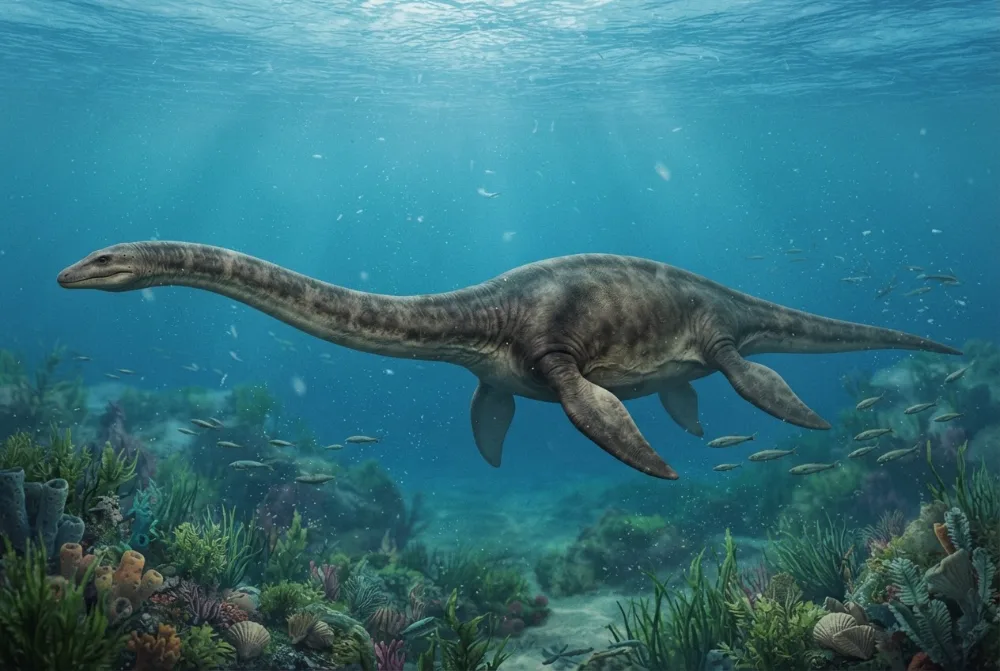
Albertonectes was a huge marine reptile that lived in the sea, not a dinosaur. It had an incredibly long neck, longer than a school bus, and swam with four flippers like paddles.12
Yaphila nini?
Yayinkulu kangakanani?
Yayinde kangakanani?
Yayinzima kangakanani?
 inde njengeemoto ezingama-2.5 zipakwe zilandelelana🍌inde njengeebhanana ezingama-67 zilandelelana
 malunga nobunzima bendlovu🍉inzima njengamavatala angama-960🎒inzima njengamagumbi okufundela apheleleyo abantwana angama-6🐻❄️inzima njengeebhere ezimhlophe ezingama-11🏊ibinokuqubha ubude bechibi elikhulu lokuqubha (50 m) ngemizuzwana engama-8.2
Albertonectes wayemkhulu kangakanani xa ethelekiswa NAWE?
Yimathematika nje kwibhrawuza yakho. Akukho nto igcinwayo okanye ithunyelwe naphi na.
Yayikhawuleza kangakanani?


Iinyani ezimnandi
Albertonectes had 76 neck bones, more than any other known animal. Its neck was about 7 metres (23 feet) long.12
Its fossils were discovered by accident in 2007 during ammolite mining. An excavator broke part of the skeleton, and some stomach stones were lost.12
Albertonectes lived in the Western Interior Seaway, a huge inland sea that stretched from the Gulf of Mexico to the Arctic Ocean.2
No skull of Albertonectes has ever been found, so scientists can only guess what its head looked like based on other elasmosaurs.12
Over 97 stomach stones were found with the skeleton, but they are too small to help with buoyancy or digestion. Scientists are still not sure why plesiosaurs swallowed stones.12
Albertonectes was a plesiosaur, not a dinosaur. Dinosaurs lived on land, while plesiosaurs were air-breathing reptiles that lived in the sea.2
Eyona mibuzo ibuzwa kakhulu: Albertonectes
?How big was Albertonectes?
Albertonectes was about 12.1 metres (40 feet) long and weighed around 4.8 metric tons (5.3 short tons). Its neck alone was about 7 metres (23 feet) long.12
?Was Albertonectes a dinosaur?
No, Albertonectes was a plesiosaur, a marine reptile that lived in the sea. Dinosaurs lived on land.2
?What did Albertonectes eat?
Scientists think Albertonectes ate small fish and crustaceans. Its small, slender teeth were not for attacking large prey.2
?How many neck bones did Albertonectes have?
Albertonectes had 76 neck bones, more than any other known animal. That is why its neck was so long.12
?When did Albertonectes live?
Albertonectes lived about 73.5 million years ago, during the Late Cretaceous period.1
Inyaniso ngeentsomi
Intsomi: Albertonectes was a dinosaur.
Inyaniso: Albertonectes was a plesiosaur, a marine reptile that lived in the ocean, not a dinosaur. Dinosaurs were land animals.2
Kwiingcali zeedayinaso
- Igama lenzululwazi
- Albertonectes
- Inikwe igama ngu:
- Kubo et al. 20124
- Iqela
- Iiplesiosauri
- Usapho / iclade
- Elasmosauridae4
- Ukuhlelwa
- Plesiosauria > Elasmosauridae > Sauropterygia4
- Ubudala bamatye
- 84 ukuya ku-72 izigidi zeminyaka (Campanian)4
- Izakhiwo zamatye
- Bearpaw Shale4
- Amazwe
- iKhanada4
- Iirekhodi zeefosili
- 1 kwi-Paleobiology Database4
- Ukufunyanwa
- The only known skeleton was found in 2007 by an ammolite mining company near Lethbridge, Alberta, Canada. It was named Albertonectes vanderveldei in 2012 by paleontologist Tai Kubo and his team.12
- Kusaxoxwa ngayo
- Scientists are not sure why Albertonectes swallowed so many stomach stones, since they are too small to help with buoyancy or digestion.2
Apho iinyani zivela khona
- Albertonectes (en.wikipedia.org)
- Albertonectes | The Canadian Encyclopedia (thecanadianencyclopedia.ca)
- PBDB Taxon (paleobiodb.org)
- Albertonectes in The Paleobiology Database (CC BY 4.0): ubudala, iindawo, izakhiwo zamatye, ukuhlelwa.
Yonke inyani ekweli phepha inenombolo ebonisa umthombo wayo. Ukuba siphosisile, uxolo, sithanda iidayinaso, asiyojenali yenzululwazi. Sixelele apha: [email protected], siya kuyilungisa.
 URex ulambile! I-Dino Wiki yiprojekthi katata ukwenzela unyana wakhe othanda iidayinaso, isimahla, ayinazintengiso, ayinazilandeli. Abantu abadala banokuphakela uRex isidlwana ukuze incede ihlale kwi-intanethi.Phakela uRex
 Elasmosaurus
 Pliosaurus
 Plesiosaurus
 Cimoliasaurus
 Colymbosaurus
 Trinacromerum
 Tyrannosaurus
 Triceratops
 Velociraptor
 Spinosaurus
 Ankylosaurus
 Parasaurolophus