 Uyiyiphi idayinaso? Ikwizi
 Idabi leedayinaso
 Ugqatso lweedayinaso
 Imidlalo emincinci yeedayinaso
 I-albhamu yezitikha
 Iilisti ze-TOP zeedayinaso
 Ndothuse!
Plesiosaurus
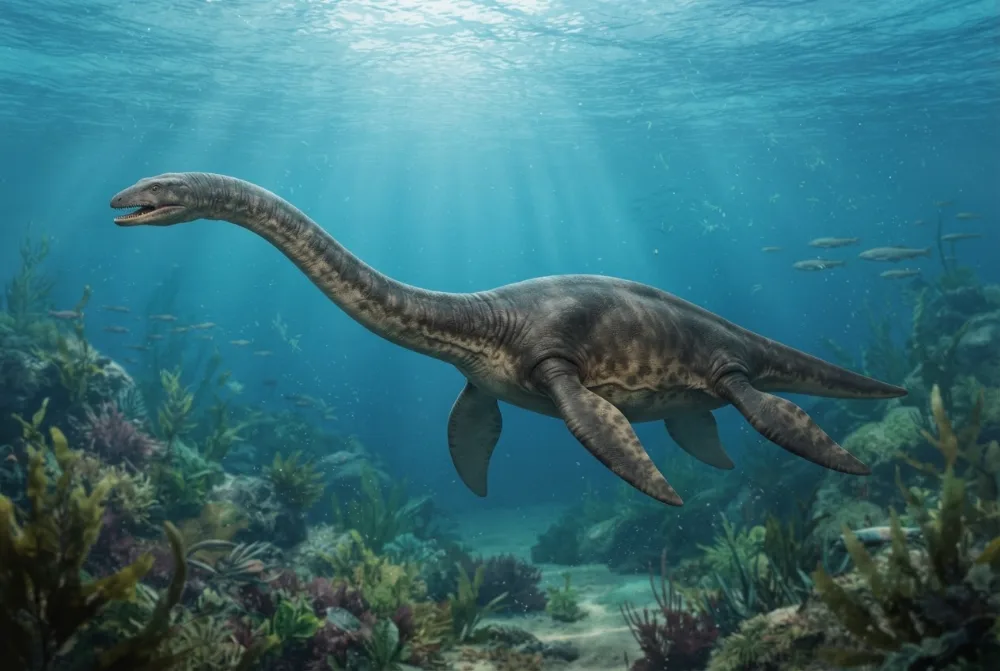
Plesiosaurus was a marine reptile that swam in the oceans while dinosaurs lived on land. It had a long neck, a small head, and four flipper-like limbs to push through the water. It was about 3.5 metres long and ate small prey like fish and crustaceans.1
Yaphila nini?
Yayinkulu kangakanani?
Yayinde kangakanani?
 inde njengezinja ezingama-4, impumlo ukuya emsileni🍌inde njengeebhanana ezingama-19 zilandelelana🏊ibinokuqubha ubude bechibi elikhulu lokuqubha (50 m) ngemizuzwana engama-6.2
Plesiosaurus wayemkhulu kangakanani xa ethelekiswa NAWE?
Yimathematika nje kwibhrawuza yakho. Akukho nto igcinwayo okanye ithunyelwe naphi na.
Yayikhawuleza kangakanani?


Iinyani ezimnandi
Plesiosaurus was named in 1821 by William Conybeare and Henry Thomas De la Beche, and the name means 'near reptile'.1
Mary Anning discovered an almost complete Plesiosaurus skeleton in 1823, which helped scientists understand what these animals looked like.1
Plesiosaurs swam with four flipper-like limbs, and experiments with robot flippers showed they could generate 60% more thrust from their back flipper by timing both limbs carefully.1
Plesiosaurs were unable to return to land, so they likely gave birth to live young in the open water, as supported by a preserved foetus in a related species.1
Plesiosaurs survived for more than 140 million years, making it through multiple extinctions that wiped out other groups.1
Some plesiosaurs swallowed stones that stayed in their stomachs, possibly to help break up food or to help with buoyancy.1
Eyona mibuzo ibuzwa kakhulu: Plesiosaurus
?Is Plesiosaurus a dinosaur?
No, it is a marine reptile that lived in the oceans while dinosaurs lived on land. It is only distantly related to dinosaurs.1
?What did Plesiosaurus eat?
It ate small prey like fish and crustaceans.1
?When did Plesiosaurus live?
It lived during the Early Jurassic, about 203 to 174 million years ago.3
?Who discovered Plesiosaurus?
Mary Anning discovered the first complete skeleton in 1823 near Lyme Regis, England.31
?Did Plesiosaurus have live babies?
Yes, it gave birth to live young in the water. A fossil of a related species shows a single large baby inside its mother.14
?Could Plesiosaurus go on land?
No, it was fully adapted to life in the water and could not return to land.1
Inyaniso ngeentsomi
Intsomi: Plesiosaurs are often thought to be dinosaurs, especially because they lived at the same time.
Inyaniso: Plesiosaurs are marine reptiles and are only distantly related to dinosaurs, which lived on land.1
Kwiingcali zeedayinaso
- Igama lenzululwazi
- Plesiosaurus
- Inikwe igama ngu:
- de la Beche and Conybeare 18215
- Iqela
- Iiplesiosauri
- Usapho / iclade
- Plesiosauroidea5
- Ukuhlelwa
- Plesiosauria > Sauropterygia5
- Ubudala bamatye
- 206 ukuya ku-66 izigidi zeminyaka (Rhaetian / Maastrichtian)5
- Izakhiwo zamatye
- Kimmeridge Clay, Charmouth Mudstone, Westbury5
- Amazwe
- iUnited Kingdom, iFransi, iUSA, iBhelgiyam, iNew Zealand, uMzantsi Afrika5
- Iirekhodi zeefosili
- 55 kwi-Paleobiology Database5
- Ukufunyanwa
- Plesiosaurus was named in 1821 by William Conybeare and Henry Thomas De la Beche, and Mary Anning discovered an almost complete skeleton in 1823.1
- Kusaxoxwa ngayo
- Scientists still debate how plesiosaurs used their four flippers to swim, and whether the stones they swallowed helped with digestion or buoyancy.1
Apho iinyani zivela khona
- What is a plesiosaur? The prehistoric sea creatures that inspired the Loch Ness Monster | Natural History Museum (nhm.ac.uk)
- PBDB Taxon (paleobiodb.org)
- Plesiosaurus (Wikipedia) (Wikipedia)
- Plesiosaur (en.wikipedia.org)
- Plesiosaurus in The Paleobiology Database (CC BY 4.0): ubudala, iindawo, izakhiwo zamatye, ukuhlelwa.
Yonke inyani ekweli phepha inenombolo ebonisa umthombo wayo. Ukuba siphosisile, uxolo, sithanda iidayinaso, asiyojenali yenzululwazi. Sixelele apha: [email protected], siya kuyilungisa.
 URex ulambile! I-Dino Wiki yiprojekthi katata ukwenzela unyana wakhe othanda iidayinaso, isimahla, ayinazintengiso, ayinazilandeli. Abantu abadala banokuphakela uRex isidlwana ukuze incede ihlale kwi-intanethi.Phakela uRex
 Elasmosaurus
 Pliosaurus
 Cimoliasaurus
 Colymbosaurus
 Trinacromerum
 Cryptoclidus
 Stegosaurus
 Iguanodon
 Archaeopteryx
 Giganotosaurus
 Microraptor
 Deinonychus