 Uyiyiphi idayinaso? Ikwizi
 Idabi leedayinaso
 Ugqatso lweedayinaso
 Imidlalo emincinci yeedayinaso
 I-albhamu yezitikha
 Iilisti ze-TOP zeedayinaso
 Ndothuse!
Yaphila nini?

Yayinkulu kangakanani?
Yayinde kangakanani?
Yayiphakame kangakanani?
uqikelelo
Yayinzima kangakanani?
 inde njengeekati zasekhaya ezingama-2, impumlo ukuya emsileni🍌inde njengeebhanana ezingama-6 zilandelelanamalunga nobunzima bekati yasekhaya🍌inzima njengeebhanana ezingama-42🏊ibinokuqubha ubude bechibi elikhulu lokuqubha (50 m) ngemizuzwana engama-16
Baptornis wayemkhulu kangakanani xa ethelekiswa NAWE?
Yimathematika nje kwibhrawuza yakho. Akukho nto igcinwayo okanye ithunyelwe naphi na.
Yayikhawuleza kangakanani?


Iinyani ezimnandi
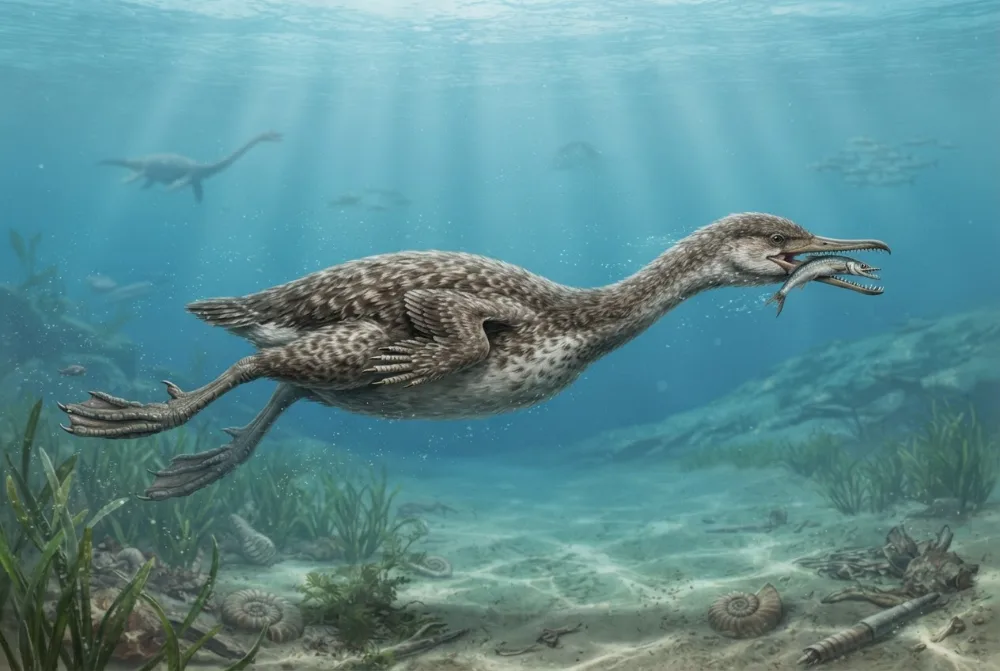
Baptornis had teeth in its beak, which is rare for birds. Most modern birds have no teeth.1
It was a strong swimmer and diver, but on land it was clumsy. It probably pushed itself along on its belly or did small hops.1
Fossils of young Baptornis have been found in Canada and Alaska, suggesting these birds migrated north to breed in summer, like some penguins do today.1
Baptornis lived about 87 to 80 million years ago, when a shallow sea covered much of central North America.1
One Baptornis fossil was found with tiny round coprolites (fossil poop) inside. The poop contained remains of a small sabre-toothed herring.1
Baptornis was one of the first Mesozoic birds discovered, along with Archaeopteryx. It was named by famous fossil hunter Othniel Charles Marsh in 1877.1
A second, much larger species of Baptornis was once named (Baptornis varneri), but later scientists moved it to a different genus called Brodavis.1
Eyona mibuzo ibuzwa kakhulu: Baptornis
?How big was Baptornis?
About the size of a loon, which is roughly 0.7 to 1 metre long. It was a medium-sized bird among its relatives.12
?Could Baptornis fly?
No, Baptornis was flightless. It was a strong swimmer and diver instead.1
?What did Baptornis eat?
It ate fish, especially small sabre-toothed herring called Enchodus. It caught them with its beak and swallowed them whole or in pieces.1
?Did Baptornis have teeth?
Yes, Baptornis had teeth in its beak, which is unusual for birds. Most modern birds have no teeth.1
Kwiingcali zeedayinaso
- Igama lenzululwazi
- Baptornis
- Inikwe igama ngu:
- Marsh 18773
- Iqela
- Iintaka zokuqala
- Usapho / iclade
- Baptornithidae3
- Ukuhlelwa
- Theropoda > Avialae3
- Ubudala bamatye
- 90 ukuya ku-72 izigidi zeminyaka (Coniacian / Campanian)3
- Izakhiwo zamatye
- Dinosaur Park, Niobrara, Judith River3
- Amazwe
- iKhanada, iUSA, iSweden3
- Iirekhodi zeefosili
- 10 kwi-Paleobiology Database3
- Ikwaziwa ngokuba
- Parascaniornis (amagama amadala ngoku abalwa njengesilwanyana esinye)3
- Ukufunyanwa
- Othniel Charles Marsh discovered the first fossils of Baptornis in Kansas in the 1870s. He named it in 1877.1
- Kusaxoxwa ngayo
- Scientists are not sure if a fossil from Sweden called Parascaniornis stensioi is actually a second species of Baptornis or just the same species.1
Apho iinyani zivela khona
- Baptornis (en.wikipedia.org)
- The Skeleton of Baptornis advenus (Aves: Hesperornithiformes) (exa.ai)
- Baptornis in The Paleobiology Database (CC BY 4.0): ubudala, iindawo, izakhiwo zamatye, ukuhlelwa.
Yonke inyani ekweli phepha inenombolo ebonisa umthombo wayo. Ukuba siphosisile, uxolo, sithanda iidayinaso, asiyojenali yenzululwazi. Sixelele apha: [email protected], siya kuyilungisa.
 URex ulambile! I-Dino Wiki yiprojekthi katata ukwenzela unyana wakhe othanda iidayinaso, isimahla, ayinazintengiso, ayinazilandeli. Abantu abadala banokuphakela uRex isidlwana ukuze incede ihlale kwi-intanethi.Phakela uRex
 Archaeopteryx
 Hesperornis
 Ichthyornis
 Jurapteryx
 Gobipteryx
 Martinavis
 Tyrannosaurus
 Triceratops
 Velociraptor
 Spinosaurus
 Ankylosaurus
 Parasaurolophus