 Uyiyiphi idayinaso? Ikwizi
 Idabi leedayinaso
 Ugqatso lweedayinaso
 Imidlalo emincinci yeedayinaso
 I-albhamu yezitikha
 Iilisti ze-TOP zeedayinaso
 Ndothuse!
Baryonyx
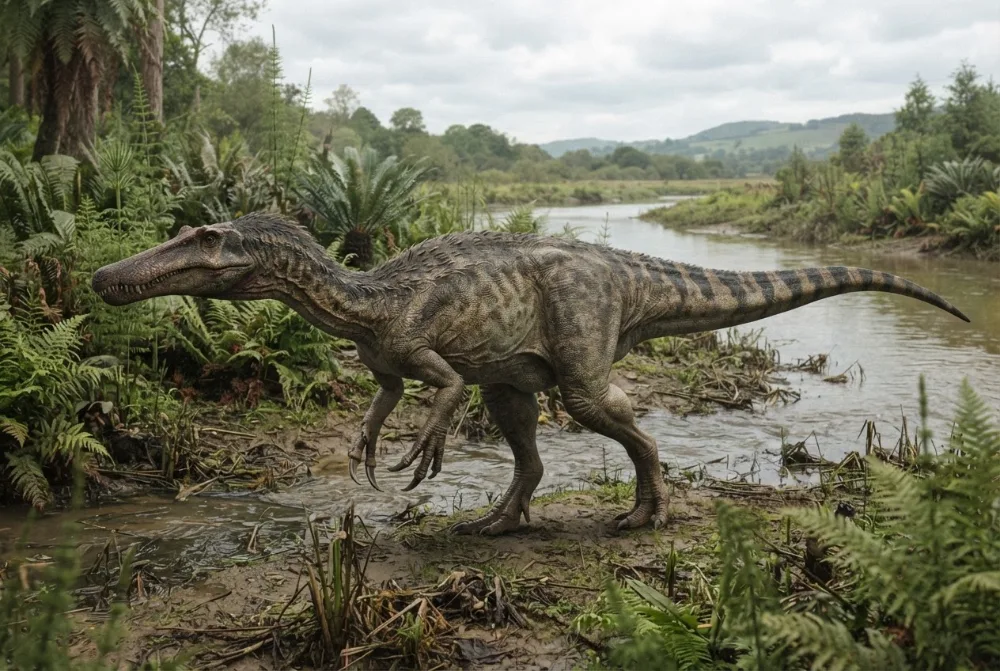
Baryonyx was a big, fish-eating dinosaur with a long snout like a crocodile and a huge claw on each hand. It lived about 130 to 125 million years ago in what is now England and other parts of Europe. It was one of the first dinosaurs shown to eat fish!1
Yaphila nini?
Yayinkulu kangakanani?
Yayinde kangakanani?
Yayiphakame kangakanani?
Yayinzima kangakanani?
 inde njengeemoto ezingama-2 zipakwe zilandelelana🍌inde njengeebhanana ezingama-56 zilandelelana
 inzima njengezinja ezingama-100🍉inzima njengamavatala angama-400🎒inzima njengamagumbi okufundela apheleleyo abantwana angama-2.5🐻❄️inzima njengeebhere ezimhlophe ezingama-4🏃ibinokubaleka iimitha ezili-100 ngemizuzwana engama-14 (oyena mntu ukhawulezayo udinga i-9,6)
Baryonyx wayemkhulu kangakanani xa ethelekiswa NAWE?
Yimathematika nje kwibhrawuza yakho. Akukho nto igcinwayo okanye ithunyelwe naphi na.
Yayikhawuleza kangakanani?


Iinyani ezimnandi
Baryonyx had a huge claw on its first finger, about 30 centimeters (12 inches) long, which it may have used to catch fish.1
Its snout was long and narrow, like a crocodile's, with many small, serrated teeth, perfect for gripping slippery fish.1
The first Baryonyx skeleton was found in 1983 in a clay pit in Surrey, England, by an amateur fossil collector named William Walker.1
Baryonyx was the first theropod dinosaur proven to eat fish, because fish scales were found in its stomach area.1
It lived in a warm, swampy environment with rivers and lakes, alongside other dinosaurs like Iguanodon and small sauropods.1
Some scientists think Baryonyx may have waded in water like a heron, using its long snout to snap up fish.1
Baryonyx also had a notch in its upper jaw, similar to a gharial, which helped it hold onto wriggling prey.1
Eyona mibuzo ibuzwa kakhulu: Baryonyx
?How big was Baryonyx?
About 7.5 to 10 metres (25 to 33 feet) long and weighed 1.2 to 2 metric tons (1.3 to 2.2 short tons).12
?What did Baryonyx eat?
It mainly ate fish, but also scavenged and ate young Iguanodon. Fish scales and bones were found in its stomach.12
?Did Baryonyx have feathers?
Nobody knows for sure. No feathers have been found with Baryonyx fossils, but some related dinosaurs may have had simple feathers.1
?Could Baryonyx swim?
It may have waded in shallow water and was probably a good swimmer, like a crocodile. It lived in a swampy environment.12
?Was Baryonyx bigger than T. rex?
No, Baryonyx was smaller. T. rex was about 12 metres (40 feet) long and weighed over 8 metric tons, while Baryonyx was up to 10 metres (33 feet) and 2 metric tons.1
?Why did Baryonyx have a big claw?
It used its 31-centimetre (12-inch) claw to catch fish and tear apart prey. The claw was on its thumb.12
?When did Baryonyx live?
It lived during the Early Cretaceous period, about 130 to 125 million years ago.12
?Where was Baryonyx found?
The first skeleton was found in 1983 in a clay pit in Surrey, England. Fossils have also been found in Spain.12
?Is Baryonyx a dinosaur?
Yes, Baryonyx is a theropod dinosaur. It is not a marine reptile or pterosaur.12
?How fast could Baryonyx run?
Scientists do not know its exact speed, but as a large theropod it probably ran at a moderate pace, maybe 25 to 40 km/h (15 to 25 mph).1
Inyaniso ngeentsomi
Intsomi: Baryonyx was a slow, clumsy dinosaur that only ate fish.
Inyaniso: While it ate fish, Baryonyx was also an active predator and scavenger, and it could probably move well on land.1
Kwiingcali zeedayinaso
- Igama lenzululwazi
- Baryonyx
- Inikwe igama ngu:
- Charig and Milner 19863
- Iqela
- Iispinosauri
- Usapho / iclade
- Spinosauridae3
- Ukuhlelwa
- Theropoda > Spinosauridae3
- Ubudala bamatye
- 139 ukuya ku-110 izigidi zeminyaka (Berriasian / Albian)3
- Izakhiwo zamatye
- Pinilla de los Moros, Weald Clay, Wessex3
- Amazwe
- iSpeyin, iUnited Kingdom, iPortugal, iTunisia3
- Iirekhodi zeefosili
- 12 kwi-Paleobiology Database3
- Ukufunyanwa
- The first Baryonyx skeleton was discovered in 1983 by amateur fossil collector William J. Walker in a clay pit in Surrey, England. It was named by Alan J. Charig and Angela C. Milner in 1986.1
- Kusaxoxwa ngayo
- Scientists still debate whether Baryonyx mainly hunted fish or also scavenged on land, and whether some fossils from other places really belong to this genus.1
Apho iinyani zivela khona
- Baryonyx (en.wikipedia.org)
- Baryonyx | Natural History Museum (nhm.ac.uk)
- Baryonyx in The Paleobiology Database (CC BY 4.0): ubudala, iindawo, izakhiwo zamatye, ukuhlelwa.
Yonke inyani ekweli phepha inenombolo ebonisa umthombo wayo. Ukuba siphosisile, uxolo, sithanda iidayinaso, asiyojenali yenzululwazi. Sixelele apha: [email protected], siya kuyilungisa.
 URex ulambile! I-Dino Wiki yiprojekthi katata ukwenzela unyana wakhe othanda iidayinaso, isimahla, ayinazintengiso, ayinazilandeli. Abantu abadala banokuphakela uRex isidlwana ukuze incede ihlale kwi-intanethi.Phakela uRex
 Spinosaurus
 Suchomimus
 Angaturama
 Camarillasaurus
 Ceratosuchops
 Iberospinus
 Stegosaurus
 Iguanodon
 Archaeopteryx
 Giganotosaurus
 Microraptor
 Deinonychus