 Uyiyiphi idayinaso? Ikwizi
 Idabi leedayinaso
 Ugqatso lweedayinaso
 Imidlalo emincinci yeedayinaso
 I-albhamu yezitikha
 Iilisti ze-TOP zeedayinaso
 Ndothuse!
Yaphila nini?

Yayinkulu kangakanani?
Yayinde kangakanani?
Yayiphakame kangakanani?
Yayinzima kangakanani?
 inde njengeemoto ezingama-2.5 zipakwe zilandelelana🍌inde njengeebhanana ezingama-61 zilandelelana
 malunga nobunzima bendlovu🍉inzima njengamavatala angama-1000🎒inzima njengamagumbi okufundela apheleleyo abantwana angama-6🐻❄️inzima njengeebhere ezimhlophe ezingama-11🏃ibinokubaleka iimitha ezili-100 ngemizuzwana engama-15 (oyena mntu ukhawulezayo udinga i-9,6)
Iguanodon wayemkhulu kangakanani xa ethelekiswa NAWE?
Yimathematika nje kwibhrawuza yakho. Akukho nto igcinwayo okanye ithunyelwe naphi na.
Yayikhawuleza kangakanani?


Iinyani ezimnandi
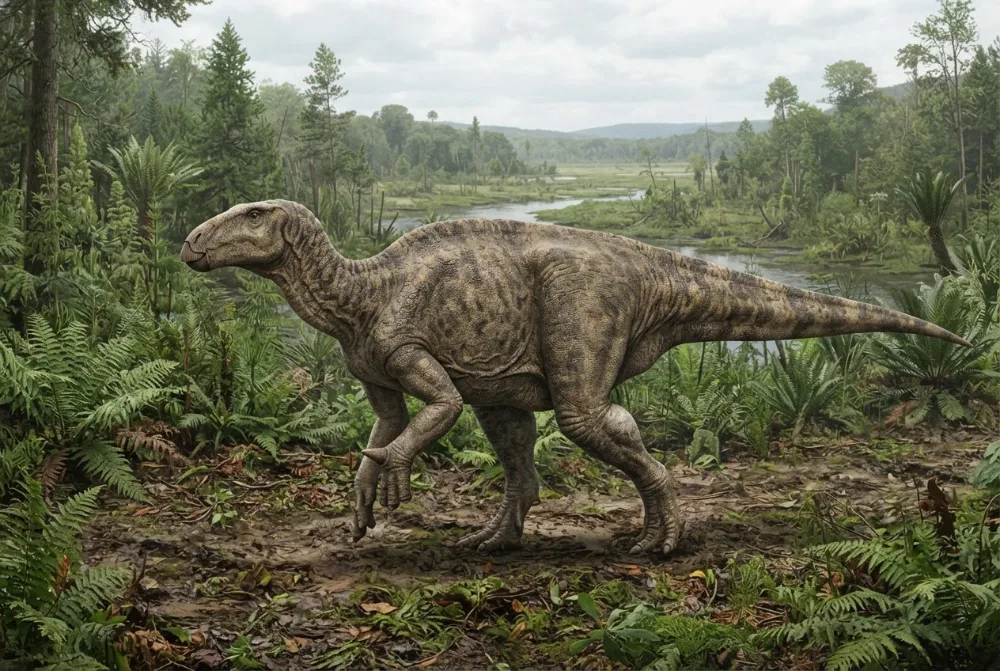
Iguanodon was named in 1825 by Gideon Mantell after he found teeth that looked like iguana teeth.1
Its thumb had a big, sharp spike that scientists think was used for defense against predators.1
Iguanodon had a flexible little finger that could grasp objects, unlike its other fingers which were more like hooves.1
When Iguanodon closed its mouth, the bones in its upper jaw would bow out, making the teeth grind against each other like a chewing motion.1
The front of Iguanodon's mouth had no teeth, just a bony beak covered with a hard material for cropping plants.1
Iguanodon could reach food from ground level up to 4 to 5 metres (13 to 16 feet) high, so it ate both low plants and tree leaves.1
In 1878, many complete Iguanodon skeletons were found in a coal mine in Bernissart, Belgium, which helped scientists understand the dinosaur much better.1
Eyona mibuzo ibuzwa kakhulu: Iguanodon
?How big was Iguanodon?
Iguanodon was about 9 to 11 metres (30 to 36 feet) long and weighed around 4.5 metric tons (5 short tons).1
?What did Iguanodon eat?
Iguanodon was a plant-eater. It used its beak to snip leaves and its cheek teeth to grind tough plants like cycads.34
?Did Iguanodon have a thumb spike?
Yes, Iguanodon had a large, sharp spike on each thumb. It may have been used for defense or for breaking into fruits and seeds.35
?Could Iguanodon walk on two legs?
Yes, Iguanodon could walk on two legs or on all fours. It was one of the few dinosaurs that could do both.34
?When did Iguanodon live?
Iguanodon lived during the Early Cretaceous period, about 126 to 122 million years ago.1
?Who discovered Iguanodon?
Iguanodon was named by Gideon Mantell in 1825 after teeth were found in Sussex, England. His wife Mary Ann Mantell is often credited with finding the first teeth.51
?Was Iguanodon a dinosaur?
Yes, Iguanodon was a dinosaur. It was one of the first dinosaurs ever named, after Megalosaurus.1
?How fast could Iguanodon run?
Up to about 24 km/h (15 mph) on two legs, about as fast as a grown-up riding a bike. Most of the time it walked much slower.4
Inyaniso ngeentsomi
Intsomi: Iguanodon was a slow, clumsy dinosaur that always walked on four legs.
Inyaniso: Iguanodon could walk on two legs or all fours, and it was probably quite agile for its size.2
Kwiingcali zeedayinaso
- Igama lenzululwazi
- Iguanodon
- Inikwe igama ngu:
- Mantell 18256
- Iqela
- Izitya-zityalo ezinemilomo
- Usapho / iclade
- Ankylopollexia6
- Ukuhlelwa
- Ornithischia > Ornithopoda > Iguanodontia6
- Ubudala bamatye
- 155 ukuya ku-66 izigidi zeminyaka (Kimmeridgian / Maastrichtian)6
- Izakhiwo zamatye
- Arcillas de Morella, Weald Clay, Wessex6
- Amazwe
- iUnited Kingdom, iSpeyin, iJamani, iFransi, iPortugal, iBhelgiyam6
- Iirekhodi zeefosili
- 133 kwi-Paleobiology Database6
- Ikwaziwa ngokuba
- Heterosaurus, Iguanosaurus, Struthopus, Therosaurus (amagama amadala ngoku abalwa njengesilwanyana esinye)6
- Ukufunyanwa
- Iguanodon was first named by Gideon Mantell in 1825 based on fossil teeth found in Sussex, England. Later, in 1878, many complete skeletons were discovered in a Belgian coal mine and studied by Louis Dollo.1
- Kusaxoxwa ngayo
- Scientists still debate exactly what plants Iguanodon ate. Some think it ate horsetails, cycads, and conifers, while others link it to the spread of flowering plants.1
Apho iinyani zivela khona
- Iguanodon (en.wikipedia.org)
- Iguanodon | Diet, Habitat & Extinction (britannica.com)
- Iguanodon | National Geographic Kids (kids.nationalgeographic.com)
- enchantedlearning.com (enchantedlearning.com)
- Iguanodon: the teeth that led to a dinosaur discovery | Natural History Museum (nhm.ac.uk)
- Iguanodon in The Paleobiology Database (CC BY 4.0): ubudala, iindawo, izakhiwo zamatye, ukuhlelwa.
Yonke inyani ekweli phepha inenombolo ebonisa umthombo wayo. Ukuba siphosisile, uxolo, sithanda iidayinaso, asiyojenali yenzululwazi. Sixelele apha: [email protected], siya kuyilungisa.
 URex ulambile! I-Dino Wiki yiprojekthi katata ukwenzela unyana wakhe othanda iidayinaso, isimahla, ayinazintengiso, ayinazilandeli. Abantu abadala banokuphakela uRex isidlwana ukuze incede ihlale kwi-intanethi.Phakela uRex
 Tenontosaurus
 Thescelosaurus
 Zalmoxes
 Camptosaurus
 Rhabdodon
 Nanosaurus
 Stegosaurus
 Archaeopteryx
 Giganotosaurus
 Microraptor
 Deinonychus
 Baryonyx