 Uyiyiphi idayinaso? Ikwizi
 Idabi leedayinaso
 Ugqatso lweedayinaso
 Imidlalo emincinci yeedayinaso
 I-albhamu yezitikha
 Iilisti ze-TOP zeedayinaso
 Ndothuse!
Carinodens
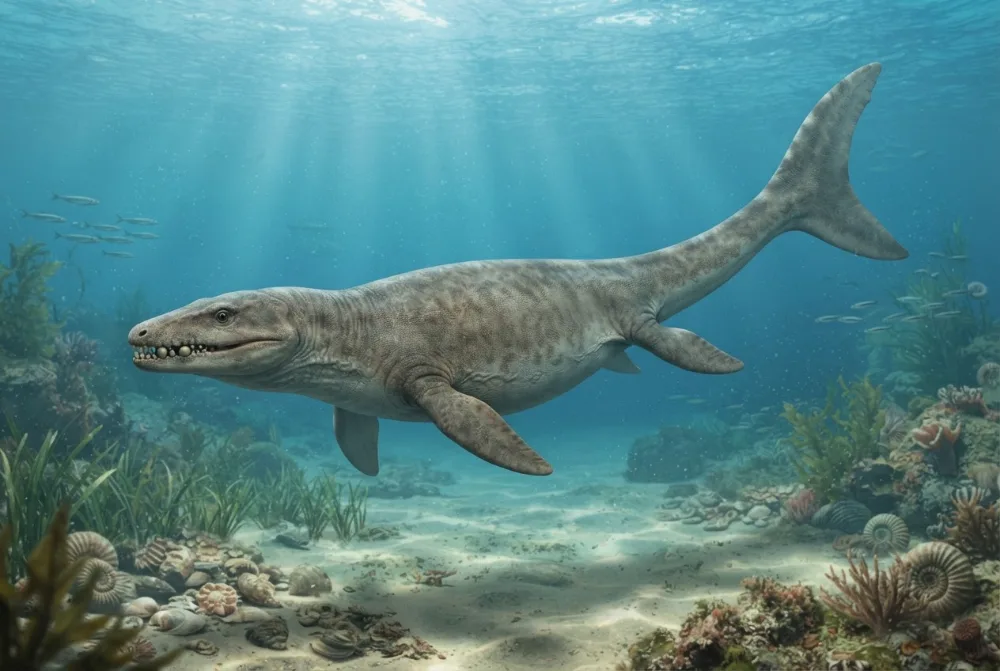
Carinodens was a small mosasaur, a marine lizard that lived in the late Cretaceous seas. It had round, blunt teeth like a set of nutcrackers for crushing hard-shelled animals. At only about 2 to 2.6 metres long, it was one of the tiniest mosasaurs ever.1
Yaphila nini?
Yayinkulu kangakanani?
Yayinde kangakanani?
 inde njengezinja ezingama-2.5, impumlo ukuya emsileni🍌inde njengeebhanana ezingama-14 zilandelelana🏊ibinokuqubha ubude bechibi elikhulu lokuqubha (50 m) ngemizuzwana engama-6
Carinodens wayemkhulu kangakanani xa ethelekiswa NAWE?
Yimathematika nje kwibhrawuza yakho. Akukho nto igcinwayo okanye ithunyelwe naphi na.
Yayikhawuleza kangakanani?


Iinyani ezimnandi
Carinodens was first thought to be a crocodile! A fossil jaw was originally named Bottosaurus belgicus and considered a crocodilian before being recognized as a mosasaur.1
Its teeth were very different from each other. The front teeth were round and curved, while the back teeth were flat and blade-like with a keel on each side.1
Scientists can tell what Carinodens ate by looking at tiny scratches on its teeth. The wear patterns show it munched on hard-shelled animals that lived on the seafloor.1
Carinodens is closely related to Globidens, another mosasaur with crushing teeth. Together they belong to a group called Globidensini.1
The name Carinodens means 'keel teeth' because its teeth have a ridge like the keel of a boat. It replaced the older name Compressidens, which was already used for a different animal.1
Eyona mibuzo ibuzwa kakhulu: Carinodens
?What did Carinodens eat?
Carinodens ate hard-shelled animals like clams, oysters, and sea urchins. Its blunt teeth were perfect for crushing them, and scratches on the teeth show it munched on creatures that lived on the seafloor.12
?How big was Carinodens?
Carinodens was about 2 to 2.6 metres (6.6 to 8.5 feet) long. That makes it one of the smallest mosasaurs ever.1
?Where did Carinodens live?
Carinodens lived in the late Cretaceous seas, and its fossils have been found in Europe, North America, South America, and North Africa. Most skull fossils come from the Netherlands and Belgium.1
?Is Carinodens a dinosaur?
No, Carinodens is not a dinosaur. It is a marine lizard called a mosasaur that lived in the sea during the time of the dinosaurs.1
Kwiingcali zeedayinaso
- Igama lenzululwazi
- Carinodens
- Inikwe igama ngu:
- Thurmond 19693
- Iqela
- Iimosasauri
- Usapho / iclade
- Mosasauridae3
- Ukuhlelwa
- Mosasauroidea3
- Ubudala bamatye
- 72 ukuya ku-66 izigidi zeminyaka (Maastrichtian)3
- Izakhiwo zamatye
- Maastricht, Gramame, Bereza Beds3
- Amazwe
- iNetherlands, iMorocco, iBrazil, iUkraine, iRashiya, iBhelgiyam3
- Iirekhodi zeefosili
- 16 kwi-Paleobiology Database3
- Ukufunyanwa
- The first fossils were found in Belgium and described by Louis Dollo in 1913 as Globidens fraasi. In 1969, J.T. Thurmond gave it the new name Carinodens because the old name was already taken.1
- Kusaxoxwa ngayo
- Scientists are not sure how many species of Carinodens existed. Some think C. belgicus and C. fraasi might be the same species, while others believe they are different based on tooth shape.1
Apho iinyani zivela khona
- Carinodens (en.wikipedia.org)
- Feeding the Mechanical Mosasaur: what did Carinodens eat? | Netherlands Journal of Geosciences | Cambridge Core (cambridge.org)
- Carinodens in The Paleobiology Database (CC BY 4.0): ubudala, iindawo, izakhiwo zamatye, ukuhlelwa.
Yonke inyani ekweli phepha inenombolo ebonisa umthombo wayo. Ukuba siphosisile, uxolo, sithanda iidayinaso, asiyojenali yenzululwazi. Sixelele apha: [email protected], siya kuyilungisa.
 URex ulambile! I-Dino Wiki yiprojekthi katata ukwenzela unyana wakhe othanda iidayinaso, isimahla, ayinazintengiso, ayinazilandeli. Abantu abadala banokuphakela uRex isidlwana ukuze incede ihlale kwi-intanethi.Phakela uRex
 Mosasaurus
 Prognathodon
 Tylosaurus
 Platecarpus
 Clidastes
 Globidens
 Tyrannosaurus
 Triceratops
 Velociraptor
 Spinosaurus
 Ankylosaurus
 Parasaurolophus