 Uyiyiphi idayinaso? Ikwizi
 Idabi leedayinaso
 Ugqatso lweedayinaso
 Imidlalo emincinci yeedayinaso
 I-albhamu yezitikha
 Iilisti ze-TOP zeedayinaso
 Ndothuse!
Cyamodus
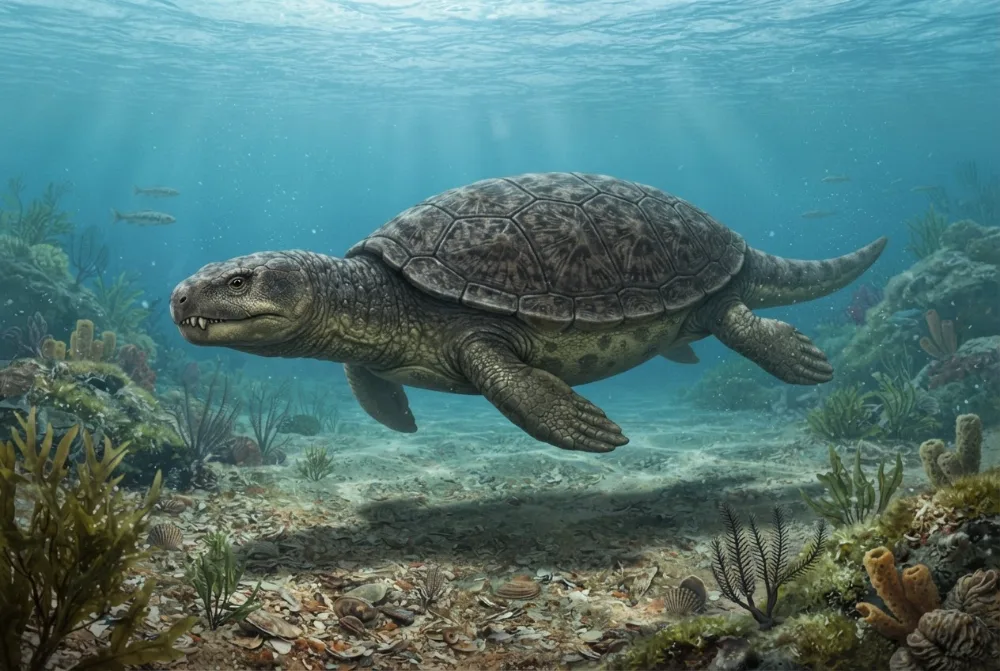
Cyamodus was a turtle-like marine reptile that lived in the Triassic seas. It had a hard shell made of bony plates and used its blunt teeth to crush shellfish. It was not a dinosaur, but a type of placodont.1
Yaphila nini?
Yayinkulu kangakanani?
Yayinde kangakanani?
Yayinzima kangakanani?
 inde njengeekati zasekhaya ezingama-3, impumlo ukuya emsileni🍌inde njengeebhanana ezingama-8 zilandelelana🍉inzima njengamavatala angama-5🏊ibinokuqubha ubude bechibi elikhulu lokuqubha (50 m) ngemizuzwana engama-20
Cyamodus wayemkhulu kangakanani xa ethelekiswa NAWE?
Yimathematika nje kwibhrawuza yakho. Akukho nto igcinwayo okanye ithunyelwe naphi na.
Yayikhawuleza kangakanani?


Iinyani ezimnandi
Cyamodus had a two-part shell: a big plate covered its body from neck to hips, and a smaller plate covered its hips and tail base.1
Its shell was made of many hexagonal or circular bony plates that made it heavy, helping it sink and stay underwater to find food.1
Fossils of two baby Cyamodus were found inside the stomach of a Lariosaurus, a large marine reptile that ate them.1
Cyamodus lived about 245 to 235 million years ago, during the Middle and Late Triassic.1
Its skull was heart-shaped and broad, and its limbs were short so it probably only came on land to rest.1
The first Cyamodus fossils were found in Germany and were originally thought to be from fish.1
Eyona mibuzo ibuzwa kakhulu: Cyamodus
?How big was Cyamodus?
Most Cyamodus species were about 1.3 to 1.5 metres (4.3 to 4.9 feet) long and weighed 20 to 25 kilograms (44 to 55 pounds). The smallest species, C. rostratus, was about 0.9 metres (3.0 feet) long and weighed 5 kilograms (11 pounds).1
?What did Cyamodus eat?
Cyamodus ate shellfish, which it crushed with its blunt teeth. It lived near the sea floor, vacuuming up various shellfish and crushing them between its teeth.1
?Was Cyamodus a dinosaur?
No, Cyamodus was not a dinosaur. It was a type of placodont, a marine reptile related to turtles, and it lived during the Triassic period.1
Inyaniso ngeentsomi
Intsomi: Cyamodus was an ancient turtle.
Inyaniso: It was not a turtle, but a placodont, a different group of marine reptiles that lived at the same time.1
Kwiingcali zeedayinaso
- Igama lenzululwazi
- Cyamodus
- Inikwe igama ngu:
- von Meyer 18633
- Iqela
- Izirhubuluzi zaselwandle
- Usapho / iclade
- Cyamodontidae3
- Ukuhlelwa
- Placodontia > Sauropterygia3
- Ubudala bamatye
- 247 ukuya ku-227 izigidi zeminyaka ()3
- Izakhiwo zamatye
- Besano, Meissner, Templomhegy Dolomite3
- Amazwe
- iJamani, iFransi, iSlovenia, iSwitzerland, iPoland, iHungary3
- Iirekhodi zeefosili
- 18 kwi-Paleobiology Database3
- Ukufunyanwa
- The genus Cyamodus was named by German scientist Christian Erich Hermann von Meyer in 1863, based on fossils from Germany.12
- Kusaxoxwa ngayo
- Scientists debate whether Cyamodus ate only shellfish or also grazed on algae.1
Apho iinyani zivela khona
- Cyamodus (en.wikipedia.org)
- PBDB Taxon (paleobiodb.org)
- Cyamodus in The Paleobiology Database (CC BY 4.0): ubudala, iindawo, izakhiwo zamatye, ukuhlelwa.
Yonke inyani ekweli phepha inenombolo ebonisa umthombo wayo. Ukuba siphosisile, uxolo, sithanda iidayinaso, asiyojenali yenzululwazi. Sixelele apha: [email protected], siya kuyilungisa.
 URex ulambile! I-Dino Wiki yiprojekthi katata ukwenzela unyana wakhe othanda iidayinaso, isimahla, ayinazintengiso, ayinazilandeli. Abantu abadala banokuphakela uRex isidlwana ukuze incede ihlale kwi-intanethi.Phakela uRex
 Nothosaurus
 Placodus
 Lariosaurus
 Cymatosaurus
 Proneusticosaurus
 Simosaurus
 Chonespondylus
 Cymbospondylus
 Phalarodon
 Mixosaurus
 Chaohusaurus
 Chensaurus