 Uyiyiphi idayinaso? Ikwizi
 Idabi leedayinaso
 Ugqatso lweedayinaso
 Imidlalo emincinci yeedayinaso
 I-albhamu yezitikha
 Iilisti ze-TOP zeedayinaso
 Ndothuse!
Lariosaurus
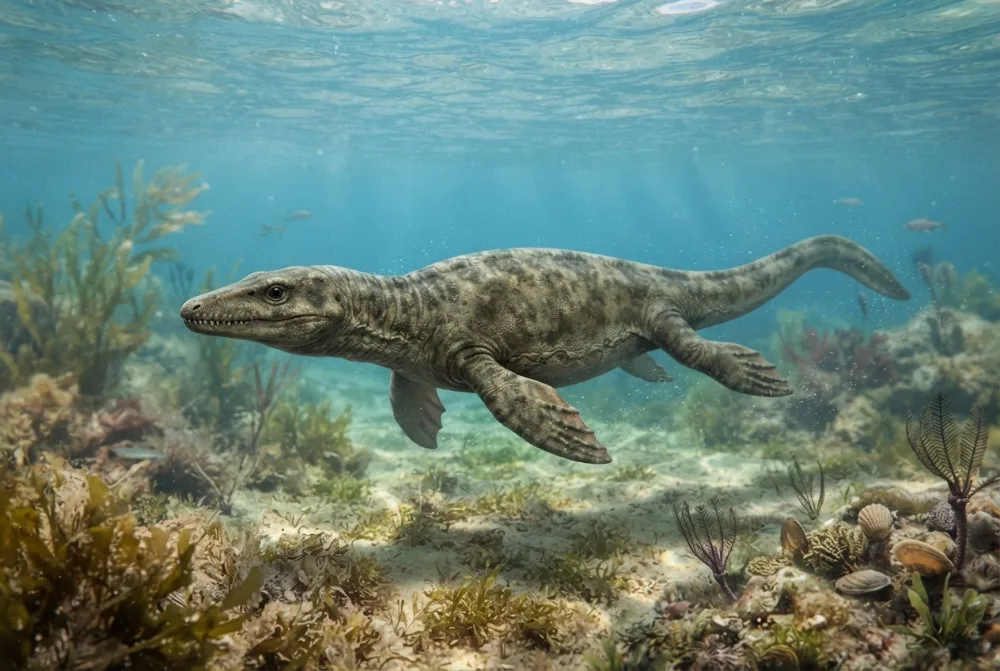
Lariosaurus was a small, ancient sea reptile that lived in warm, shallow seas during the Triassic Period. It had a short neck, small flippers, and webbed feet, and it probably spent a lot of time hunting in shallow water or even on land.12
Yaphila nini?
Yayinkulu kangakanani?
Yayinde kangakanani?
 inde njengeekati zasekhaya ezingama-1.5, impumlo ukuya emsileni🍌inde njengeebhanana ezingama-4 zilandelelana🏊ibinokuqubha ubude bechibi elikhulu lokuqubha (50 m) ngemizuzwana engama-26
Lariosaurus wayemkhulu kangakanani xa ethelekiswa NAWE?
Yimathematika nje kwibhrawuza yakho. Akukho nto igcinwayo okanye ithunyelwe naphi na.
Yayikhawuleza kangakanani?


Iinyani ezimnandi
Lariosaurus was one of the smallest nothosaurs, measuring less than one meter long.1
Its front legs were adapted into paddles, but its back legs still had five toes, which is unusual among nothosaurs.1
Scientists think Lariosaurus could give birth to live young, because fossils of babies have been found inside adults.1
A fossil with preserved skin shows that Lariosaurus had webbed hands and feet, like a duck.2
Lariosaurus had a short neck and small flippers, making it a poor swimmer compared to other nothosaurs.1
The first Lariosaurus fossil was discovered in 1830 near Lake Como, Italy, making it one of the earliest known marine reptiles from the Alps.1
Lariosaurus had a sturdy armor of belly ribs (gastralia) that protected its underside.1
Eyona mibuzo ibuzwa kakhulu: Lariosaurus
?What did Lariosaurus eat?
It ate small prey like fish and other reptiles. One fossil had two young placodonts (a type of shelled reptile) in its stomach.1
?How did Lariosaurus swim?
It swam by rowing its strong front limbs like a seal, using a 'flying-rowing' motion. Its hands and feet were webbed, not flippers.23
?Did Lariosaurus have live babies?
Yes, scientists think it gave birth to live young. Fossils of baby Lariosaurus have been found inside adults.1
Inyaniso ngeentsomi
Intsomi: Some people thought Lariosaurus was a dinosaur or a stegosaur.
Inyaniso: Lariosaurus is a nothosaur, a type of marine reptile, not a dinosaur. The nothosaur Eupodosaurus was once mistaken for a stegosaurian dinosaur but is now considered the same as Lariosaurus.1
Kwiingcali zeedayinaso
- Igama lenzululwazi
- Lariosaurus
- Inikwe igama ngu:
- Curioni 18474
- Iqela
- Izirhubuluzi zaselwandle
- Usapho / iclade
- Nothosauridae4
- Ukuhlelwa
- Sauropterygia4
- Ubudala bamatye
- 251 ukuya ku-237 izigidi zeminyaka ()4
- Izakhiwo zamatye
- Falang, Meride, Perledo-Varenna4
- Amazwe
- i-Itali, iTshayina, iJamani, iSpeyin, iSwitzerland, iNetherlands4
- Iirekhodi zeefosili
- 27 kwi-Paleobiology Database4
- Ikwaziwa ngokuba
- Deirosaurus, Eupodosaurus, Macromerosauro, Macromerosaurus, Macromirosaurus, Rhaeticonia, Silvestrosaurus (amagama amadala ngoku abalwa njengesilwanyana esinye)4
- Ukufunyanwa
- Lariosaurus was named in 1847 by Curioni, based on a fossil found in 1830 at Perledo on Lake Como, Italy.1
- Kusaxoxwa ngayo
- Scientists debate whether the genera Ceresiosaurus and Silvestrosaurus should be considered the same as Lariosaurus.1
Apho iinyani zivela khona
- Lariosaurus (en.wikipedia.org)
- The first specimen with skin preserved of Lariosaurus (Eusauropterygia) from the Middle Triassic of Monte San Giorgio (Switzerland) allows inferences about its swimming method | Swiss Journal of Palaeontology | Springer Nature Link (link.springer.com)
- An ancient reptile’s fossilized skin reveals how it swam like a seal (sciencenews.org)
- Lariosaurus in The Paleobiology Database (CC BY 4.0): ubudala, iindawo, izakhiwo zamatye, ukuhlelwa.
Yonke inyani ekweli phepha inenombolo ebonisa umthombo wayo. Ukuba siphosisile, uxolo, sithanda iidayinaso, asiyojenali yenzululwazi. Sixelele apha: [email protected], siya kuyilungisa.
 URex ulambile! I-Dino Wiki yiprojekthi katata ukwenzela unyana wakhe othanda iidayinaso, isimahla, ayinazintengiso, ayinazilandeli. Abantu abadala banokuphakela uRex isidlwana ukuze incede ihlale kwi-intanethi.Phakela uRex
 Nothosaurus
 Placodus
 Cyamodus
 Cymatosaurus
 Proneusticosaurus
 Simosaurus
 Chonespondylus
 Cymbospondylus
 Phalarodon
 Mixosaurus
 Chaohusaurus
 Chensaurus