 Uyiyiphi idayinaso? Ikwizi
 Idabi leedayinaso
 Ugqatso lweedayinaso
 Imidlalo emincinci yeedayinaso
 I-albhamu yezitikha
 Iilisti ze-TOP zeedayinaso
 Ndothuse!
Datai
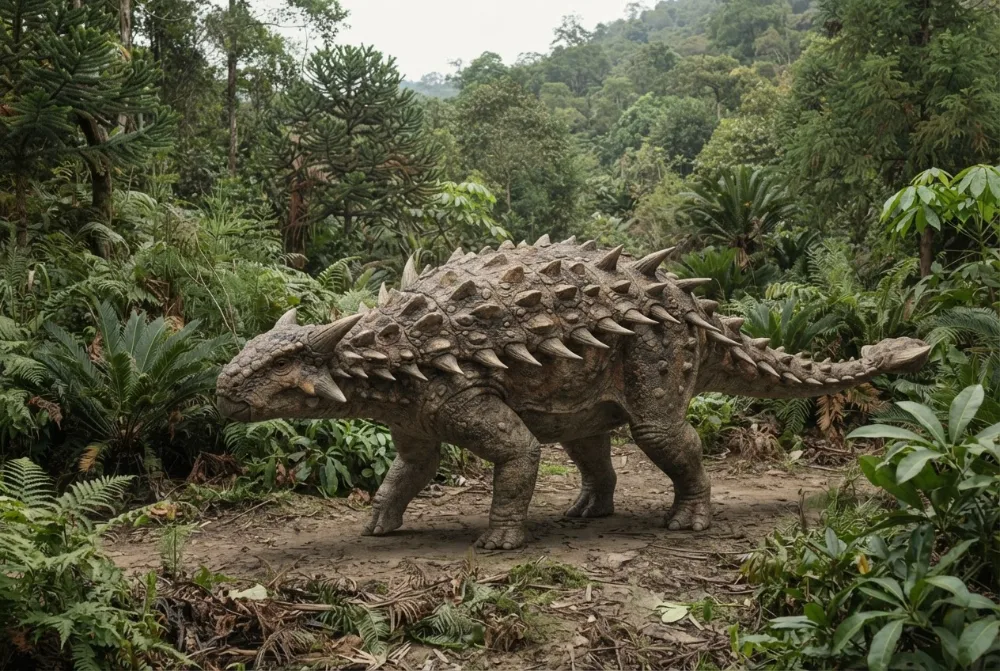
Datai was an armored dinosaur that walked on four legs and had bony plates and spikes on its body. It had a pair of horns on its cheeks, which made it look extra tough. It lived in what is now China, about 90 million years ago.12
Yaphila nini?
Yayinkulu kangakanani?
Yayinde kangakanani?
Yayiphakame kangakanani?
uqikelelo
 inde njengezinja ezingama-4, impumlo ukuya emsileni🍌inde njengeebhanana ezingama-22 zilandelelana🏃ibinokubaleka iimitha ezili-100 ngemizuzwana engama-18 (oyena mntu ukhawulezayo udinga i-9,6)
Datai wayemkhulu kangakanani xa ethelekiswa NAWE?
Yimathematika nje kwibhrawuza yakho. Akukho nto igcinwayo okanye ithunyelwe naphi na.
Yayikhawuleza kangakanani?


Iinyani ezimnandi
Datai had a pair of horns on its cheeks, which is unusual and helped scientists identify it as a new species.2
The two Datai fossils were found lying on top of each other, likely because they were buried quickly by wind-blown sand.2
The neck bones of one Datai had curved holes about 2 cm wide, probably made by small creatures like mollusks burrowing in the sediment after the dinosaur died.2
Datai's tail had ossified tendons, which suggests it may have had a tail club for defense.1
Scientists used Datai's features to help make the family tree of ankylosaurs more stable, because before, many relationships were uncertain.1
Datai lived during the Late Cretaceous, about 96 to 90 million years ago, which is a time when many armored dinosaurs roamed.1
Eyona mibuzo ibuzwa kakhulu: Datai
?What did Datai eat?
Datai was a plant-eating dinosaur. It was a ground-dwelling herbivore, so it likely ate low-growing plants.3
?Did Datai have a tail club?
It likely did. Its tail bones were surrounded by ossified tendons, which suggests it may have had a tail club for defense.1
?How big was Datai?
Scientists don't know exactly, because the fossils are from young, not fully grown individuals. The known specimens were immature, so their adult size is uncertain.1
?When did Datai live?
Datai lived during the Late Cretaceous, about 96 to 90 million years ago, in what is now China.1
Inyaniso ngeentsomi
Intsomi: Some people think all armored dinosaurs had tail clubs, but not all did.
Inyaniso: Datai likely had a tail club because of ossified tendons near its tail, but many other ankylosaurs did not have one.1
Kwiingcali zeedayinaso
- Igama lenzululwazi
- Datai
- Inikwe igama ngu:
- Xing et al. 20243
- Iqela
- Iidayinaso ezinesikrweqe
- Usapho / iclade
- Ankylosauridae3
- Ukuhlelwa
- Ornithischia > Ankylosauria > Ankylosauridae > Thyreophora3
- Ubudala bamatye
- 94 ukuya ku-86 izigidi zeminyaka (Turonian / Coniacian)3
- Izakhiwo zamatye
- Zhoutian3
- Amazwe
- iTshayina3
- Iirekhodi zeefosili
- 1 kwi-Paleobiology Database3
- Ukufunyanwa
- The fossils were found in 2016 in Jiangxi Province, China, and later acquired by the Yingliang Stone Natural History Museum. In 2024, a team led by Xing Lida named the new species Datai yingliangis.12
- Kusaxoxwa ngayo
- Scientists are still debating exactly where Datai fits in the ankylosaur family tree. Depending on the analysis, it appears either as a basal ankylosaurine or as a close relative of Pinacosaurus.1
Apho iinyani zivela khona
- Datai (en.wikipedia.org)
- Fossils of new armored dinosaur species found in east China-Xinhua (english.news.cn)
- Datai in The Paleobiology Database (CC BY 4.0): ubudala, iindawo, izakhiwo zamatye, ukuhlelwa.
Yonke inyani ekweli phepha inenombolo ebonisa umthombo wayo. Ukuba siphosisile, uxolo, sithanda iidayinaso, asiyojenali yenzululwazi. Sixelele apha: [email protected], siya kuyilungisa.
 URex ulambile! I-Dino Wiki yiprojekthi katata ukwenzela unyana wakhe othanda iidayinaso, isimahla, ayinazintengiso, ayinazilandeli. Abantu abadala banokuphakela uRex isidlwana ukuze incede ihlale kwi-intanethi.Phakela uRex
 Ankylosaurus
 Sauropelta
 Pinacosaurus
 Scutellosaurus
 Struthiosaurus
 Euoplocephalus
 Tyrannosaurus
 Triceratops
 Velociraptor
 Spinosaurus
 Parasaurolophus
 Pteranodon