 Uyiyiphi idayinaso? Ikwizi
 Idabi leedayinaso
 Ugqatso lweedayinaso
 Imidlalo emincinci yeedayinaso
 I-albhamu yezitikha
 Iilisti ze-TOP zeedayinaso
 Ndothuse!
Eonatator
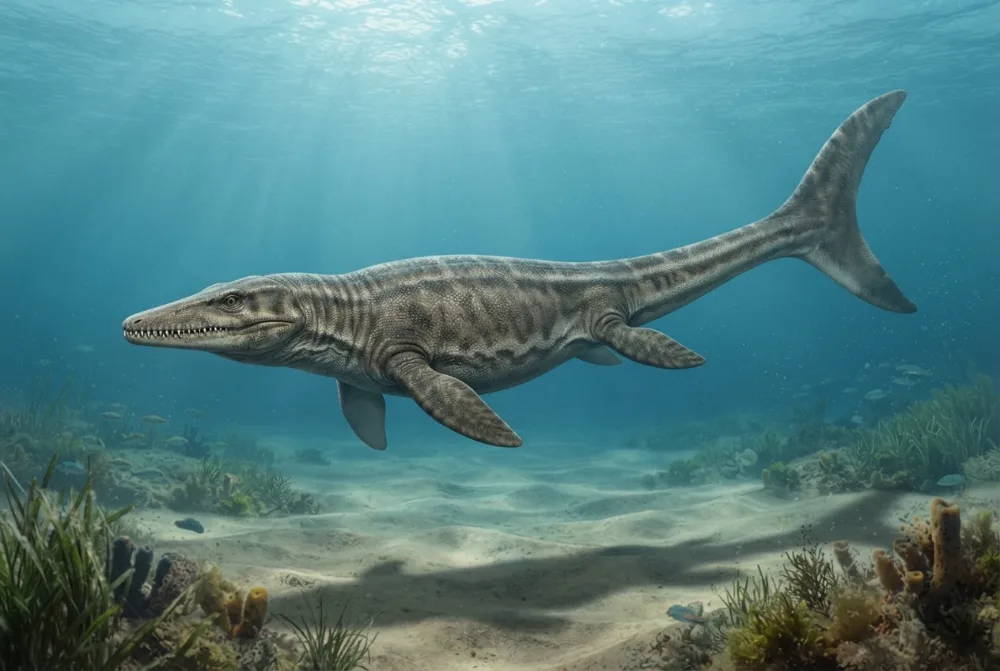
Eonatator was a small, speedy marine lizard that swam in warm Cretaceous seas. It was an early relative of the giant mosasaurs, but much smaller and more agile.1
Yaphila nini?
Yayinkulu kangakanani?
Yayinde kangakanani?
 inde njengezinja ezingama-2.5, impumlo ukuya emsileni🍌inde njengeebhanana ezingama-14 zilandelelana🏊ibinokuqubha ubude bechibi elikhulu lokuqubha (50 m) ngemizuzwana engama-6
Eonatator wayemkhulu kangakanani xa ethelekiswa NAWE?
Yimathematika nje kwibhrawuza yakho. Akukho nto igcinwayo okanye ithunyelwe naphi na.
Yayikhawuleza kangakanani?


Iinyani ezimnandi
Eonatator's tail made up about 40% of its head and body length, helping it swim fast.1
The first Eonatator fossil was found in the Niobrara Chalk of Kansas in 1918 by Charles Hazelius Sternberg and his son Levi.1
Eonatator was originally thought to be a species of Clidastes or Halisaurus, but scientists gave it its own genus in 2005.1
A second species, Eonatator coellensis, was discovered in Colombia and named after the town of Coello.1
Eonatator had a smooth, triangular bone on top of its skull with a round hole called the parietal foramen.1
Like many mosasaurs, Eonatator gave birth to live young instead of laying eggs.2
Eyona mibuzo ibuzwa kakhulu: Eonatator
?How big was Eonatator?
Eonatator was a small mosasaur. The type specimen of Eonatator sternbergii was about 2.6 metres (8.5 ft) long, and a specimen of Eonatator coellensis measured 2.8 metres (9.2 ft) long as preserved, missing part of its tail.1
?What did Eonatator eat?
The sources do not say exactly what Eonatator ate. As a small marine lizard and a mosasaur, it likely ate fish and other small sea creatures, but no specific diet is given.1
?Where was Eonatator found?
Eonatator fossils have been found in North America (Kansas and Alabama), Colombia, and Sweden. The first fossil was discovered in the Niobrara Chalk of Kansas in 1918.1
?Is Eonatator a dinosaur?
No, Eonatator is not a dinosaur. It is a marine lizard belonging to the mosasaur family.1
Kwiingcali zeedayinaso
- Igama lenzululwazi
- Eonatator
- Inikwe igama ngu:
- Bardet et al. 20053
- Iqela
- Iimosasauri
- Usapho / iclade
- Mosasauridae3
- Ukuhlelwa
- Mosasauroidea3
- Ubudala bamatye
- 86 ukuya ku-72 izigidi zeminyaka (Santonian / Campanian)3
- Izakhiwo zamatye
- Niobrara, Nivel de Lutitas y Arenas3
- Amazwe
- iSweden, iUSA, iColombia3
- Iirekhodi zeefosili
- 9 kwi-Paleobiology Database3
- Ukufunyanwa
- The first Eonatator fossil, a nearly complete skeleton, was found in Kansas in 1918 by Charles Hazelius Sternberg and his son Levi. It was named Eonatator sternbergii by Nathalie Bardet and colleagues in 2005.1
- Kusaxoxwa ngayo
- Some scientists think Eonatator might actually belong to the genus Halisaurus, but most now accept it as a separate genus.1
Apho iinyani zivela khona
- Eonatator (en.wikipedia.org)
- PBDB Taxon (paleobiodb.org)
- Eonatator in The Paleobiology Database (CC BY 4.0): ubudala, iindawo, izakhiwo zamatye, ukuhlelwa.
Yonke inyani ekweli phepha inenombolo ebonisa umthombo wayo. Ukuba siphosisile, uxolo, sithanda iidayinaso, asiyojenali yenzululwazi. Sixelele apha: [email protected], siya kuyilungisa.
 URex ulambile! I-Dino Wiki yiprojekthi katata ukwenzela unyana wakhe othanda iidayinaso, isimahla, ayinazintengiso, ayinazilandeli. Abantu abadala banokuphakela uRex isidlwana ukuze incede ihlale kwi-intanethi.Phakela uRex
 Mosasaurus
 Prognathodon
 Tylosaurus
 Platecarpus
 Clidastes
 Globidens
 Tyrannosaurus
 Triceratops
 Velociraptor
 Spinosaurus
 Ankylosaurus
 Parasaurolophus