 Uyiyiphi idayinaso? Ikwizi
 Idabi leedayinaso
 Ugqatso lweedayinaso
 Imidlalo emincinci yeedayinaso
 I-albhamu yezitikha
 Iilisti ze-TOP zeedayinaso
 Ndothuse!
Eucoelophysis
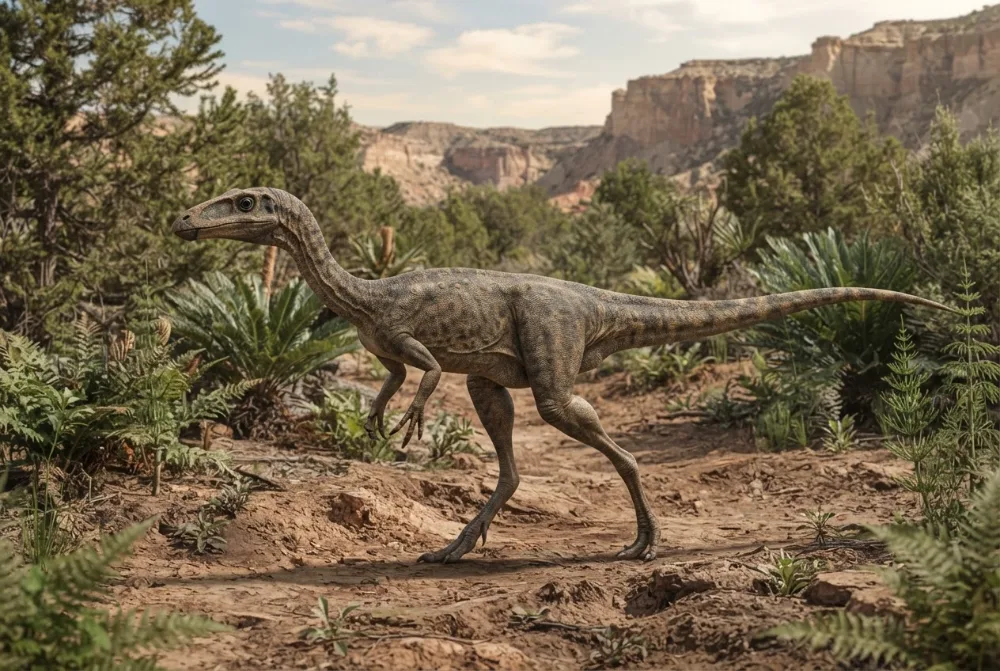
Eucoelophysis was a small, plant-eating dinosaur that lived about 212 million years ago in what is now New Mexico. It had a beak and walked on two legs, looking a bit like a long-legged lizard. Scientists once thought it was a meat-eater, but now they know it munched on plants.12
Yaphila nini?
Yayinkulu kangakanani?
Yayinde kangakanani?
Yayiphakame kangakanani?
uqikelelo
 inde njengezinja ezingama-3, impumlo ukuya emsileni🍌inde njengeebhanana ezingama-17 zilandelelana🏃ibinokubaleka iimitha ezili-100 ngemizuzwana engama-7.8 (oyena mntu ukhawulezayo udinga i-9,6)
Eucoelophysis wayemkhulu kangakanani xa ethelekiswa NAWE?
Yimathematika nje kwibhrawuza yakho. Akukho nto igcinwayo okanye ithunyelwe naphi na.
Yayikhawuleza kangakanani?


Iinyani ezimnandi
Its fossils were first found in the 1880s by David Baldwin, but were mixed up with another dinosaur called Coelophysis.1
For a long time, scientists thought Eucoelophysis was a meat-eating dinosaur, but in 2007 a study showed it was actually a plant-eater related to Silesaurus.1
Eucoelophysis lived during the Late Triassic period, about 212 million years ago.1
The name Eucoelophysis means 'true hollow form' because it was thought to be the real Coelophysis at first.1
Only a few bones of Eucoelophysis have been found, including parts of the hip and hind legs.1
Eucoelophysis is now placed in a group called Silesauridae, which are close relatives of dinosaurs.1
Eyona mibuzo ibuzwa kakhulu: Eucoelophysis
?Was Eucoelophysis a dinosaur?
No, it is not a dinosaur. Scientists now place it in a group called Silesauridae, which are close relatives of dinosaurs but not true dinosaurs.1
?How big was Eucoelophysis?
The exact size is not known from the few bones found, but it was a small animal, probably about the size of a modern turkey or a small dog.1
?What did Eucoelophysis eat?
It was a plant-eater. It had a beak and munched on plants, unlike the meat-eating dinosaurs it was once mistaken for.1
?When did Eucoelophysis live?
It lived during the Late Triassic period, about 212 million years ago, in what is now New Mexico.1
Kwiingcali zeedayinaso
- Igama lenzululwazi
- Eucoelophysis
- Inikwe igama ngu:
- Sullivan and Lucas 19992
- Iqela
- Izitya-zityalo ezinemilomo
- Usapho / iclade
- Silesauridae2
- Ukuhlelwa
- Ornithischia2
- Ubudala bamatye
- 227 ukuya ku-201 izigidi zeminyaka (Norian / Rhaetian)2
- Izakhiwo zamatye
- Chinle2
- Amazwe
- iUSA2
- Iirekhodi zeefosili
- 2 kwi-Paleobiology Database2
- Ukufunyanwa
- Eucoelophysis was named in 1999 by Robert Sullivan and Spencer Lucas based on a skeleton found in New Mexico. The species name baldwini honors David Baldwin, who collected the first fossils in the 1880s.12
- Kusaxoxwa ngayo
- Scientists are still debating whether some fossils from the Snyder Quarry and Hayden Quarry belong to Eucoelophysis or to other animals.1
Apho iinyani zivela khona
- Eucoelophysis (en.wikipedia.org)
- Eucoelophysis in The Paleobiology Database (CC BY 4.0): ubudala, iindawo, izakhiwo zamatye, ukuhlelwa.
Yonke inyani ekweli phepha inenombolo ebonisa umthombo wayo. Ukuba siphosisile, uxolo, sithanda iidayinaso, asiyojenali yenzululwazi. Sixelele apha: [email protected], siya kuyilungisa.
 URex ulambile! I-Dino Wiki yiprojekthi katata ukwenzela unyana wakhe othanda iidayinaso, isimahla, ayinazintengiso, ayinazilandeli. Abantu abadala banokuphakela uRex isidlwana ukuze incede ihlale kwi-intanethi.Phakela uRex
 Iguanodon
 Tenontosaurus
 Thescelosaurus
 Zalmoxes
 Camptosaurus
 Rhabdodon
 Nothosaurus
 Massospondylus
 Plateosaurus
 Coelophysis
 Podokesaurus
 Simosaurus