 Uyiyiphi idayinaso? Ikwizi
 Idabi leedayinaso
 Ugqatso lweedayinaso
 Imidlalo emincinci yeedayinaso
 I-albhamu yezitikha
 Iilisti ze-TOP zeedayinaso
 Ndothuse!
Yaphila nini?

Yayinkulu kangakanani?
Yayinde kangakanani?
Yayiphakame kangakanani?
uqikelelo
Halszkaraptor wayemkhulu kangakanani xa ethelekiswa NAWE?
Yimathematika nje kwibhrawuza yakho. Akukho nto igcinwayo okanye ithunyelwe naphi na.
Yayikhawuleza kangakanani?


Iinyani ezimnandi
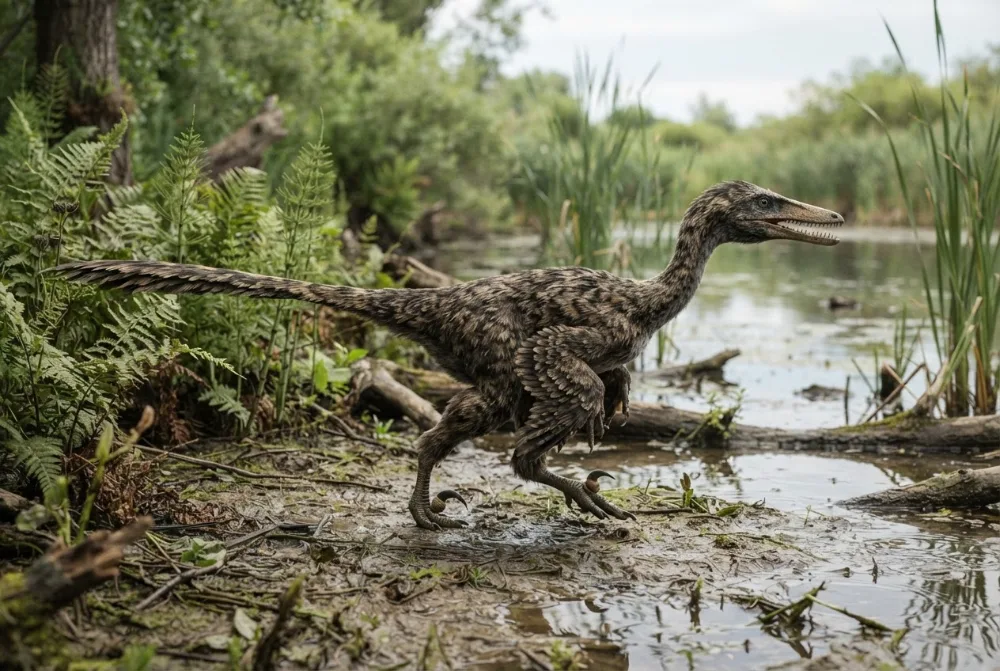
Halszkaraptor had a very long neck for a dinosaur, about 20 cm (7.9 in) long, which is almost half its total body length.1
Its front limbs were short and flipper-like, which scientists think it may have used to paddle in water.1
The snout had many tiny holes that might have held sensors to detect vibrations in water, like a crocodile.1
The only known fossil was smuggled out of Mongolia and later returned after scientists proved it was real using a powerful X-ray scanner.1
It lived about 75 million years ago, during the Late Cretaceous period.1
Some scientists think Halszkaraptor was an insectivore that hunted small bugs in murky water or at night, because its eyes were large.1
Eyona mibuzo ibuzwa kakhulu: Halszkaraptor
?Was Halszkaraptor a dinosaur?
Yes, Halszkaraptor was a small, duck-sized dromaeosaurid dinosaur from the Late Cretaceous.1
?How big was Halszkaraptor?
About the size of a mallard duck. Its head was 7 cm long and its neck was 20 cm long.1
?Could Halszkaraptor swim?
Some scientists think it could swim using flipper-like forelimbs and a long neck, but others disagree because its bones were not dense enough.12
?What did Halszkaraptor eat?
It likely ate small fish or insects. Its sharp, backward-curving teeth and snout sensors helped it catch prey in water.13
?Why did Halszkaraptor have a long neck?
Its long, swan-like neck helped it strike at prey in the water, similar to how herons hunt today.13
?When did Halszkaraptor live?
It lived about 75 million years ago, during the Late Cretaceous period.1
Inyaniso ngeentsomi
Intsomi: Halszkaraptor was a fully aquatic dinosaur like a dolphin.
Inyaniso: Scientists debate whether it was semi-aquatic. It had some adaptations for water, like a long neck and flipper-like arms, but also strong legs for running on land. It likely spent time both in water and on land.1
Kwiingcali zeedayinaso
- Igama lenzululwazi
- Halszkaraptor
- Inikwe igama ngu:
- Cau et al. 20174
- Iqela
- Iirapta
- Usapho / iclade
- Dromaeosauridae4
- Ukuhlelwa
- Theropoda > Dromaeosauridae4
- Ubudala bamatye
- 84 ukuya ku-72 izigidi zeminyaka (Campanian)4
- Izakhiwo zamatye
- Djadokhta4
- Amazwe
- iMongolia4
- Iirekhodi zeefosili
- 1 kwi-Paleobiology Database4
- Ukufunyanwa
- The fossil was found by poachers in Mongolia before 2011, then bought by a dealer who showed it to scientists in 2015. It was named Halszkaraptor escuilliei in 2017 by Andrea Cau and colleagues.1
- Kusaxoxwa ngayo
- Scientists are still debating whether Halszkaraptor was truly semi-aquatic or mainly lived on land and ate insects.1
Apho iinyani zivela khona
- Halszkaraptor (en.wikipedia.org)
- Synchrotron scanning reveals amphibious ecomorphology in a new clade of bird-like dinosaurs | Nature (nature.com)
- Duck-Like Dinosaur Is Among Oddest Fossils Yet Found | National Geographic (nationalgeographic.com)
- Halszkaraptor in The Paleobiology Database (CC BY 4.0): ubudala, iindawo, izakhiwo zamatye, ukuhlelwa.
Yonke inyani ekweli phepha inenombolo ebonisa umthombo wayo. Ukuba siphosisile, uxolo, sithanda iidayinaso, asiyojenali yenzululwazi. Sixelele apha: [email protected], siya kuyilungisa.
 URex ulambile! I-Dino Wiki yiprojekthi katata ukwenzela unyana wakhe othanda iidayinaso, isimahla, ayinazintengiso, ayinazilandeli. Abantu abadala banokuphakela uRex isidlwana ukuze incede ihlale kwi-intanethi.Phakela uRex
 Velociraptor
 Microraptor
 Deinonychus
 Asiamericana
 Richardoestesia
 Saurornitholestes
 Tyrannosaurus
 Triceratops
 Spinosaurus
 Ankylosaurus
 Parasaurolophus
 Pteranodon