 Uyiyiphi idayinaso? Ikwizi
 Idabi leedayinaso
 Ugqatso lweedayinaso
 Imidlalo emincinci yeedayinaso
 I-albhamu yezitikha
 Iilisti ze-TOP zeedayinaso
 Ndothuse!
Jormungandr
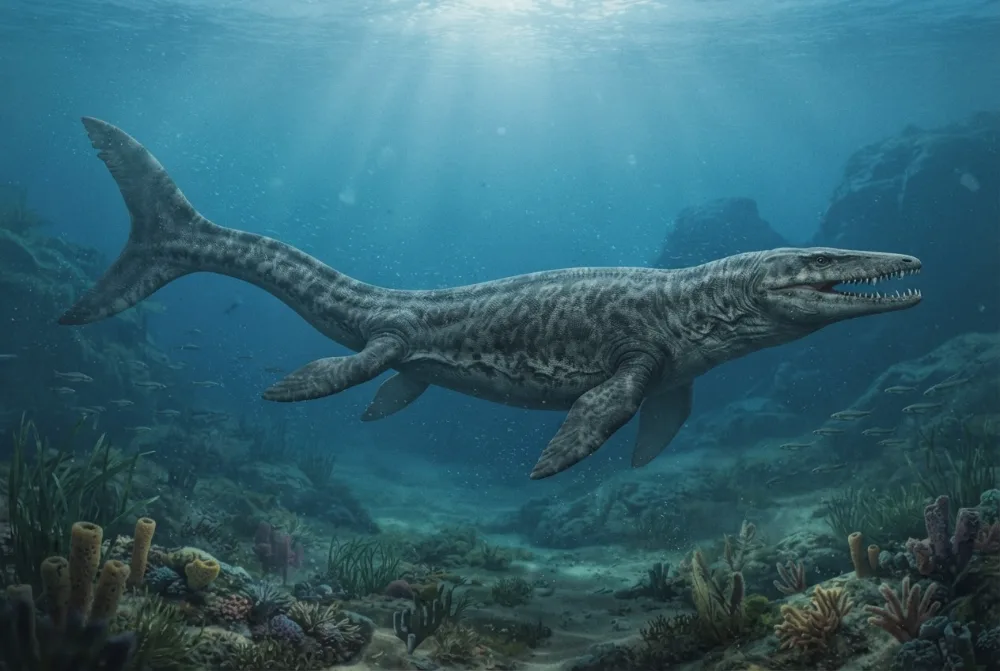
Jormungandr was a huge, swimming lizard that lived in the sea during the time of dinosaurs. It had a long body, strong jaws, and sharp teeth for catching fish and other sea creatures. This marine reptile was not a dinosaur, but a fierce predator of the ancient oceans.1
Yaphila nini?
Yayinkulu kangakanani?
Yayinde kangakanani?
 inde njengezinja ezingama-7, impumlo ukuya emsileni🍌inde njengeebhanana ezingama-41 zilandelelana🏊ibinokuqubha ubude bechibi elikhulu lokuqubha (50 m) ngemizuzwana engama-4.9
Jormungandr wayemkhulu kangakanani xa ethelekiswa NAWE?
Yimathematika nje kwibhrawuza yakho. Akukho nto igcinwayo okanye ithunyelwe naphi na.
Yayikhawuleza kangakanani?


Iinyani ezimnandi
Jormungandr's skull was about 72 centimeters (28 inches) long, and its lower jaw measured 80.8 centimeters (31.8 inches).1
The fossil was discovered in 2015 by a fossil collector named Deborah Shepherd near Walhalla, North Dakota.1
Jormungandr lived about 80 million years ago, during the Late Cretaceous period.1
The fourth dorsal vertebra of Jormungandr has marks that scientists think are bite marks from another mosasaur, possibly from a fight or scavenging.1
Jormungandr shares features with both primitive mosasaurs like Clidastes and more advanced ones like Mosasaurus, making it a 'missing link' in mosasaur evolution.1
The species name walhallaensis comes from the town of Walhalla, which is named after Valhalla, the hall of slain warriors in Norse mythology.1
Inyaniso ngeentsomi
Intsomi: Some people think Jormungandr was a dinosaur.
Inyaniso: Jormungandr was a mosasaur, a type of marine lizard, not a dinosaur. Mosasaurs are reptiles but belong to a different group than dinosaurs.1
Kwiingcali zeedayinaso
- Igama lenzululwazi
- Jormungandr
- Inikwe igama ngu:
- Zietlow et al. 20232
- Iqela
- Iimosasauri
- Usapho / iclade
- Mosasauridae2
- Ukuhlelwa
- Mosasauroidea2
- Ubudala bamatye
- 84 ukuya ku-72 izigidi zeminyaka (Campanian)2
- Izakhiwo zamatye
- Pierre Shale2
- Amazwe
- iUSA2
- Iirekhodi zeefosili
- 1 kwi-Paleobiology Database2
- Ukufunyanwa
- The only known fossil of Jormungandr was found in 2015 by fossil collector Deborah Shepherd near Walhalla, North Dakota. It was later described and named by paleontologists Amelia Zietlow, Clint Boyd, and Nathan Van Vranken in 2023.1
- Kusaxoxwa ngayo
- Scientists are not sure if Jormungandr is a distinct genus or just a new species of Clidastes. Some researchers think it might be renamed Clidastes walhallaensis in the future.1
Apho iinyani zivela khona
- Jormungandr walhallaensis (en.wikipedia.org)
- Jormungandr in The Paleobiology Database (CC BY 4.0): ubudala, iindawo, izakhiwo zamatye, ukuhlelwa.
Yonke inyani ekweli phepha inenombolo ebonisa umthombo wayo. Ukuba siphosisile, uxolo, sithanda iidayinaso, asiyojenali yenzululwazi. Sixelele apha: [email protected], siya kuyilungisa.
 URex ulambile! I-Dino Wiki yiprojekthi katata ukwenzela unyana wakhe othanda iidayinaso, isimahla, ayinazintengiso, ayinazilandeli. Abantu abadala banokuphakela uRex isidlwana ukuze incede ihlale kwi-intanethi.Phakela uRex
 Mosasaurus
 Prognathodon
 Tylosaurus
 Platecarpus
 Clidastes
 Globidens
 Tyrannosaurus
 Triceratops
 Velociraptor
 Spinosaurus
 Ankylosaurus
 Parasaurolophus