 Uyiyiphi idayinaso? Ikwizi
 Idabi leedayinaso
 Ugqatso lweedayinaso
 Imidlalo emincinci yeedayinaso
 I-albhamu yezitikha
 Iilisti ze-TOP zeedayinaso
 Ndothuse!
Kaikaifilu
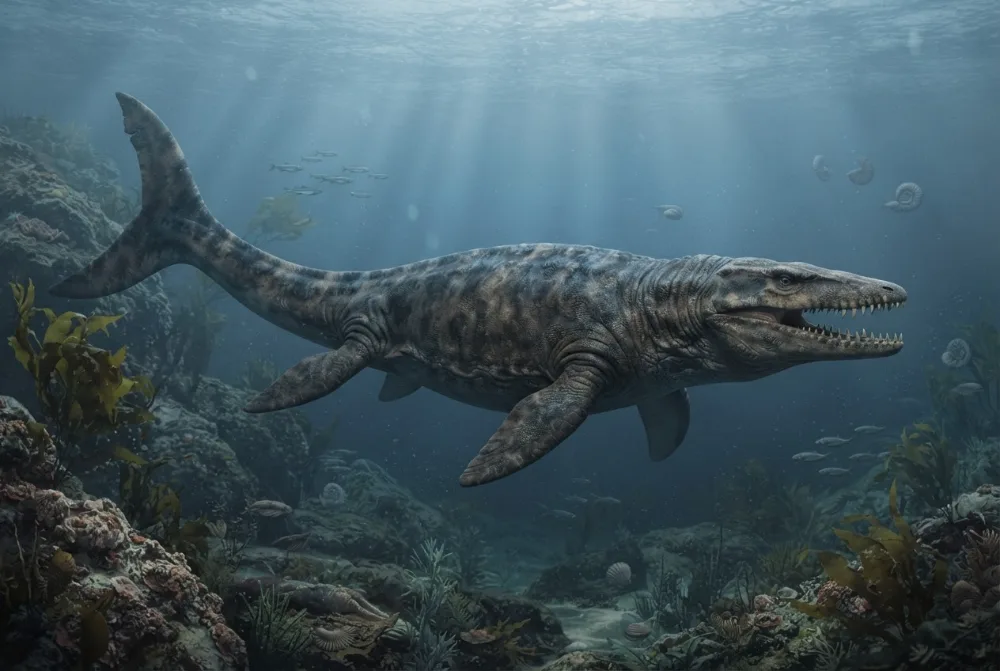
Kaikaifilu was a giant marine lizard that swam in the cold seas near Antarctica 66 million years ago. It was one of the biggest mosasaurs in the Southern Hemisphere, with a skull as long as a tall child!1
Yaphila nini?
Yayinkulu kangakanani?
Yayinde kangakanani?
 inde njengeemoto ezingama-2 zipakwe zilandelelana🍌inde njengeebhanana ezingama-56 zilandelelana🏊ibinokuqubha ubude bechibi elikhulu lokuqubha (50 m) ngemizuzwana engama-5.5
Kaikaifilu wayemkhulu kangakanani xa ethelekiswa NAWE?
Yimathematika nje kwibhrawuza yakho. Akukho nto igcinwayo okanye ithunyelwe naphi na.
Yayikhawuleza kangakanani?


Iinyani ezimnandi
Kaikaifilu had different types of teeth in its mouth, which is rare for mosasaurs. This is called heterodont dentition.1
Its skull was about 1.1 to 1.2 metres long, almost twice as long as the skull of another Antarctic mosasaur called Taniwhasaurus antarcticus.1
Kaikaifilu lived in waters that could be as cold as 6 °C, and sometimes the sea surface temperature dropped below freezing.1
It lived right at the end of the Age of Dinosaurs, during the Cretaceous-Paleogene extinction event, and was one of the last mosasaurs to exist.1
The only known fossil of Kaikaifilu is a partial skull and a humerus (upper arm bone), found in 2011 by a Chilean expedition.2
Scientists think Kaikaifilu might belong to the Tylosaurinae group, but some features make this uncertain.1
Eyona mibuzo ibuzwa kakhulu: Kaikaifilu
?How big was Kaikaifilu?
About 10 metres long, making it the largest mosasaur known from the Southern Hemisphere.13
?What did Kaikaifilu eat?
It was an apex predator that ate fish, plesiosaurs, other mosasaurs, and filter-feeding marine reptiles.13
?When did Kaikaifilu live?
It lived about 66 million years ago, right at the end of the Age of Dinosaurs, during the Cretaceous-Paleogene extinction event.13
?Where was Kaikaifilu found?
Its fossil was found on Seymour Island in Antarctica, by a Chilean expedition in 2011.1
?Why did Kaikaifilu have different teeth?
It had different types of teeth (heterodont dentition), which is rare for mosasaurs and helped it eat a variety of prey.1
Kwiingcali zeedayinaso
- Igama lenzululwazi
- Kaikaifilu
- Inikwe igama ngu:
- Otero et al. 20174
- Iqela
- Iimosasauri
- Usapho / iclade
- Mosasauridae4
- Ukuhlelwa
- Mosasauroidea4
- Ubudala bamatye
- 72 ukuya ku-66 izigidi zeminyaka (Maastrichtian)4
- Izakhiwo zamatye
- Lopez de Bertodano4
- Amazwe
- i-Antarctica4
- Iirekhodi zeefosili
- 1 kwi-Paleobiology Database4
- Ukufunyanwa
- Kaikaifilu was named in 2017 by Rodrigo Otero and colleagues, based on a fossil found in January 2011 on Seymour Island, Antarctica, by a Chilean expedition.42
- Kusaxoxwa ngayo
- Scientists are not sure if Kaikaifilu truly belongs to the Tylosaurinae group, because some of its features are different from other tylosaurines.1
Apho iinyani zivela khona
- Kaikaifilu (en.wikipedia.org)
- Kaikaifilu hervei gen. et sp. nov., a new large mosasaur (Squamata, Mosasauridae) from the upper Maastrichtian of Antarctica (sciencedirect.com)
- A giant predatory lizard swam in Antarctic seas near the end of the dinosaur age | ScienceDaily (sciencedaily.com)
- Kaikaifilu in The Paleobiology Database (CC BY 4.0): ubudala, iindawo, izakhiwo zamatye, ukuhlelwa.
Yonke inyani ekweli phepha inenombolo ebonisa umthombo wayo. Ukuba siphosisile, uxolo, sithanda iidayinaso, asiyojenali yenzululwazi. Sixelele apha: [email protected], siya kuyilungisa.
 URex ulambile! I-Dino Wiki yiprojekthi katata ukwenzela unyana wakhe othanda iidayinaso, isimahla, ayinazintengiso, ayinazilandeli. Abantu abadala banokuphakela uRex isidlwana ukuze incede ihlale kwi-intanethi.Phakela uRex
 Mosasaurus
 Prognathodon
 Tylosaurus
 Platecarpus
 Clidastes
 Globidens
 Tyrannosaurus
 Triceratops
 Velociraptor
 Spinosaurus
 Ankylosaurus
 Parasaurolophus