 Uyiyiphi idayinaso? Ikwizi
 Idabi leedayinaso
 Ugqatso lweedayinaso
 Imidlalo emincinci yeedayinaso
 I-albhamu yezitikha
 Iilisti ze-TOP zeedayinaso
 Ndothuse!
Koreaceratops
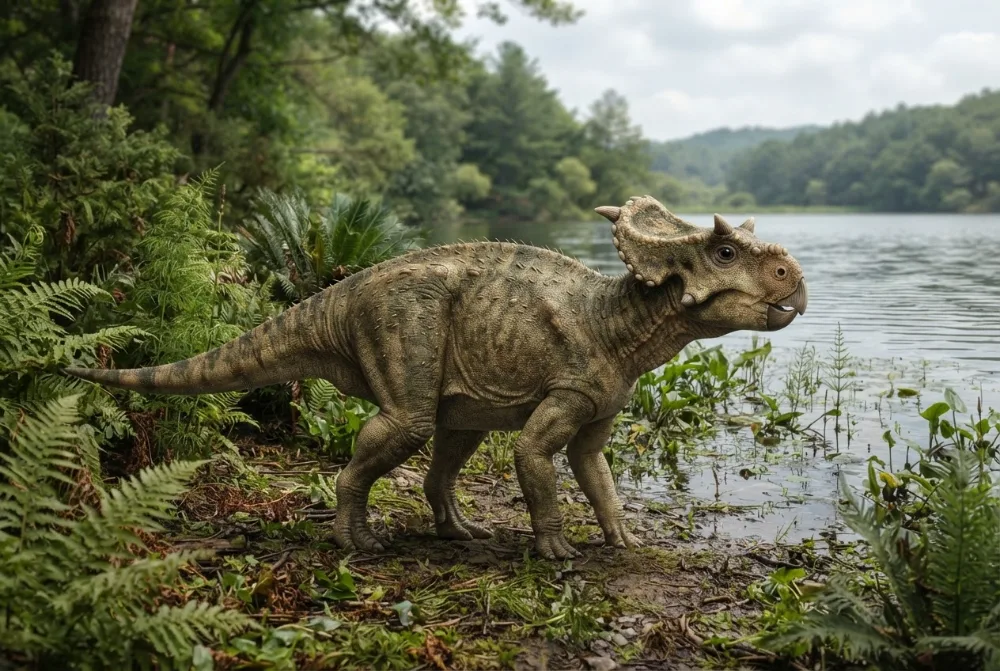
Koreaceratops was a small, plant-eating dinosaur that lived in South Korea during the Early Cretaceous. It had a beak like a parrot and walked on two legs, but scientists think it might have been a good swimmer too!12
Yaphila nini?
Yayinkulu kangakanani?
Yayinde kangakanani?
 inde njengeekati zasekhaya ezingama-2.5, impumlo ukuya emsileni🍌inde njengeebhanana ezingama-7 zilandelelana🏃ibinokubaleka iimitha ezili-100 ngemizuzwana engama-10 (oyena mntu ukhawulezayo udinga i-9,6)
Koreaceratops wayemkhulu kangakanani xa ethelekiswa NAWE?
Yimathematika nje kwibhrawuza yakho. Akukho nto igcinwayo okanye ithunyelwe naphi na.
Yayikhawuleza kangakanani?


Iinyani ezimnandi
Koreaceratops had very tall spines on its tail bones, some over five times the height of the bone they attached to.12
Scientists think those tall tail spines might have helped Koreaceratops swim, like a paddle or a fin.12
The only known fossil of Koreaceratops was found in a sandstone block that had been used to build a dam.1
The type specimen was about eight years old when it died and had not yet reached full size or maturity.1
Koreaceratops lived in a semiarid environment, like a dry or dusty landscape.1
Eyona mibuzo ibuzwa kakhulu: Koreaceratops
?How big was Koreaceratops?
About 1.3 metres (4.3 feet) long, based on an estimate by paleontologist Thomas Holtz.1
?Could Koreaceratops swim?
Maybe! Scientists think its very tall tail spines might have helped it swim like a paddle, but the evidence is not certain.31
?What did Koreaceratops eat?
Koreaceratops was a plant-eater, like other ceratopsian dinosaurs.1
Kwiingcali zeedayinaso
- Igama lenzululwazi
- Koreaceratops
- Inikwe igama ngu:
- Lee et al. 20104
- Iqela
- Iidayinaso ezineempondo
- Usapho / iclade
- Leptoceratopsidae4
- Ukuhlelwa
- Ornithischia > Ceratopsia4
- Ubudala bamatye
- 113 ukuya ku-100 izigidi zeminyaka (Albian)4
- Izakhiwo zamatye
- Tando beds4
- Amazwe
- uMzantsi Korea4
- Iirekhodi zeefosili
- 1 kwi-Paleobiology Database4
- Ukufunyanwa
- Koreaceratops was named in 2011 by Yuong-Nam Lee and colleagues. The fossil was first noticed by a public official in 2008, after it had been built into a dam in Hwaseong City, South Korea.1
- Kusaxoxwa ngayo
- Scientists are not sure exactly where Koreaceratops fits on the ceratopsian family tree. Some studies place it near Archaeoceratops, while a 2022 study suggests it is closer to Protoceratops.1
Apho iinyani zivela khona
- Koreaceratops (en.wikipedia.org)
- The first ceratopsian dinosaur from South Korea - Seoul National University (snu.elsevierpure.com)
- Koreaceratops—A Swimming Ceratopsian? (smithsonianmag.com)
- Koreaceratops in The Paleobiology Database (CC BY 4.0): ubudala, iindawo, izakhiwo zamatye, ukuhlelwa.
Yonke inyani ekweli phepha inenombolo ebonisa umthombo wayo. Ukuba siphosisile, uxolo, sithanda iidayinaso, asiyojenali yenzululwazi. Sixelele apha: [email protected], siya kuyilungisa.
 URex ulambile! I-Dino Wiki yiprojekthi katata ukwenzela unyana wakhe othanda iidayinaso, isimahla, ayinazintengiso, ayinazilandeli. Abantu abadala banokuphakela uRex isidlwana ukuze incede ihlale kwi-intanethi.Phakela uRex
 Triceratops
 Protoceratops
 Ojoceratops
 Tatankaceratops
 Psittacosaurus
 Centrosaurus
 Stegosaurus
 Iguanodon
 Archaeopteryx
 Giganotosaurus
 Microraptor
 Deinonychus