 Uyiyiphi idayinaso? Ikwizi
 Idabi leedayinaso
 Ugqatso lweedayinaso
 Imidlalo emincinci yeedayinaso
 I-albhamu yezitikha
 Iilisti ze-TOP zeedayinaso
 Ndothuse!
Libonectes
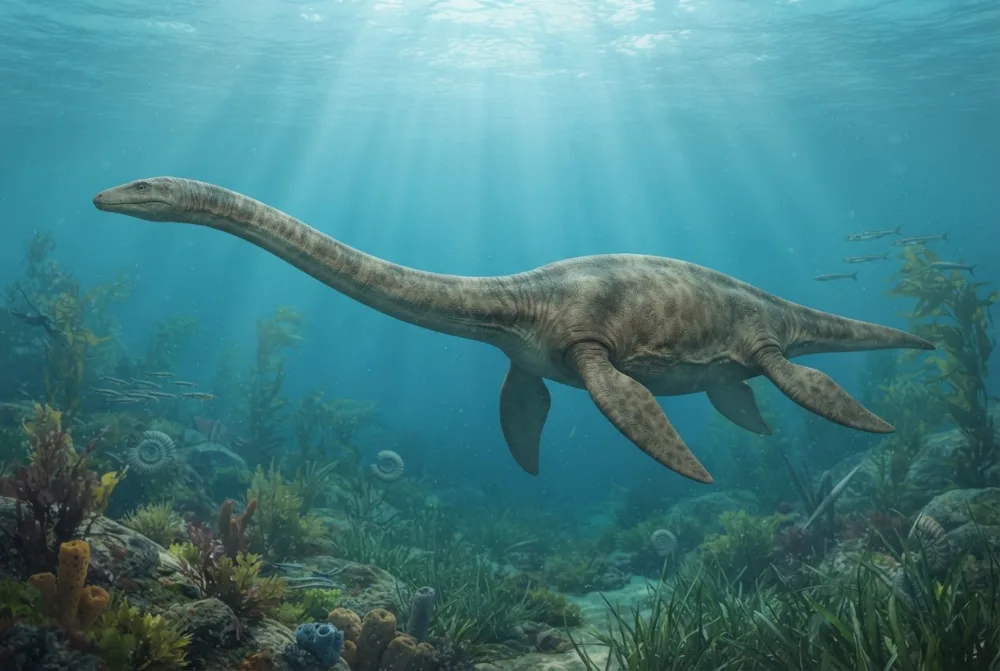
Libonectes was a long-necked marine reptile that swam in warm seas during the time of the dinosaurs. It used its strong flippers to paddle through the water and may have swallowed fish and ammonites whole. Fossils show it had a skull that is one of the best preserved of any elasmosaurid plesiosaur.1
Yaphila nini?
Yayinkulu kangakanani?
Yayinde kangakanani?
 inde njengezinja ezingama-7, impumlo ukuya emsileni🍌inde njengeebhanana ezingama-40 zilandelelana🏊ibinokuqubha ubude bechibi elikhulu lokuqubha (50 m) ngemizuzwana engama-7.2
Libonectes wayemkhulu kangakanani xa ethelekiswa NAWE?
Yimathematika nje kwibhrawuza yakho. Akukho nto igcinwayo okanye ithunyelwe naphi na.
Yayikhawuleza kangakanani?


Iinyani ezimnandi
Libonectes had a neck that was 5.06 metres (16.6 feet) long, more than two-thirds of its total body length.1
The first fossils were found by a farmer named T.W. Tidwell in the late 1930s in Texas.1
Its skull is the best preserved skull of any elasmosaurid plesiosaur ever found.1
Libonectes lived about 93 million years ago, during the Late Cretaceous period.3
It was originally named Elasmosaurus morgani in 1949, but was given its own genus, Libonectes, in 1997.1
Gastroliths (stomach stones) have been found inside Libonectes fossils, which may have helped it digest food or control its buoyancy in the water.1
Libonectes probably swam slowly and used its large size to trap prey.1
Eyona mibuzo ibuzwa kakhulu: Libonectes
?How big was Libonectes?
Libonectes was a medium-sized plesiosaur, about 7.2 metres (24 feet) long. Its neck alone was 5.06 metres (16.6 feet) long.1
?What did Libonectes eat?
Libonectes probably ate small fish and ammonites. It may have swallowed prey whole and used stomach stones to help digest food.1
Inyaniso ngeentsomi
Intsomi: Some people think plesiosaurs like Libonectes could lift their heads and necks high out of the water like a swan.
Inyaniso: Scientists now believe their necks were not flexible enough to lift high above the water. They probably held their necks more horizontally while swimming.1
Kwiingcali zeedayinaso
- Igama lenzululwazi
- Libonectes
- Inikwe igama ngu:
- Carpenter 19973
- Iqela
- Iiplesiosauri
- Usapho / iclade
- Elasmosauridae3
- Ukuhlelwa
- Plesiosauria > Elasmosauridae > Sauropterygia3
- Ubudala bamatye
- 100 ukuya ku-90 izigidi zeminyaka (Cenomanian / Turonian)3
- Izakhiwo zamatye
- Britton, Akrabou3
- Amazwe
- iUSA, iMorocco3
- Iirekhodi zeefosili
- 2 kwi-Paleobiology Database3
- Ukufunyanwa
- The first Libonectes fossils were found by tenant farmer T.W. Tidwell in the late 1930s in Texas. Charles Gill Morgan prepared the fossils, and the species was named Elasmosaurus morgani by Welles in 1949. It was reclassified as its own genus Libonectes by Carpenter in 1997.1
- Kusaxoxwa ngayo
- Scientists are not sure whether Libonectes was a pure carnivore or an omnivore, because gastroliths could indicate plant eating or just buoyancy control.1
Apho iinyani zivela khona
- Libonectes (en.wikipedia.org)
- Libonectes morgani, an elasmosaur with transatlantic dispersal (sachspal.de)
- Libonectes in The Paleobiology Database (CC BY 4.0): ubudala, iindawo, izakhiwo zamatye, ukuhlelwa.
Yonke inyani ekweli phepha inenombolo ebonisa umthombo wayo. Ukuba siphosisile, uxolo, sithanda iidayinaso, asiyojenali yenzululwazi. Sixelele apha: [email protected], siya kuyilungisa.
 URex ulambile! I-Dino Wiki yiprojekthi katata ukwenzela unyana wakhe othanda iidayinaso, isimahla, ayinazintengiso, ayinazilandeli. Abantu abadala banokuphakela uRex isidlwana ukuze incede ihlale kwi-intanethi.Phakela uRex
 Elasmosaurus
 Pliosaurus
 Plesiosaurus
 Cimoliasaurus
 Colymbosaurus
 Trinacromerum
 Tyrannosaurus
 Triceratops
 Velociraptor
 Spinosaurus
 Ankylosaurus
 Parasaurolophus