 Uyiyiphi idayinaso? Ikwizi
 Idabi leedayinaso
 Ugqatso lweedayinaso
 Imidlalo emincinci yeedayinaso
 I-albhamu yezitikha
 Iilisti ze-TOP zeedayinaso
 Ndothuse!
Lusonectes
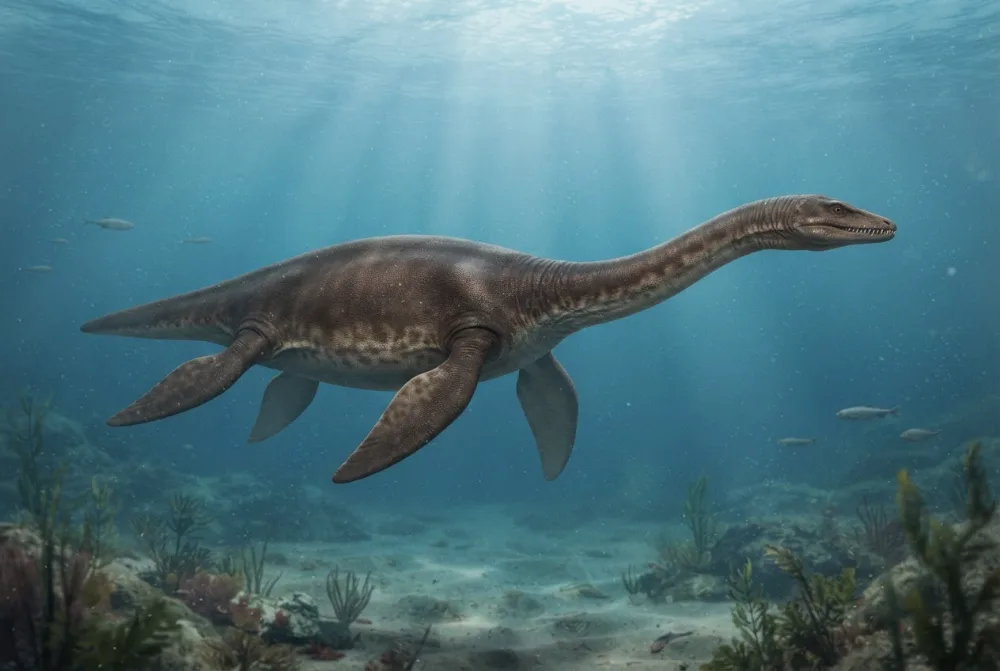
Lusonectes was a marine reptile that swam in the warm Jurassic seas near what is now Portugal. It had a long snout and sharp teeth to catch fish and other slippery prey.2
Yaphila nini?
Yayikhawuleza kangakanani?


Iinyani ezimnandi
Lusonectes is the only plesiosaur from Portugal that scientists can identify as a distinct species.1
Its name comes from Latin and Greek words meaning 'Portuguese swimmer'.1
The only fossil found is a partial skull, which is about 127 millimeters (5 inches) long.1
Lusonectes lived about 184 to 175 million years ago, during the Early Jurassic period.3
It was first described in 1897 by French paleontologist Henri Émile Sauvage, who thought it was a Plesiosaurus.2
Lusonectes is one of the few plesiosaurs from the Early Jurassic found outside the United Kingdom and Germany.2
Kwiingcali zeedayinaso
- Igama lenzululwazi
- Lusonectes
- Inikwe igama ngu:
- Smith et al. 20123
- Iqela
- Iiplesiosauri
- Usapho / iclade
- Plesiosauridae3
- Ukuhlelwa
- Plesiosauria > Sauropterygia3
- Ubudala bamatye
- 184 ukuya ku-175 izigidi zeminyaka (Toarcian)3
- Izakhiwo zamatye
- São Gião3
- Amazwe
- iPortugal3
- Iirekhodi zeefosili
- 1 kwi-Paleobiology Database3
- Ukufunyanwa
- The fossil was first described in 1897 by French paleontologist Henri Émile Sauvage, who called it Plesiosaurus sp. In 2012, scientists Smith, Araújo, and Mateus gave it the new name Lusonectes sauvagei.2
- Kusaxoxwa ngayo
- Scientists are not sure whether Lusonectes was an early pliosaurid or a plesiosauroid, because the only fossil is a poorly preserved partial skull.2
Apho iinyani zivela khona
- A new plesiosauroid from the Toarcian (Lower Jurassic) (app.pan.pl)
- The osteology, taxonomy, and phylogenetic affinities of the Early Jurassic plesiosaur Lusonectes sauvagei - PMC (pmc.ncbi.nlm.nih.gov)
- Lusonectes in The Paleobiology Database (CC BY 4.0): ubudala, iindawo, izakhiwo zamatye, ukuhlelwa.
Yonke inyani ekweli phepha inenombolo ebonisa umthombo wayo. Ukuba siphosisile, uxolo, sithanda iidayinaso, asiyojenali yenzululwazi. Sixelele apha: [email protected], siya kuyilungisa.
 URex ulambile! I-Dino Wiki yiprojekthi katata ukwenzela unyana wakhe othanda iidayinaso, isimahla, ayinazintengiso, ayinazilandeli. Abantu abadala banokuphakela uRex isidlwana ukuze incede ihlale kwi-intanethi.Phakela uRex
 Elasmosaurus
 Pliosaurus
 Plesiosaurus
 Cimoliasaurus
 Colymbosaurus
 Trinacromerum
 Dilophosaurus
 Stenopterygius
 Dorygnathus
 Lufengosaurus
 Scutellosaurus
 Yunnanosaurus