 Uyiyiphi idayinaso? Ikwizi
 Idabi leedayinaso
 Ugqatso lweedayinaso
 Imidlalo emincinci yeedayinaso
 I-albhamu yezitikha
 Iilisti ze-TOP zeedayinaso
 Ndothuse!
Yaphila nini?

Yayinkulu kangakanani?
Yayinde kangakanani?
Yayiphakame kangakanani?
uqikelelo
Yayinzima kangakanani?
Manidens wayemkhulu kangakanani xa ethelekiswa NAWE?
Yimathematika nje kwibhrawuza yakho. Akukho nto igcinwayo okanye ithunyelwe naphi na.
Yayikhawuleza kangakanani?


Iinyani ezimnandi
Manidens lived during the Middle Jurassic, about 171 to 167 million years ago, in a time when South America had many lakes and forests.1
Its name comes from the Latin words for 'hand' and 'tooth' because its last tooth looked like a tiny hand with fingers.1
Manidens is a heterodontosaurid, a group of small ornithischian dinosaurs that often had different types of teeth for different jobs.1
The only known skeleton of Manidens includes parts of the skull, jaws, backbone, shoulder, and hips, but not the tail or legs.1
Scientists think Manidens shows an intermediate step in the evolution of plant-eating: it had high tooth crowns but not the heavy wear facets that later relatives had.1
Manidens was one of the few ornithischian dinosaurs known from the Jurassic of South America, making it a rare find.1
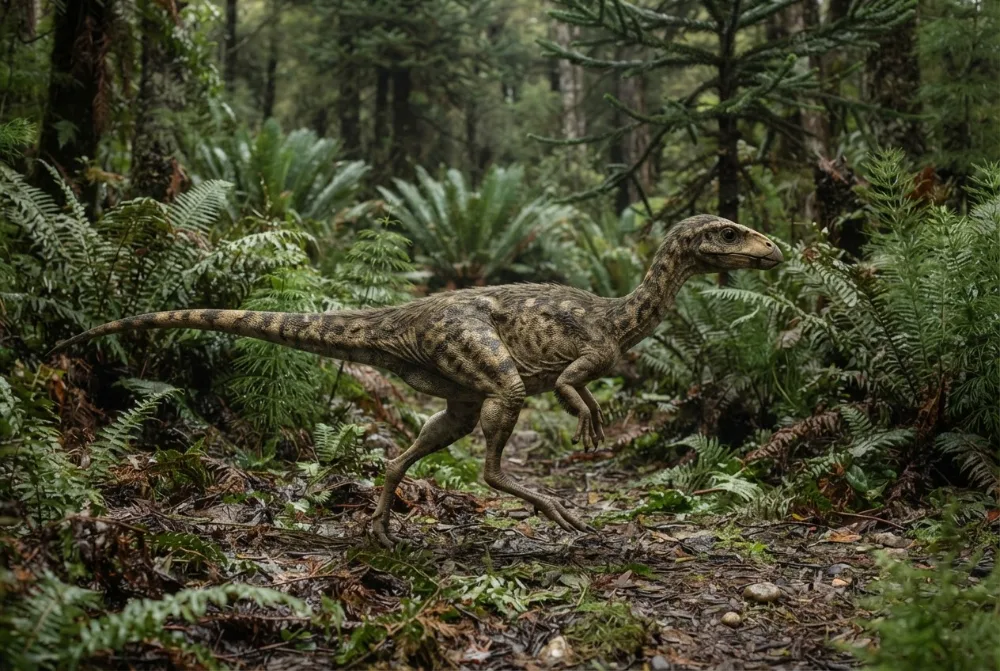
Eyona mibuzo ibuzwa kakhulu: Manidens
?How big was Manidens?
Manidens was about 60 cm (2.0 ft) long and weighed around 500 g (1.1 lb), smaller than later heterodontosaurids.2
?What did Manidens eat?
Manidens was a plant-eater. It had high-crowned teeth for chewing plants, but it lacked the heavy wear facets seen in more advanced relatives.21
?When did Manidens live?
Manidens lived during the Early Jurassic, about 179 to 178 million years ago, in what is now Argentina.2
?Did Manidens have feathers?
Scientists think it might have. A close relative called Tianyulong had filamentous structures, so Manidens may have had them too.2
Kwiingcali zeedayinaso
- Igama lenzululwazi
- Manidens
- Inikwe igama ngu:
- Pol et al. 20113
- Iqela
- Izitya-zityalo ezinemilomo
- Usapho / iclade
- Heterodontosauridae3
- Ukuhlelwa
- Ornithischia > Heterodontosauridae3
- Ubudala bamatye
- 184 ukuya ku-171 izigidi zeminyaka (Toarcian / Aalenian)3
- Izakhiwo zamatye
- Cañadón Asfalto3
- Amazwe
- i-Argentina3
- Iirekhodi zeefosili
- 2 kwi-Paleobiology Database3
- Ukufunyanwa
- Manidens was named in 2011 by Diego Pol, Oliver Rauhut, and Marcos Becerra. The fossils were found at the Queso Rallado site near Cerro Cóndor, Argentina, in the Cañadón Asfalto Formation.13
- Kusaxoxwa ngayo
- Scientists are still debating exactly how Manidens chewed its food, since its teeth were high and close together but lacked the heavy wear seen in more advanced plant-eaters.1
Apho iinyani zivela khona
- A Middle Jurassic heterodontosaurid dinosaur from Patagonia and the evolution of heterodontosaurids (staff.mef.org.ar)
- Manidens (en.wikipedia.org)
- Manidens in The Paleobiology Database (CC BY 4.0): ubudala, iindawo, izakhiwo zamatye, ukuhlelwa.
Yonke inyani ekweli phepha inenombolo ebonisa umthombo wayo. Ukuba siphosisile, uxolo, sithanda iidayinaso, asiyojenali yenzululwazi. Sixelele apha: [email protected], siya kuyilungisa.
 URex ulambile! I-Dino Wiki yiprojekthi katata ukwenzela unyana wakhe othanda iidayinaso, isimahla, ayinazintengiso, ayinazilandeli. Abantu abadala banokuphakela uRex isidlwana ukuze incede ihlale kwi-intanethi.Phakela uRex
 Iguanodon
 Tenontosaurus
 Thescelosaurus
 Zalmoxes
 Camptosaurus
 Rhabdodon
 Dilophosaurus
 Stenopterygius
 Dorygnathus
 Lufengosaurus
 Scutellosaurus
 Yunnanosaurus