 Uyiyiphi idayinaso? Ikwizi
 Idabi leedayinaso
 Ugqatso lweedayinaso
 Imidlalo emincinci yeedayinaso
 I-albhamu yezitikha
 Iilisti ze-TOP zeedayinaso
 Ndothuse!
Martinectes
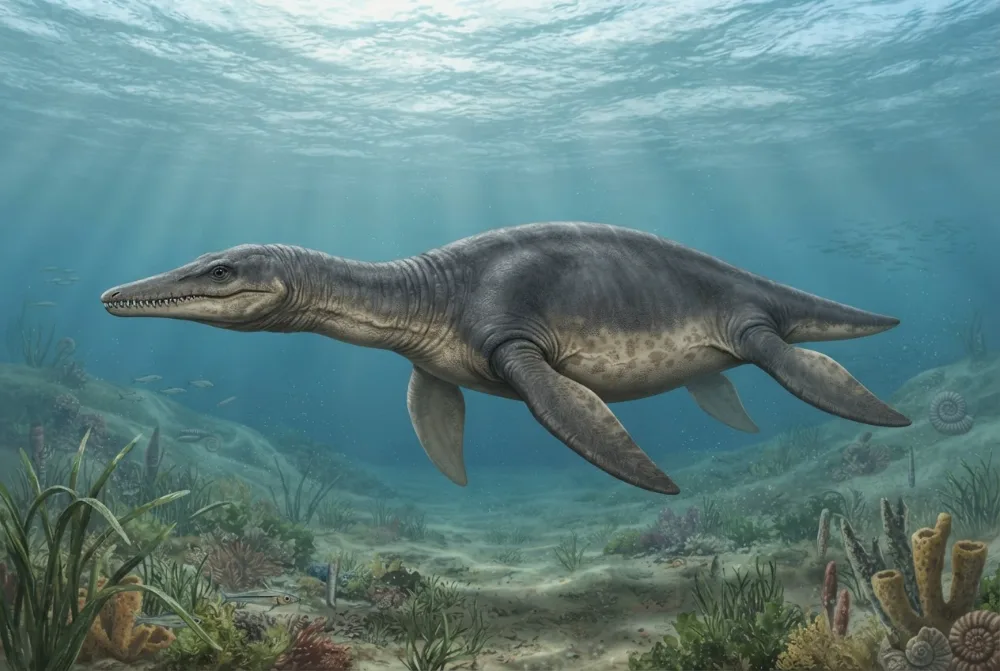
Martinectes was a small, fast-swimming marine reptile that lived in the shallow seas of North America during the time of the dinosaurs. It had a short neck, a long snout, and four big flippers that helped it chase after fish and squid.1
Yaphila nini?
Yayinkulu kangakanani?
Yayinde kangakanani?
Yayinzima kangakanani?
 inde njengezinja ezingama-2.5, impumlo ukuya emsileni🍌inde njengeebhanana ezingama-14 zilandelelana🍉inzima njengamavatala angama-250🧸inzima njengabantwana basenkulisa abangama-67🎒inzima njengabantwana besikolo abangama-40🐻❄️inzima njengeebhere ezimhlophe ezingama-3🏊ibinokuqubha ubude bechibi elikhulu lokuqubha (50 m) ngemizuzwana engama-6.9
Martinectes wayemkhulu kangakanani xa ethelekiswa NAWE?
Yimathematika nje kwibhrawuza yakho. Akukho nto igcinwayo okanye ithunyelwe naphi na.
Yayikhawuleza kangakanani?


Iinyani ezimnandi
Martinectes was one of the smallest adult polycotylid plesiosaurs ever found, measuring only about 2.3 to 2.6 metres long.1
It had large eyes with a bony ledge above them, which may have shaded its eyes from sunlight while hunting near the water's surface.1
Martinectes lived about 80 million years ago in the Western Interior Seaway, a huge ocean that split North America in two.1
Its name means 'Martin's swimmer', honoring the person who helped discover its fossils.1
Martinectes was originally thought to be a species of Dolichorhynchops, but scientists gave it its own genus in 2024.1
It had unusually wide bones in its spine and a very short back part of its skull, which helped scientists tell it apart from other plesiosaurs.1
Eyona mibuzo ibuzwa kakhulu: Martinectes
?How big was Martinectes?
Martinectes was a large polycotylid plesiosaur, measuring at least around 5 metres (16 ft) long. Some estimates suggest it could reach up to 6 to 7 metres (20 to 23 ft), while a 2026 estimate put it at about 4.95 metres (16.2 ft) long.2
?Was Martinectes a dinosaur?
No, Martinectes was a plesiosaur, a marine reptile that lived in the seas during the time of the dinosaurs. It was not a dinosaur.2
?What did Martinectes eat?
Martinectes likely chased after fish and squid, using its long snout and four big flippers to swim fast. Its small teeth and narrow jaws suggest it ate small, slippery prey.2
Kwiingcali zeedayinaso
- Igama lenzululwazi
- Martinectes
- Inikwe igama ngu:
- Clark et al. 20243
- Iqela
- Iiplesiosauri
- Usapho / iclade
- Polycotylidae3
- Ukuhlelwa
- Plesiosauria > Sauropterygia3
- Ubudala bamatye
- 84 ukuya ku-72 izigidi zeminyaka (Campanian)3
- Izakhiwo zamatye
- Pierre Shale, Taylor Marl3
- Amazwe
- iUSA3
- Iirekhodi zeefosili
- 3 kwi-Paleobiology Database3
- Ukufunyanwa
- Martinectes was named in 2024 by Robert O. Clark, F. Robin O'Keefe, and Sara E. Slack. They studied fossils that had been found in Wyoming and South Dakota, USA, and realized they belonged to a new genus.31
- Kusaxoxwa ngayo
- Scientists are still debating exactly how Martinectes used its unusual eye ledges and wide skull for hunting.1
Apho iinyani zivela khona
- A new genus of small polycotylid plesiosaur from the Upper Cretaceous of the Western Interior Seaway and a clarification of the genus Dolichorhynchops (sciencedirect.com)
- Martinectes (en.wikipedia.org)
- Martinectes in The Paleobiology Database (CC BY 4.0): ubudala, iindawo, izakhiwo zamatye, ukuhlelwa.
Yonke inyani ekweli phepha inenombolo ebonisa umthombo wayo. Ukuba siphosisile, uxolo, sithanda iidayinaso, asiyojenali yenzululwazi. Sixelele apha: [email protected], siya kuyilungisa.
 URex ulambile! I-Dino Wiki yiprojekthi katata ukwenzela unyana wakhe othanda iidayinaso, isimahla, ayinazintengiso, ayinazilandeli. Abantu abadala banokuphakela uRex isidlwana ukuze incede ihlale kwi-intanethi.Phakela uRex
 Elasmosaurus
 Pliosaurus
 Plesiosaurus
 Cimoliasaurus
 Colymbosaurus
 Trinacromerum
 Tyrannosaurus
 Triceratops
 Velociraptor
 Spinosaurus
 Ankylosaurus
 Parasaurolophus