 Uyiyiphi idayinaso? Ikwizi
 Idabi leedayinaso
 Ugqatso lweedayinaso
 Imidlalo emincinci yeedayinaso
 I-albhamu yezitikha
 Iilisti ze-TOP zeedayinaso
 Ndothuse!
Megapterygius
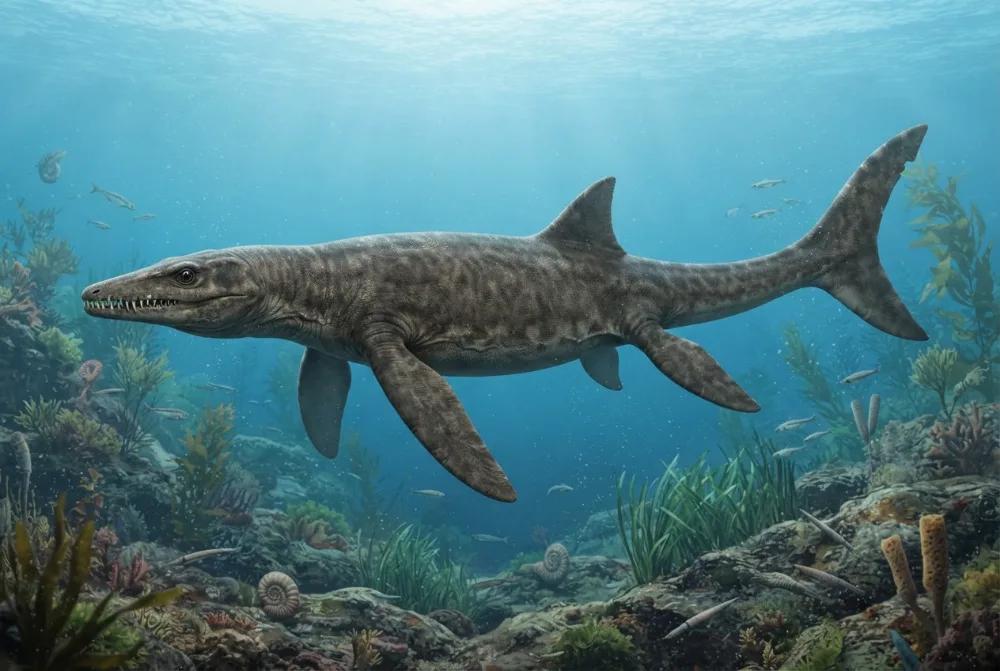
Megapterygius was a huge marine lizard that swam in the seas around Japan 72 million years ago. It had enormous flippers that were longer than its head, and scientists think it even had a dorsal fin like a shark!12
Yaphila nini?
Yayinkulu kangakanani?
Yayinde kangakanani?
Yayinzima kangakanani?
 inde njengezinja ezingama-6, impumlo ukuya emsileni🍌inde njengeebhanana ezingama-33 zilandelelana🍉inzima njengamavatala angama-90🧸inzima njengabantwana basenkulisa abangama-24🎒inzima njengabantwana besikolo abangama-14🏊ibinokuqubha ubude bechibi elikhulu lokuqubha (50 m) ngemizuzwana engama-4.7
Megapterygius wayemkhulu kangakanani xa ethelekiswa NAWE?
Yimathematika nje kwibhrawuza yakho. Akukho nto igcinwayo okanye ithunyelwe naphi na.
Yayikhawuleza kangakanani?


Iinyani ezimnandi
Megapterygius had rear flippers that were even longer than its front flippers, a feature only seen in one other mosasaur, Tylosaurus.1
Its flippers were longer than its skull, which is unique among mosasaurs with paddle-like limbs.1
The shape of its backbone suggests it had a dorsal fin, like a dolphin or shark, which would have helped it turn quickly in the water.12
Its skull was slightly wide around the eye sockets, giving it binocular vision that helped it hunt prey. This is only the second mosasaur known to have this ability.1
The fossil was found in 2006 by Akihiro Misaki, who was actually looking for ammonite fossils when he spotted a vertebra.12
More than 100 shark teeth were found around the Megapterygius skeleton, suggesting that sharks scavenged its body after it died.1
Megapterygius is the most complete mosasaur skeleton ever found in Japan or the northwestern Pacific.2
Eyona mibuzo ibuzwa kakhulu: Megapterygius
?How big was Megapterygius?
Megapterygius was about 6 metres long, with a skull about 0.8 metres long. That is roughly the size of a large great white shark.12
?Did Megapterygius have a dorsal fin?
Scientists think it did. The shape of its backbone is like that of dolphins and porpoises, which have dorsal fins, and this would have helped it turn quickly in the water. It's the first mosasaur with evidence of a dorsal fin.12
?What did Megapterygius eat?
Scientists think it hunted large groups of small prey, like schools of fish. Its binocular vision and big flippers would have helped it catch them.1
Kwiingcali zeedayinaso
- Igama lenzululwazi
- Megapterygius
- Inikwe igama ngu:
- Konishi et al. 20234
- Iqela
- Iimosasauri
- Usapho / iclade
- Mosasauridae4
- Ukuhlelwa
- Mosasauroidea4
- Ubudala bamatye
- 84 ukuya ku-66 izigidi zeminyaka (Campanian / Maastrichtian)4
- Izakhiwo zamatye
- Toyajo4
- Amazwe
- iJapan4
- Iirekhodi zeefosili
- 1 kwi-Paleobiology Database4
- Ukufunyanwa
- The fossil was discovered in 2006 by Akihiro Misaki in Wakayama Prefecture, Japan. It was named Megapterygius wakayamaensis by Takuya Konishi and colleagues in 2023.12
- Kusaxoxwa ngayo
- Scientists are still debating how Megapterygius used its four large flippers and tail fin together for swimming, since no modern animal has a similar body shape.2
Apho iinyani zivela khona
- Megapterygius (en.wikipedia.org)
- UC paleontologist describes Wakayama 'blue dragon' that ruled prehistoric waters off Japan - University of Cincinnati: Founder of Co-op, Leader in Co-op | University of Cincinnati (uc.edu)
- Megapterygius | Dino Encyclopedia (dinosaurmuseum.jp)
- Megapterygius in The Paleobiology Database (CC BY 4.0): ubudala, iindawo, izakhiwo zamatye, ukuhlelwa.
Yonke inyani ekweli phepha inenombolo ebonisa umthombo wayo. Ukuba siphosisile, uxolo, sithanda iidayinaso, asiyojenali yenzululwazi. Sixelele apha: [email protected], siya kuyilungisa.
 URex ulambile! I-Dino Wiki yiprojekthi katata ukwenzela unyana wakhe othanda iidayinaso, isimahla, ayinazintengiso, ayinazilandeli. Abantu abadala banokuphakela uRex isidlwana ukuze incede ihlale kwi-intanethi.Phakela uRex
 Mosasaurus
 Prognathodon
 Tylosaurus
 Platecarpus
 Clidastes
 Globidens
 Tyrannosaurus
 Triceratops
 Velociraptor
 Spinosaurus
 Ankylosaurus
 Parasaurolophus