 Uyiyiphi idayinaso? Ikwizi
 Idabi leedayinaso
 Ugqatso lweedayinaso
 Imidlalo emincinci yeedayinaso
 I-albhamu yezitikha
 Iilisti ze-TOP zeedayinaso
 Ndothuse!
Ophthalmosaurus
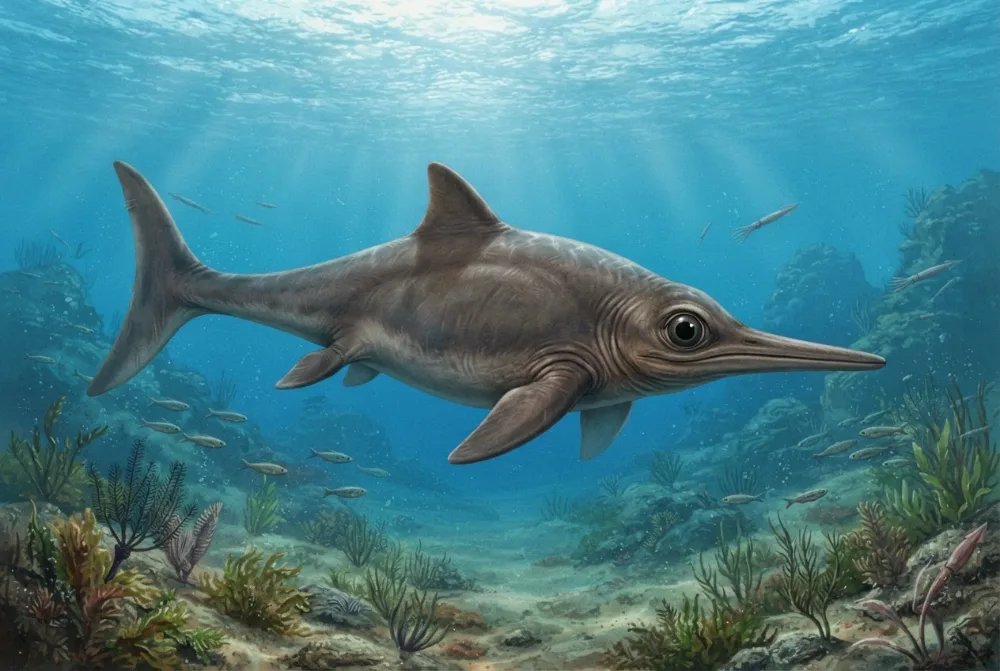
Ophthalmosaurus was a sleek, fast-swimming marine reptile with enormous eyes, almost as big as dinner plates. It lived in the warm seas of the Jurassic period and hunted small fish and squid. Even though it looked like a dolphin, it was actually an ichthyosaur, not a dinosaur.1
Yaphila nini?
Yayinkulu kangakanani?
Yayinde kangakanani?
Yayinzima kangakanani?
 inde njengezinja ezingama-4, impumlo ukuya emsileni🍌inde njengeebhanana ezingama-22 zilandelelana🍉inzima njengamavatala angama-190🧸inzima njengabantwana basenkulisa abangama-50🎒inzima njengabantwana besikolo abangama-30🐻❄️inzima njengeebhere ezimhlophe ezingama-2🏊ibinokuqubha ubude bechibi elikhulu lokuqubha (50 m) ngemizuzwana engama-4
Ophthalmosaurus wayemkhulu kangakanani xa ethelekiswa NAWE?
Yimathematika nje kwibhrawuza yakho. Akukho nto igcinwayo okanye ithunyelwe naphi na.
Yayikhawuleza kangakanani?


Iinyani ezimnandi
Ophthalmosaurus had eyes that measured about 22 to 23 centimetres (8.7 to 9.1 inches) across, which is bigger than a human head.1
It could dive to depths of 600 metres (2,000 feet) or more, reaching the twilight zone of the ocean, and stay underwater for about 20 minutes.1
Its tail ended in a two-lobed fin, with the lower half supported by the backbone and the upper half made only of soft tissue, helping it swim fast.1
Ophthalmosaurus had short, rounded limbs, with the front ones bigger than the back ones, which it used for steering rather than paddling.1
Fossils show it lived in shallow seas, like the Oxford Clay in England, which was only about 50 metres (160 feet) deep at the time.1
Some scientists think Ophthalmosaurus could swim at about 2 metres per second (6.6 feet per second) when chasing prey.1
Inyaniso ngeentsomi
Intsomi: Ophthalmosaurus was a dinosaur that lived in the water.
Inyaniso: Ophthalmosaurus was an ichthyosaur, a marine reptile, not a dinosaur. Ichthyosaurs were a different group of reptiles that lived in the oceans.1
Kwiingcali zeedayinaso
- Igama lenzululwazi
- Ophthalmosaurus
- Inikwe igama ngu:
- Seeley 18742
- Iqela
- Ii-ichthyosauri
- Usapho / iclade
- Ophthalmosauridae2
- Ukuhlelwa
- Ichthyosauria > Ichthyosauromorpha2
- Ubudala bamatye
- 201 ukuya ku-133 izigidi zeminyaka (Hettangian / Valanginian)2
- Izakhiwo zamatye
- Oxford Clay, Sundance, Vaca Muerta2
- Amazwe
- iUnited Kingdom, i-Argentina, iUSA, iRashiya, iFransi, iGreenland2
- Iirekhodi zeefosili
- 27 kwi-Paleobiology Database2
- Ikwaziwa ngokuba
- Ancanamunia, Yasykovia (amagama amadala ngoku abalwa njengesilwanyana esinye)2
- Ukufunyanwa
- Ophthalmosaurus was first described by Harry Seeley in 1874, based on fossils from the Oxford Clay in England. He focused on the shape of the collarbone bones.12
- Kusaxoxwa ngayo
- Scientists still debate whether some species, like Ophthalmosaurus natans from North America, are really separate species or just close relatives.1
Apho iinyani zivela khona
- Ophthalmosaurus (en.wikipedia.org)
- Ophthalmosaurus in The Paleobiology Database (CC BY 4.0): ubudala, iindawo, izakhiwo zamatye, ukuhlelwa.
Yonke inyani ekweli phepha inenombolo ebonisa umthombo wayo. Ukuba siphosisile, uxolo, sithanda iidayinaso, asiyojenali yenzululwazi. Sixelele apha: [email protected], siya kuyilungisa.
 URex ulambile! I-Dino Wiki yiprojekthi katata ukwenzela unyana wakhe othanda iidayinaso, isimahla, ayinazintengiso, ayinazilandeli. Abantu abadala banokuphakela uRex isidlwana ukuze incede ihlale kwi-intanethi.Phakela uRex
 Ichthyosaurus
 Platypterygius
 Stenopterygius
 Khudiakovia
 Chonespondylus
 Cymbospondylus
 Pterodactylus
 Peloneustes
 Rhamphocephalus
 Gongbusaurus
 Shunosaurus
 Bishanopliosaurus