 Uyiyiphi idayinaso? Ikwizi
 Idabi leedayinaso
 Ugqatso lweedayinaso
 Imidlalo emincinci yeedayinaso
 I-albhamu yezitikha
 Iilisti ze-TOP zeedayinaso
 Ndothuse!
Yaphila nini?

Yayinkulu kangakanani?
Yayinde kangakanani?
Yayiphakame kangakanani?
uqikelelo
Yayinzima kangakanani?
 inde njengezinja ezingama-2.5, impumlo ukuya emsileni🍌inde njengeebhanana ezingama-14 zilandelelana
 inzima njengeekati zasekhaya ezingama-12🍉inzima njengamavatala angama-10🧸inzima njengabantwana basenkulisa abangama-2.5🎒inzima njengabantwana besikolo abangama-1.5🏃ibinokubaleka iimitha ezili-100 ngemizuzwana engama-8 (oyena mntu ukhawulezayo udinga i-9,6)
Orodromeus wayemkhulu kangakanani xa ethelekiswa NAWE?
Yimathematika nje kwibhrawuza yakho. Akukho nto igcinwayo okanye ithunyelwe naphi na.
Yayikhawuleza kangakanani?


Iinyani ezimnandi
Orodromeus was discovered at a site called Egg Mountain, which was a nesting colony of the much larger dinosaur Maiasaura.1
The first fossils were found by Robert Makela, and the dinosaur was named after him: Orodromeus makelai.1
Some eggs once thought to belong to Orodromeus are now believed to be from a troodontid dinosaur, like Stenonychosaurus.1
Orodromeus embryos had well-developed bones and teeth, suggesting the babies could walk and feed themselves soon after hatching.1
This dinosaur may have dug burrows, like its relative Oryctodromeus, because its bones have been found in places where they would not normally be scattered.1
Orodromeus lived alongside predators like Daspletosaurus and the horned dinosaur Einiosaurus.1
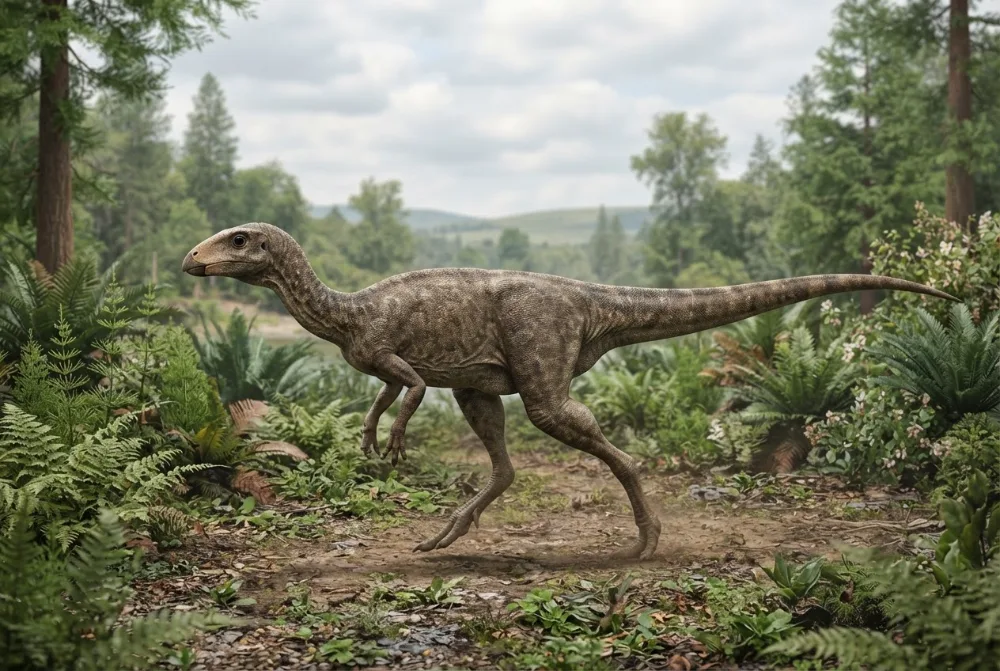
Eyona mibuzo ibuzwa kakhulu: Orodromeus
?How big was Orodromeus?
About 2.5 metres (8.2 feet) long. That is roughly the size of a large dog.12
?What did Orodromeus eat?
It was a plant-eater. It used its horny beak and grinding cheek teeth to eat tough plant material, and it probably fed on plants no higher than 1 metre (3.3 feet) off the ground.12
?When did Orodromeus live?
It lived during the Late Cretaceous Period, about 75 million years ago, in what is now Montana, USA.12
?How fast could Orodromeus run?
Nobody knows for sure, but its name means 'mountain runner' and it was built for running on two legs. It was probably very quick.12
?Did Orodromeus dig burrows?
Maybe. Scientists think it may have dug burrows like its relative Oryctodromeus, because its bones are sometimes found packed together in ways that suggest burrowing.1
Kwiingcali zeedayinaso
- Igama lenzululwazi
- Orodromeus
- Inikwe igama ngu:
- Horner and Weishampel 19883
- Iqela
- Izitya-zityalo ezinemilomo
- Usapho / iclade
- Thescelosauridae3
- Ukuhlelwa
- Ornithischia3
- Ubudala bamatye
- 84 ukuya ku-66 izigidi zeminyaka (Campanian / Maastrichtian)3
- Izakhiwo zamatye
- Two Medicine, Hell Creek, Judith River3
- Amazwe
- iUSA3
- Iirekhodi zeefosili
- 9 kwi-Paleobiology Database3
- Ukufunyanwa
- Orodromeus was named by Jack Horner and David Weishampel in 1988. The first fossils were found by Robert Makela in Teton County, Montana, during an excavation of the Egg Mountain site.1
- Kusaxoxwa ngayo
- Scientists are not sure if Orodromeus really dug burrows, because the evidence is not yet strong.1
Apho iinyani zivela khona
- Orodromeus (en.wikipedia.org)
- Orodromeus (nhm.ac.uk)
- Orodromeus in The Paleobiology Database (CC BY 4.0): ubudala, iindawo, izakhiwo zamatye, ukuhlelwa.
Yonke inyani ekweli phepha inenombolo ebonisa umthombo wayo. Ukuba siphosisile, uxolo, sithanda iidayinaso, asiyojenali yenzululwazi. Sixelele apha: [email protected], siya kuyilungisa.
 URex ulambile! I-Dino Wiki yiprojekthi katata ukwenzela unyana wakhe othanda iidayinaso, isimahla, ayinazintengiso, ayinazilandeli. Abantu abadala banokuphakela uRex isidlwana ukuze incede ihlale kwi-intanethi.Phakela uRex
 Iguanodon
 Tenontosaurus
 Thescelosaurus
 Zalmoxes
 Camptosaurus
 Rhabdodon
 Tyrannosaurus
 Triceratops
 Velociraptor
 Spinosaurus
 Ankylosaurus
 Parasaurolophus