 Uyiyiphi idayinaso? Ikwizi
 Idabi leedayinaso
 Ugqatso lweedayinaso
 Imidlalo emincinci yeedayinaso
 I-albhamu yezitikha
 Iilisti ze-TOP zeedayinaso
 Ndothuse!
Plioplatecarpus
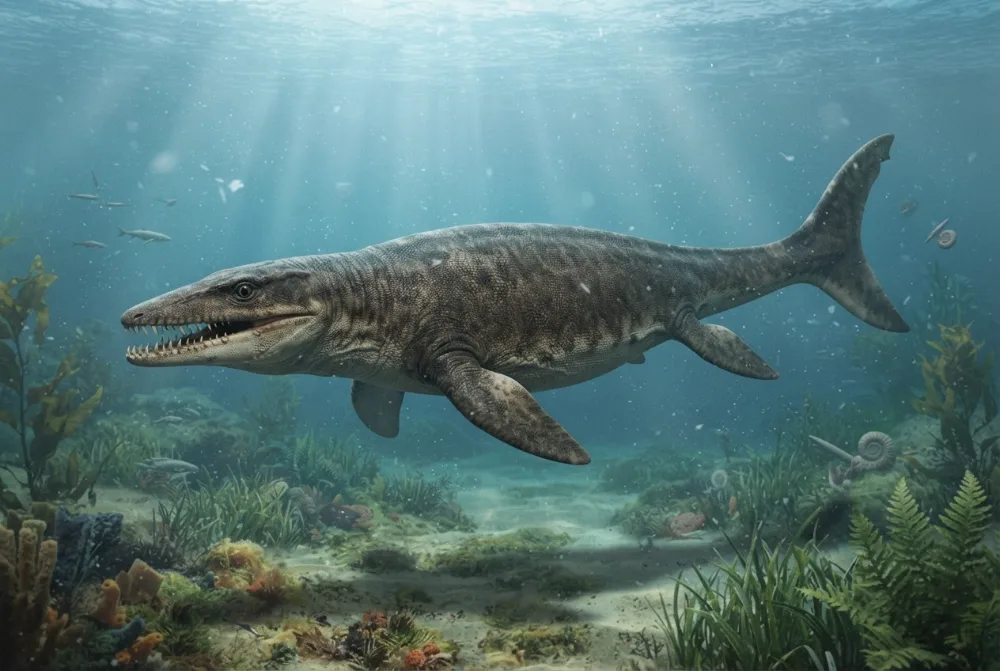
Plioplatecarpus was a medium-sized mosasaur, a giant marine lizard that lived in the late Cretaceous seas. It had big eyes and fewer, sharply curved teeth than other mosasaurs, perfect for grabbing small, slippery prey. Fossils of this ocean hunter have been found all over the world, from North America to Europe and even Antarctica.14
Yaphila nini?
Yayinkulu kangakanani?
Yayinde kangakanani?
 inde njengezinja ezingama-6, impumlo ukuya emsileni🍌inde njengeebhanana ezingama-33 zilandelelana🏊ibinokuqubha ubude bechibi elikhulu lokuqubha (50 m) ngemizuzwana engama-4.7
Plioplatecarpus wayemkhulu kangakanani xa ethelekiswa NAWE?
Yimathematika nje kwibhrawuza yakho. Akukho nto igcinwayo okanye ithunyelwe naphi na.
Yayikhawuleza kangakanani?


Iinyani ezimnandi
Plioplatecarpus had bigger eyes than most other mosasaurs, which may have helped it see in dark, deep water.1
Its teeth were fewer but strongly curved backward, so it could grab small prey very precisely.1
Some scientists think Plioplatecarpus could swim into rivers and estuaries, not just the open ocean.1
Plioplatecarpus used its front flippers for underwater flight, like a bird flaps its wings, to move through weedy or coral reef areas.2
The first Plioplatecarpus fossil was found in Belgium and named by Louis Dollo in 1882.1
Plioplatecarpus lived about 82 to 66 million years ago, during the late Cretaceous period.1
Eyona mibuzo ibuzwa kakhulu: Plioplatecarpus
?How big was Plioplatecarpus?
About 5.5 to 6 metres long, depending on the species.1
?What did Plioplatecarpus eat?
It ate small, slippery prey like fish and squid, grabbing them with its sharply curved teeth.13
?Could Plioplatecarpus swim in freshwater?
Some scientists think it could, because a fossil was found in a non-marine deposit, suggesting it entered rivers and estuaries.1
?When did Plioplatecarpus live?
It lived in the late Cretaceous period, about 82 to 68 million years ago.1
Inyaniso ngeentsomi
Intsomi: Plioplatecarpus was a dinosaur.
Inyaniso: Plioplatecarpus was a mosasaur, a type of marine lizard that lived in the sea, not a dinosaur.1
Kwiingcali zeedayinaso
- Igama lenzululwazi
- Plioplatecarpus
- Inikwe igama ngu:
- Dollo 18824
- Iqela
- Iimosasauri
- Usapho / iclade
- Mosasauridae4
- Ukuhlelwa
- Mosasauroidea4
- Ubudala bamatye
- 100 ukuya ku-62 izigidi zeminyaka (Cenomanian / Danian)4
- Izakhiwo zamatye
- Bearpaw Shale, Pierre Shale, Fox Hills4
- Amazwe
- iUSA, iKhanada, i-Antarctica, iSweden, iDenmark, iRashiya4
- Iirekhodi zeefosili
- 28 kwi-Paleobiology Database4
- Ukufunyanwa
- The first Plioplatecarpus fossil was found in Belgium and named by paleontologist Louis Dollo in 1882. Later, fossils from North America that were first called Mosasaurus were reclassified as Plioplatecarpus.1
- Kusaxoxwa ngayo
- Scientists still debate whether some North American Plioplatecarpus fossils belong to separate species or are just variations of the same species found in Europe.2
Apho iinyani zivela khona
- Plioplatecarpus (en.wikipedia.org)
- Plioplatecarpus (Reptilia, Mosasauridae) from the Upper (biblio.naturalsciences.be)
- Plioplatecarpus (prehistoric-wildlife.com)
- Plioplatecarpus in The Paleobiology Database (CC BY 4.0): ubudala, iindawo, izakhiwo zamatye, ukuhlelwa.
Yonke inyani ekweli phepha inenombolo ebonisa umthombo wayo. Ukuba siphosisile, uxolo, sithanda iidayinaso, asiyojenali yenzululwazi. Sixelele apha: [email protected], siya kuyilungisa.
 URex ulambile! I-Dino Wiki yiprojekthi katata ukwenzela unyana wakhe othanda iidayinaso, isimahla, ayinazintengiso, ayinazilandeli. Abantu abadala banokuphakela uRex isidlwana ukuze incede ihlale kwi-intanethi.Phakela uRex
 Mosasaurus
 Prognathodon
 Tylosaurus
 Platecarpus
 Clidastes
 Globidens
 Tyrannosaurus
 Triceratops
 Velociraptor
 Spinosaurus
 Ankylosaurus
 Parasaurolophus