 Uyiyiphi idayinaso? Ikwizi
 Idabi leedayinaso
 Ugqatso lweedayinaso
 Imidlalo emincinci yeedayinaso
 I-albhamu yezitikha
 Iilisti ze-TOP zeedayinaso
 Ndothuse!
Qianichthyosaurus
Qianichthyosaurus was a small, fast-swimming marine reptile that lived in the seas of ancient China. It looked a bit like a dolphin, with a long snout, big eyes, and flippers for paddling. Even though it was not a dinosaur, it ruled the ocean during the Triassic Period.1
Yaphila nini?
Yayinkulu kangakanani?
Yayinde kangakanani?
 inde njengeekati zasekhaya ezingama-4, impumlo ukuya emsileni🍌inde njengeebhanana ezingama-11 zilandelelana🏊ibinokuqubha ubude bechibi elikhulu lokuqubha (50 m) ngemizuzwana engama-4.4
Qianichthyosaurus wayemkhulu kangakanani xa ethelekiswa NAWE?
Yimathematika nje kwibhrawuza yakho. Akukho nto igcinwayo okanye ithunyelwe naphi na.
Yayikhawuleza kangakanani?


Iinyani ezimnandi
Qianichthyosaurus had hind flippers that were almost as long as its front flippers, which helped it steer and swim quickly.1
Complete fossils of Qianichthyosaurus are common in the Xiaowa Formation, including both babies and pregnant females.1
The larger ichthyosaurs Guizhouichthyosaurus and Guanlingsaurus lived at the same time but are rarer than Qianichthyosaurus.1
Qianichthyosaurus is closely related to Toretocnemus, an ichthyosaur found in California, USA.1
The two species of Qianichthyosaurus lived at different times: Q. xingyiensis is older (Ladinian) and Q. zhoui is younger (Carnian).3
Qianichthyosaurus had a very short snout compared to many other ichthyosaurs, and its eyes were huge and round.2
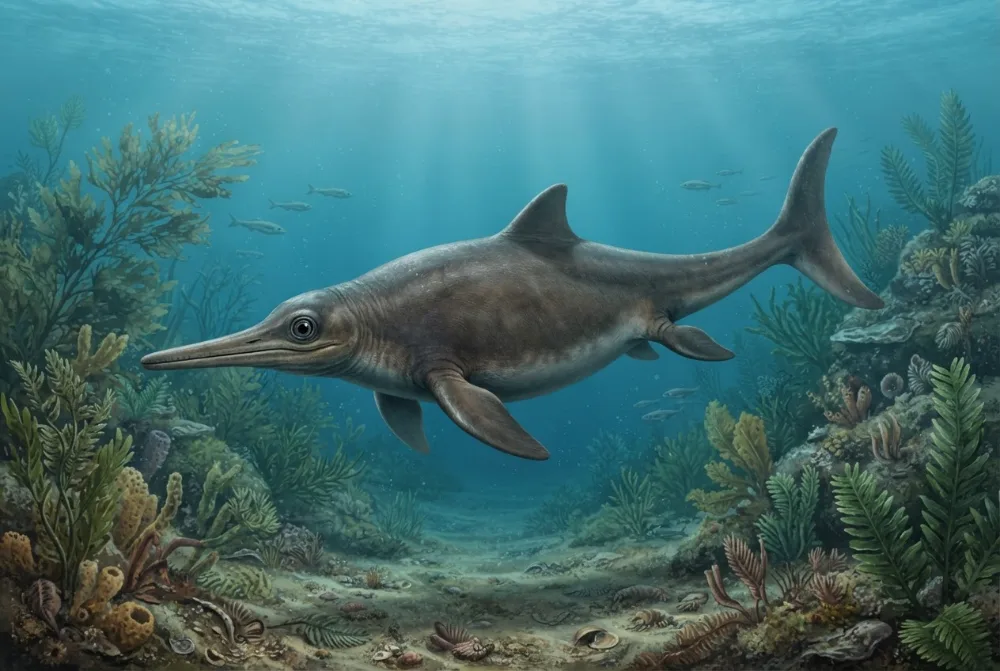
Eyona mibuzo ibuzwa kakhulu: Qianichthyosaurus
?How big was Qianichthyosaurus?
Qianichthyosaurus was a small ichthyosaur. Q. zhoui measured 1.5 to 2 m (4.9 to 6.6 ft) long, while Q. xingyiensis was smaller at 1.3 m (4.3 ft) long.1
?What did Qianichthyosaurus eat?
It had small teeth, so it probably ate small fish and squid. Its relatives, like Shastasaurus, were suction feeders that ate soft prey.14
?Is Qianichthyosaurus a dinosaur?
No, it is not a dinosaur. It was an ichthyosaur, a marine reptile that lived in the ocean during the Triassic Period.1
?When did Qianichthyosaurus live?
It lived during the Middle to Late Triassic Period, about 237 to 227 million years ago.1
Inyaniso ngeentsomi
Intsomi: Some people think Qianichthyosaurus was a dinosaur because it lived in the water and had flippers.
Inyaniso: Qianichthyosaurus was an ichthyosaur, a marine reptile that is not a dinosaur. Ichthyosaurs are a different group of reptiles that lived in the ocean.1
Kwiingcali zeedayinaso
- Igama lenzululwazi
- Qianichthyosaurus
- Inikwe igama ngu:
- Li 19995
- Iqela
- Ii-ichthyosauri
- Usapho / iclade
- Toretocnemidae5
- Ukuhlelwa
- Ichthyosauria > Ichthyosauromorpha5
- Ubudala bamatye
- 239 ukuya ku-227 izigidi zeminyaka (Ladinian / Carnian)5
- Izakhiwo zamatye
- Falang, Xiaowa5
- Amazwe
- iTshayina5
- Iirekhodi zeefosili
- 7 kwi-Paleobiology Database5
- Ukufunyanwa
- The first species, Qianichthyosaurus zhoui, was named by Chinese paleontologist Chun Li in 1999. A second species, Q. xingyiensis, was named in 2013 by Pengfei Yang and colleagues from older rocks in the Falang Formation.13
- Kusaxoxwa ngayo
- Scientists are still debating exactly how Qianichthyosaurus is related to other ichthyosaurs, especially Toretocnemus from North America.1
Apho iinyani zivela khona
- Qianichthyosaurus (en.wikipedia.org)
- PBDB Taxon (paleobiodb.org)
- A New Species of Qianichthyosaurus (Reptilia: Ichthyosauria) from Xingyi Fauna (Ladinian, Middle Triassic) of Guizhou (xbna.pku.edu.cn)
- Short-Snouted Toothless Ichthyosaur from China Suggests Late Triassic Diversification of Suction Feeding Ichthyosaurs | PLOS One (journals.plos.org)
- Qianichthyosaurus in The Paleobiology Database (CC BY 4.0): ubudala, iindawo, izakhiwo zamatye, ukuhlelwa.
Yonke inyani ekweli phepha inenombolo ebonisa umthombo wayo. Ukuba siphosisile, uxolo, sithanda iidayinaso, asiyojenali yenzululwazi. Sixelele apha: [email protected], siya kuyilungisa.
 URex ulambile! I-Dino Wiki yiprojekthi katata ukwenzela unyana wakhe othanda iidayinaso, isimahla, ayinazintengiso, ayinazilandeli. Abantu abadala banokuphakela uRex isidlwana ukuze incede ihlale kwi-intanethi.Phakela uRex
 Ichthyosaurus
 Platypterygius
 Stenopterygius
 Khudiakovia
 Ophthalmosaurus
 Chonespondylus
 Nothosaurus
 Massospondylus
 Plateosaurus
 Coelophysis
 Podokesaurus
 Simosaurus