 Uyiyiphi idayinaso? Ikwizi
 Idabi leedayinaso
 Ugqatso lweedayinaso
 Imidlalo emincinci yeedayinaso
 I-albhamu yezitikha
 Iilisti ze-TOP zeedayinaso
 Ndothuse!
Tarchia
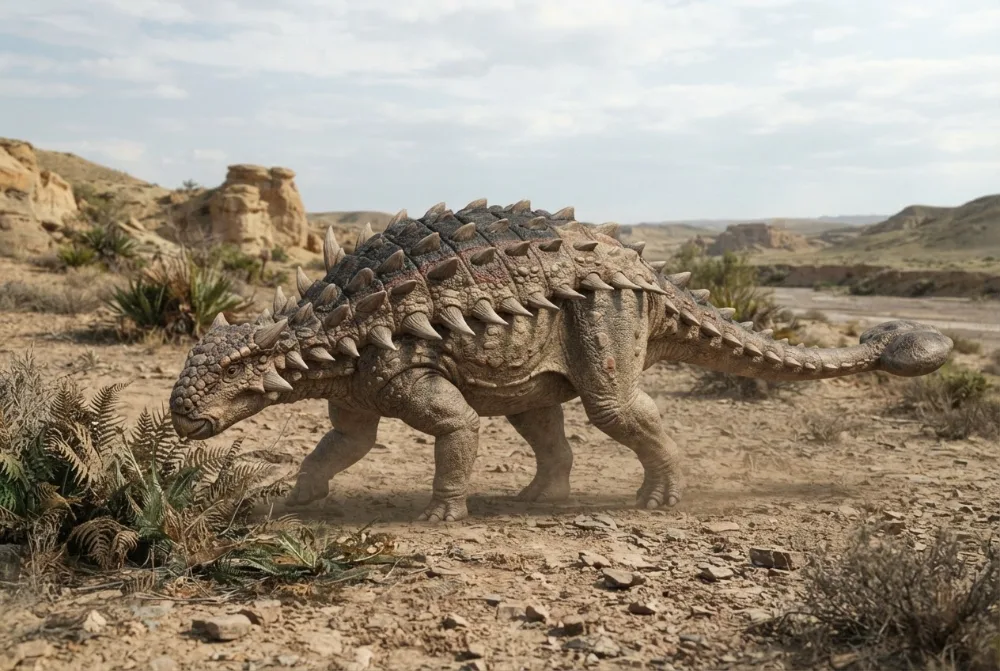
Tarchia was a tank-like dinosaur covered in bony armour and armed with a heavy club at the end of its tail. It lived in the deserts of Mongolia near the end of the Age of Dinosaurs. Despite its tough appearance, it was a gentle plant-eater.1
Yaphila nini?
Yayinkulu kangakanani?
Yayinde kangakanani?
Yayiphakame kangakanani?
uqikelelo
Yayinzima kangakanani?

 inde njengezinja ezingama-6, impumlo ukuya emsileni🍌inde njengeebhanana ezingama-33 zilandelelanainzima njengezinja ezingama-150🍉inzima njengamavatala angama-600🎒inzima njengamagumbi okufundela apheleleyo abantwana angama-4🐻❄️inzima njengeebhere ezimhlophe ezingama-7🏃ibinokubaleka iimitha ezili-100 ngemizuzwana engama-26 (oyena mntu ukhawulezayo udinga i-9,6)
Tarchia wayemkhulu kangakanani xa ethelekiswa NAWE?
Yimathematika nje kwibhrawuza yakho. Akukho nto igcinwayo okanye ithunyelwe naphi na.
Yayikhawuleza kangakanani?


Iinyani ezimnandi
Tarchia's name means 'brainy one' because its skull had a relatively large brain case compared to other ankylosaurs.1
It is the youngest known Asian ankylosaurid dinosaur, living right at the end of the Cretaceous Period.1
The tail club of Tarchia was made of fused vertebrae and could be swung as a weapon against predators.1
Fossils of Tarchia have been found in ancient desert environments with dunes and seasonal streams.1
Scientists think Tarchia may have relied on hindgut fermentation to digest tough plants, similar to modern cows.1
Three species of Tarchia are known: T. kielanae, T. teresae, and T. tumanovae.1
Eyona mibuzo ibuzwa kakhulu: Tarchia
?How big was Tarchia?
About 5.5 to 6 metres long and weighed up to 2.5 to 3 metric tons. Some specimens may have been up to 6.7 metres long.12
?What did Tarchia eat?
It was a herbivore that ate low-growing plants. It had a broad muzzle and was a selective feeder, probably eating ground-level plants.12
?Did Tarchia have any predators?
Yes. Tarbosaurus, a large meat-eating dinosaur related to Tyrannosaurus, hunted Tarchia. Tooth marks from Tarbosaurus have been found on a Tarchia skull.21
?How did Tarchia defend itself?
It had a heavy bony club at the end of its tail that it could swing at attackers. Its body was also covered in bony armour called osteoderms.21
Inyaniso ngeentsomi
Intsomi: Tarchia was a slow, stupid dinosaur.
Inyaniso: Tarchia had a relatively large brain for an ankylosaur, and its tail club shows it could defend itself actively.1
Kwiingcali zeedayinaso
- Igama lenzululwazi
- Tarchia
- Inikwe igama ngu:
- Maryanska 19773
- Iqela
- Iidayinaso ezinesikrweqe
- Usapho / iclade
- Ankylosauridae3
- Ukuhlelwa
- Ornithischia > Ankylosauria > Ankylosauridae > Thyreophora3
- Ubudala bamatye
- 84 ukuya ku-66 izigidi zeminyaka (Campanian / Maastrichtian)3
- Izakhiwo zamatye
- Nemegt, Baruungoyot3
- Amazwe
- iMongolia3
- Iirekhodi zeefosili
- 4 kwi-Paleobiology Database3
- Ukufunyanwa
- Tarchia was named in 1977 by Polish paleontologist Teresa Maryańska based on a skull found by a Polish-Mongolian expedition in 1970 near Khulsan, Mongolia.1
- Kusaxoxwa ngayo
- Scientists still debate whether some fossils belong to Tarchia or to its close relative Saichania.1
Apho iinyani zivela khona
- Tarchia (en.wikipedia.org)
- Tarchia | Natural History Museum (nhm.ac.uk)
- Tarchia in The Paleobiology Database (CC BY 4.0): ubudala, iindawo, izakhiwo zamatye, ukuhlelwa.
Yonke inyani ekweli phepha inenombolo ebonisa umthombo wayo. Ukuba siphosisile, uxolo, sithanda iidayinaso, asiyojenali yenzululwazi. Sixelele apha: [email protected], siya kuyilungisa.
 URex ulambile! I-Dino Wiki yiprojekthi katata ukwenzela unyana wakhe othanda iidayinaso, isimahla, ayinazintengiso, ayinazilandeli. Abantu abadala banokuphakela uRex isidlwana ukuze incede ihlale kwi-intanethi.Phakela uRex
 Ankylosaurus
 Sauropelta
 Pinacosaurus
 Scutellosaurus
 Struthiosaurus
 Euoplocephalus
 Tyrannosaurus
 Triceratops
 Velociraptor
 Spinosaurus
 Parasaurolophus
 Pteranodon