 Uyiyiphi idayinaso? Ikwizi
 Idabi leedayinaso
 Ugqatso lweedayinaso
 Imidlalo emincinci yeedayinaso
 I-albhamu yezitikha
 Iilisti ze-TOP zeedayinaso
 Ndothuse!
Terminonatator
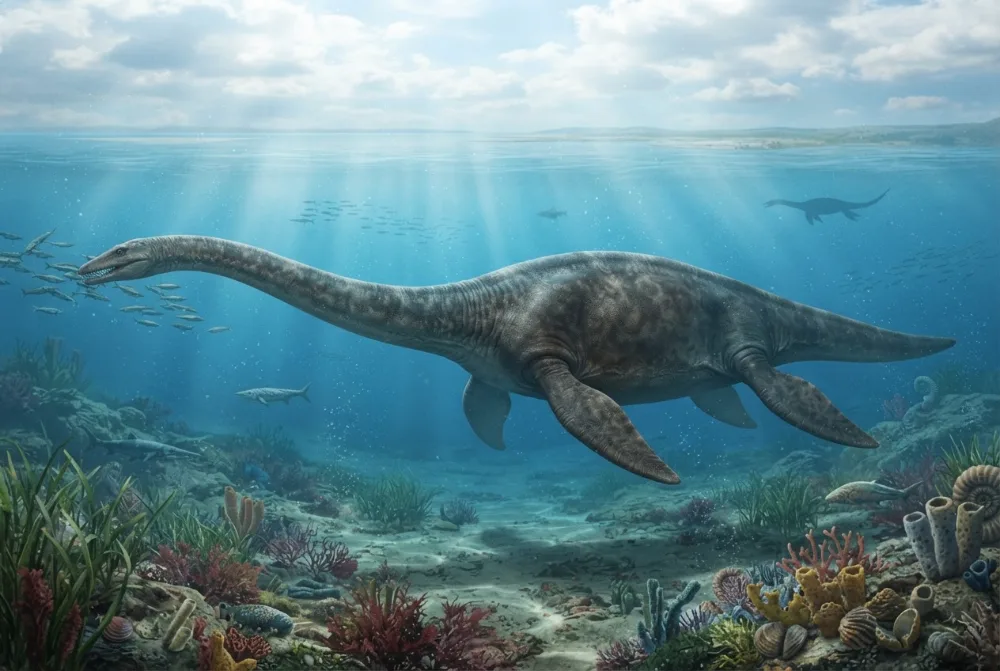
Terminonatator was a marine reptile that swam in the shallow sea that once covered Canada. It was a plesiosaur with a long neck and four flippers, and it hunted fish and other sea creatures. This animal lived near the end of the age of dinosaurs, about 80 million years ago.13
Yaphila nini?
Yayinkulu kangakanani?
Yayinde kangakanani?
 inde njengeemoto ezingama-2 zipakwe zilandelelana🍌inde njengeebhanana ezingama-50 zilandelelana🏊ibinokuqubha ubude bechibi elikhulu lokuqubha (50 m) ngemizuzwana engama-7.8
Terminonatator wayemkhulu kangakanani xa ethelekiswa NAWE?
Yimathematika nje kwibhrawuza yakho. Akukho nto igcinwayo okanye ithunyelwe naphi na.
Yayikhawuleza kangakanani?


Iinyani ezimnandi
Terminonatator is one of the youngest plesiosaurs known from the Western Interior Seaway, a sea that split North America in two during the dinosaur age.1
The only fossil found is a skull and partial skeleton of a young adult. The skull is about 27 cm (10.6 in) long and had a short snout compared to other elasmosaurids.1
Over 150 pebbles were found inside its rib cage. These gastroliths helped it digest food, just like some modern birds and crocodiles.1
Its thigh bone was longer than its upper arm bone, which is unusual for an elasmosaurid. The right thigh bone had broken and healed while the animal was alive.1
The name Terminonatator means 'last swimmer' because it lived so late in the Cretaceous period, near the end of the age of dinosaurs.1
It had only nine teeth in the tip of its upper jaw, while most other plesiosaurs had ten. This might just be a difference between individuals.1
Eyona mibuzo ibuzwa kakhulu: Terminonatator
?How big was Terminonatator?
About 7 metres (23 feet) long, and up to 9 metres (30 feet) if it had an extremely long neck like Elasmosaurus.1
?What did Terminonatator eat?
It ate fish. Its small head and long, thin teeth were good for catching fish, and it probably used its long neck to help capture schooling fish.2
?When did Terminonatator live?
It lived about 70 million years ago, near the end of the Cretaceous period, in a shallow sea that covered Saskatchewan, Canada.2
?Why did Terminonatator swallow stones?
It swallowed stones called gastroliths, which may have helped it digest food or control its buoyancy in the water.2
Kwiingcali zeedayinaso
- Igama lenzululwazi
- Terminonatator
- Inikwe igama ngu:
- Sato 20033
- Iqela
- Iiplesiosauri
- Usapho / iclade
- Elasmosauridae3
- Ukuhlelwa
- Plesiosauria > Elasmosauridae > Sauropterygia3
- Ubudala bamatye
- 84 ukuya ku-72 izigidi zeminyaka (Campanian)3
- Izakhiwo zamatye
- Bearpaw Shale3
- Amazwe
- iKhanada3
- Iirekhodi zeefosili
- 1 kwi-Paleobiology Database3
- Ukufunyanwa
- Tamaki Sato named and described Terminonatator in 2003, based on a skull and partial skeleton found high in the Bearpaw Formation near Ponteix, Saskatchewan, Canada. The species name ponteixensis honors the town of Ponteix.13
- Kusaxoxwa ngayo
- Scientists are not sure exactly how long its neck was. If it had as many neck vertebrae as Elasmosaurus (72), it could have been up to 9 m (30 ft) long.1
Apho iinyani zivela khona
- Terminonatator (en.wikipedia.org)
- “Mo” Ponteix Long-necked Plesiosaur (royalsaskmuseum.ca)
- Terminonatator in The Paleobiology Database (CC BY 4.0): ubudala, iindawo, izakhiwo zamatye, ukuhlelwa.
Yonke inyani ekweli phepha inenombolo ebonisa umthombo wayo. Ukuba siphosisile, uxolo, sithanda iidayinaso, asiyojenali yenzululwazi. Sixelele apha: [email protected], siya kuyilungisa.
 URex ulambile! I-Dino Wiki yiprojekthi katata ukwenzela unyana wakhe othanda iidayinaso, isimahla, ayinazintengiso, ayinazilandeli. Abantu abadala banokuphakela uRex isidlwana ukuze incede ihlale kwi-intanethi.Phakela uRex
 Elasmosaurus
 Pliosaurus
 Plesiosaurus
 Cimoliasaurus
 Colymbosaurus
 Trinacromerum
 Tyrannosaurus
 Triceratops
 Velociraptor
 Spinosaurus
 Ankylosaurus
 Parasaurolophus