 Uyiyiphi idayinaso? Ikwizi
 Idabi leedayinaso
 Ugqatso lweedayinaso
 Imidlalo emincinci yeedayinaso
 I-albhamu yezitikha
 Iilisti ze-TOP zeedayinaso
 Ndothuse!
Yaphila nini?

Yayinkulu kangakanani?
Yayinde kangakanani?
Yayiphakame kangakanani?
Yayinzima kangakanani?
 inde njengezinja ezingama-4, impumlo ukuya emsileni🍌inde njengeebhanana ezingama-25 zilandelelana🍉inzima njengamavatala angama-120🧸inzima njengabantwana basenkulisa abangama-31🎒inzima njengabantwana besikolo abangama-18🏃ibinokubaleka iimitha ezili-100 ngemizuzwana engama-9.2 (oyena mntu ukhawulezayo udinga i-9,6)
Tethyshadros wayemkhulu kangakanani xa ethelekiswa NAWE?
Yimathematika nje kwibhrawuza yakho. Akukho nto igcinwayo okanye ithunyelwe naphi na.
Yayikhawuleza kangakanani?


Iinyani ezimnandi
Tethyshadros lived on a large island in the ancient Tethys Ocean, which is why it was named after that sea.1
The first skeleton, nicknamed Antonio, was found in a vertical rockface and took years to dig out.1
Tethyshadros had a mix of old-fashioned features, like a short neck and a skull like Iguanodon, and advanced features, like teeth arranged in batteries like true hadrosaurs.1
Scientists once thought Tethyshadros was a dwarf dinosaur, but later bone studies showed the main skeleton was from a teenager, not a full-grown adult.1
A second skeleton, nicknamed Bruno, is bigger and more complete, with a full skull and many bones.1
Tethyshadros is one of the latest surviving non-hadrosaurid hadrosauromorphs, meaning it lived just before true hadrosaurs became common.1
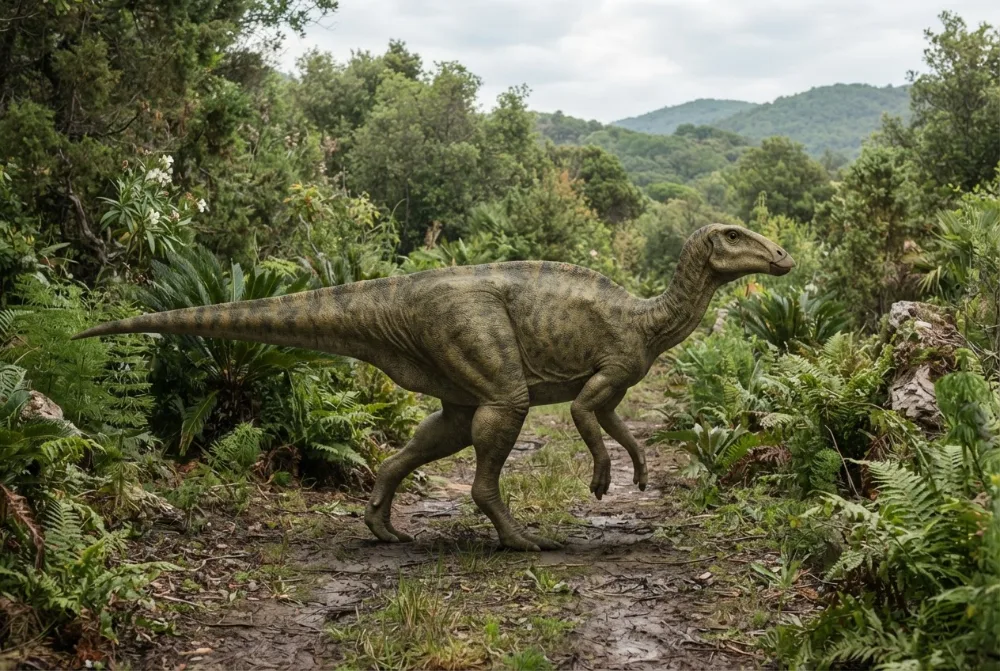
Eyona mibuzo ibuzwa kakhulu: Tethyshadros
?How big was Tethyshadros?
About 4.5 metres (15 feet) long, though some scientists think that estimate might be too high. The adult skeleton Bruno was 15 to 20% larger than the subadult Antonio.1
?What did Tethyshadros eat?
It was a plant-eater. Its beak and teeth were adapted for eating plants, and it may have used its strange serrated beak to bite specific food items.13
?Why did Tethyshadros have a strange beak?
Nobody knows for sure. It might have helped it bite certain plants, or been used for grooming or display.3
?Was Tethyshadros a dwarf dinosaur?
It was originally thought to be a dwarf, but later bone studies showed the main skeleton (Antonio) was a teenager, not a full-grown adult. The adult Bruno was larger.1
?When did Tethyshadros live?
It lived during the Late Cretaceous, about 81.5 to 80.5 million years ago.1
?Where was Tethyshadros found?
In an abandoned quarry at Villaggio del Pescatore, near Trieste, Italy. It lived on a large island in the ancient Tethys Ocean.1
Inyaniso ngeentsomi
Intsomi: Tethyshadros was a dwarf dinosaur.
Inyaniso: The first skeleton was a subadult, not a full-grown adult, so it was not a dwarf species.1
Kwiingcali zeedayinaso
- Igama lenzululwazi
- Tethyshadros
- Inikwe igama ngu:
- Dalla Vecchia 20094
- Iqela
- Izitya-zityalo ezinemilomo
- Usapho / iclade
- Telmatosauridae4
- Ukuhlelwa
- Ornithischia > Ornithopoda > Iguanodontia4
- Ubudala bamatye
- 84 ukuya ku-72 izigidi zeminyaka (Campanian)4
- Izakhiwo zamatye
- Aurisina4
- Amazwe
- i-Itali4
- Iirekhodi zeefosili
- 1 kwi-Paleobiology Database4
- Ukufunyanwa
- Fossil fragments were found in the 1980s by Alceo Tarlao and Giorgio Rimoli. A nearly complete skeleton was discovered in 1994 and excavated by 1999. The dinosaur was named Tethyshadros insularis by Fabio Dalla Vecchia in 2009.1
- Kusaxoxwa ngayo
- Scientists still debate the exact total length of Tethyshadros, because the tail of the first skeleton was missing and its length had to be estimated.1
Apho iinyani zivela khona
- Tethyshadros (en.wikipedia.org)
- Friuli-Venezia Giulia - Fossili Regionali (fossiliregionali.it)
- The “Duck-billed” Dinosaur That Wasn’t (smithsonianmag.com)
- Tethyshadros in The Paleobiology Database (CC BY 4.0): ubudala, iindawo, izakhiwo zamatye, ukuhlelwa.
Yonke inyani ekweli phepha inenombolo ebonisa umthombo wayo. Ukuba siphosisile, uxolo, sithanda iidayinaso, asiyojenali yenzululwazi. Sixelele apha: [email protected], siya kuyilungisa.
 URex ulambile! I-Dino Wiki yiprojekthi katata ukwenzela unyana wakhe othanda iidayinaso, isimahla, ayinazintengiso, ayinazilandeli. Abantu abadala banokuphakela uRex isidlwana ukuze incede ihlale kwi-intanethi.Phakela uRex
 Iguanodon
 Tenontosaurus
 Thescelosaurus
 Zalmoxes
 Camptosaurus
 Rhabdodon
 Tyrannosaurus
 Triceratops
 Velociraptor
 Spinosaurus
 Ankylosaurus
 Parasaurolophus