 Watter dino is jy? Kwis
 Dinogeveg
 Dinoresies
 Dino-minispeletjies
 Plakkeralbum
 Dino TOP-lyste
 Verras my!
Foskeia
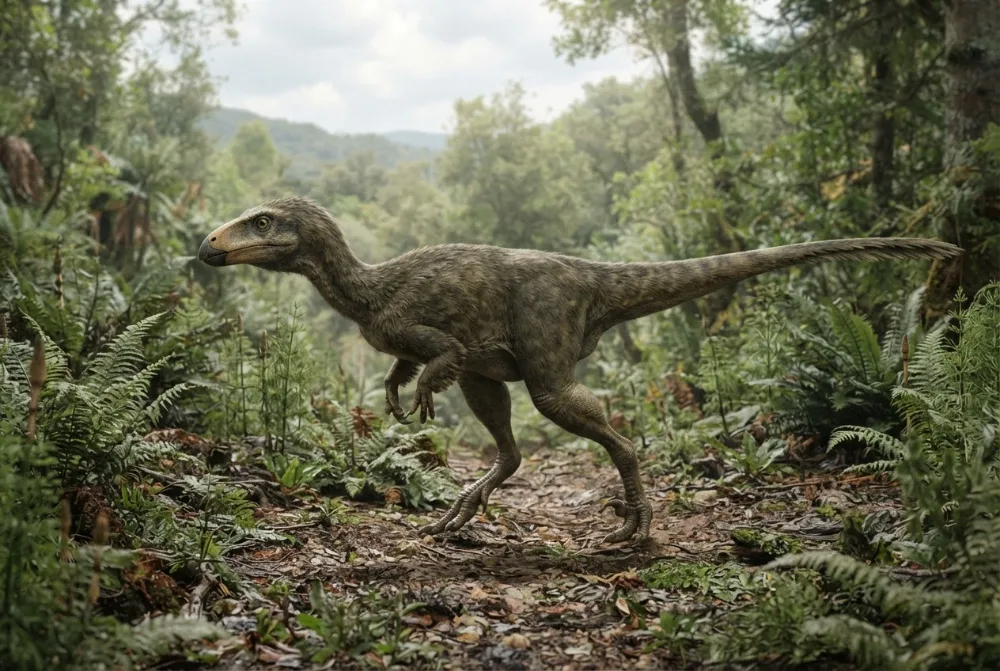
Foskeia was a small, two-legged plant-eater that lived in what is now Spain. It had a beak and a very special skull, and it was one of the earliest members of its dinosaur group.1
Wanneer het dit geleef?
Hoe groot was dit?
Hoe lank was dit?
Hoe hoog was dit?
skatting
 so lank soos 4 huiskatte van neus tot stert🍌so lank soos 11 piesangs punt aan punt🏃kon 100 meter in 8,8 sekondes hardloop (die vinnigste mens het 9,6 nodig)
Hoe groot was Foskeia vergeleke met JOU?
Net wiskunde in jou blaaier. Niks word gestoor of êrens heen gestuur nie.
Hoe vinnig was dit?


Prettige feite
Foskeia had a beak made of fused premaxillae bones, which is very unusual for an ornithopod dinosaur.1
Its front teeth stuck out forward (procumbent) and the crowns extended beyond the edge of the beak.1
The first tooth in its lower jaw was shaped like a thin thread (filiform), which is a unique feature.1
Foskeia had a very high jaw joint, which helped it bite with extra force.1
Scientists used CT scans to see inside the skull fossils and build a 3D model of the head.1
Foskeia lived about 125 to 119 million years ago, during the Early Cretaceous period.2
This dinosaur is the earliest known member of a group called Rhabdodontia, which lived only in Europe.1
Mees gevraagde vrae oor Foskeia
?How big was Foskeia?
Foskeia was very small, about 0.5 metres (1.6 feet) long, making it one of the smallest ornithopods known.31
?What did Foskeia eat?
Foskeia was a plant-eater (herbivore). Its name means 'light forager', referring to its small size and presumed herbivorous habits.3
?Could Foskeia walk on two legs?
Yes, adults were bipedal. Juveniles started out walking on all fours, but switched to two legs early in life.3
?Why did Foskeia have a beak?
Foskeia had a beak made of fused premaxillae bones, which is unusual for an ornithopod. It likely used it to bite off plant material.3
?When did Foskeia live?
Foskeia lived during the Early Cretaceous, about 125 to 119 million years ago, in what is now Spain.3
Vir dino-kenners
- Wetenskaplike naam
- Foskeia
- Benoem deur
- Dieudonné et al. 20264
- Groep
- Plantvreters met snawels
- Familie / klade
- Rhabdodontia4
- Klassifikasie
- Ornithischia > Ornithopoda > Iguanodontia4
- Ouderdom van die rotse
- 126 tot 120 miljoen jaar (Barremian / Aptian)4
- Rotsformasies
- Castrillo de la Reina4
- Lande
- Spanje4
- Fossielrekords
- 1 in The Paleobiology Database4
- Ontdekking
- Foskeia was named in 2026 by a team of scientists led by Dieudonné, based on fossils found at the Vegagete site in Burgos, Spain. The remains were first thought to belong to a different dinosaur, but new skull bones showed it was a new species.12
- Steeds omstrede
- Scientists are not sure exactly how big Foskeia grew, because only a few bones have been found so far.1
Waar die feite vandaan kom
- Foskeia pelendonum, a new rhabdodontomorph from the Lower Cretaceous of Salas de los Infantes (Burgos Province, Spain), and a new phylogeny of ornithischian dinosaurs (riull.ull.es)
- PBDB Taxon (paleobiodb.org)
- Foskeia (en.wikipedia.org)
- Foskeia in The Paleobiology Database (CC BY 4.0): ouderdom, plekke, rotsformasies, klassifikasie.
Elke feit op hierdie bladsy het 'n nommer wat na sy bron wys. As ons iets verkeerd het, jammer, ons is dino-aanhangers, nie 'n wetenskapjoernaal nie. Laat weet ons by [email protected] en ons maak dit reg.
 Rex is honger! Dino Wiki is 'n pa se projek vir sy seun wat mal is oor dino's, gratis met geen advertensies en geen spoorsnyers nie. Grootmense kan vir Rex 'n peuselhappie gee om te help om dit aanlyn te hou.Voer Rex
 Iguanodon
 Tenontosaurus
 Thescelosaurus
 Zalmoxes
 Camptosaurus
 Rhabdodon
 Stegosaurus
 Archaeopteryx
 Giganotosaurus
 Microraptor
 Deinonychus
 Baryonyx