 Woyɛ dino bɛn? Nsɛmmisa agoro
 Dino ko
 Dino mmirikatuo
 Dino agodie nketewa
 Stika nwoma
 Dino TOP nhyehyɛeɛ
 Ma me nwanwa!
Berɛ bɛn na ɛtenaa ase?

Na ɛyɛ ntɛm sɛn?


Nsɛm a ɛyɛ anigye
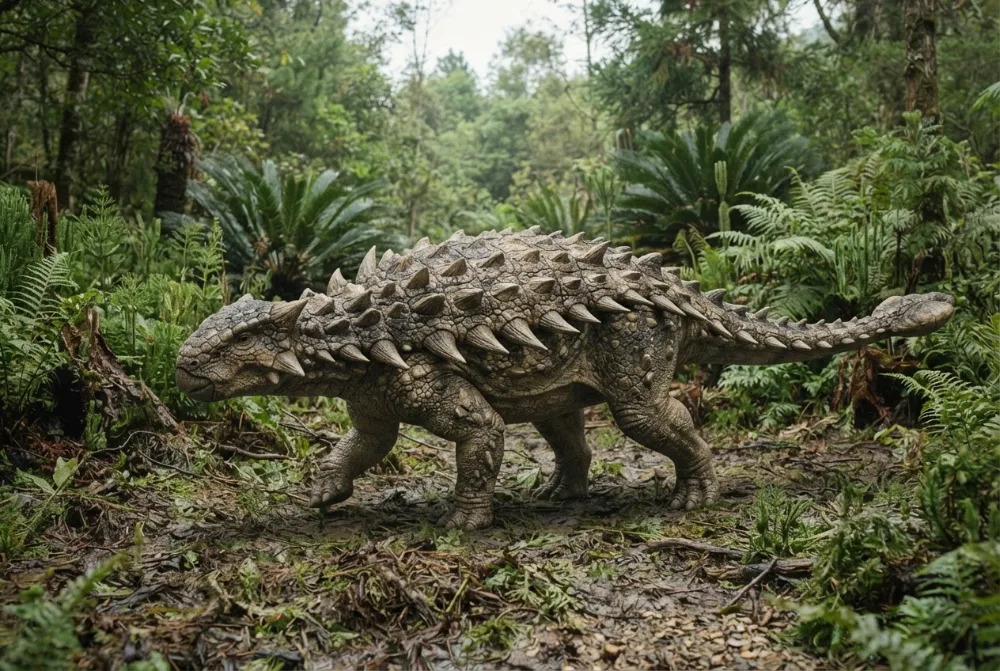
Dongyangopelta is one of the only nodosaurid armoured dinosaurs known from Asia, along with Taohelong and Sauroplites.1
Its name means 'Dongyang shield' because it was found near Dongyang City in China and had a shield of fused bones on its hips.1
The pelvic shield of Dongyangopelta was made of many fused bony bumps called osteoderms, arranged in a rosette pattern with larger bumps in the middle.1
Its thigh bone (femur) was 46 centimetres (18.1 inches) long, straight and strong, with a distinct head separated from the greater trochanter.1
Dongyangopelta had thin triangular plates on its body that ranged from 10 to 35 centimetres (3.9 to 13.8 inches) long.1
The fossil was discovered in October 2009 by Zhiwei Yang in a hillside near Yangyan Village, Zhejiang Province, China.1
Dongyangopelta lived during the Early to Late Cretaceous period, about 105 to 96 million years ago.1
Nsɛm a wɔbisa bebree fa Dongyangopelta ho
?How big was Dongyangopelta?
Scientists do not know its full size yet, but its thigh bone (femur) was 46 centimetres (18.1 inches) long, and its triangular back plates ranged from 10 to 35 centimetres (3.9 to 13.8 inches) long.1
?What did Dongyangopelta eat?
Dongyangopelta was a plant-eater. As a nodosaurid ankylosaur, it ate low-growing plants like ferns and cycads.1
?When did Dongyangopelta live?
Dongyangopelta lived during the Early to Late Cretaceous period, about 105 to 96 million years ago.1
?Where was Dongyangopelta found?
Its fossil was discovered in October 2009 by Zhiwei Yang in a hillside near Yangyan Village, Dongyang City, Zhejiang Province, China.1
Ma dino ho animdefoɔ
- Nyansahu din
- Dongyangopelta
- Obi a ɔtoo din
- Chen et al. 20133
- Kuo
- Dino a wɔwɔ akyɛm
- Abusua / kuo kɛseɛ
- Nodosauridae3
- Nkyekyɛmu
- Ornithischia > Ankylosauria > Nodosauridae > Thyreophora3
- Abotan no mfeɛ
- mfeɛ ɔpepem 113 kɔsi 94 (Albian / Cenomanian)3
- Abotan nhyehyɛeɛ
- Chaochuan3
- Aman
- Kyaena3
- Fɔsil nkyerɛwee
- 1 wɔ The Paleobiology Database mu3
- Nhunumu
- Dongyangopelta was named in 2013 by Chen Rongjun and colleagues. The fossil was found in 2009 by Zhiwei Yang in Zhejiang, China, and dug up by a team of scientists from several museums.1
- Wɔda so gye ho akyinnye
- Scientists are not sure exactly how Dongyangopelta is related to other nodosaurids. Some studies place it close to Zhejiangosaurus, others put it near Sauroplites and Taohelong.1
Baabi a nsɛm no firi
- Dongyangopelta (en.wikipedia.org)
- PBDB Taxon (paleobiodb.org)
- Dongyangopelta in The Paleobiology Database (CC BY 4.0): mfeɛ, mmeaeɛ, abotan nhyehyɛeɛ, nkyekyɛmu.
Asɛm biara a ɛwɔ krataafa yi so wɔ nɔma a ɛkyerɛ baabi a ɛfiri. Sɛ yɛfom biribi a, kafra, yɛyɛ dino dɔfoɔ, yɛnyɛ nyansahu nsɛmma krataa. Ka kyerɛ yɛn wɔ [email protected] na yɛbɛsiesie.
 Ɔkɔm de Rex! Dino Wiki yɛ agya bi adwuma a ɔyɛɛ maa ne babarima a ɔdɔ dino. Ɛyɛ kwa, dawurubɔ biara nni mu, akyidifoɔ biara nni mu. Mpanimfoɔ bɛtumi ama Rex aduane kakra, na aboa ama Dino Wiki atena intanɛt so.Ma Rex aduane
 Ankylosaurus
 Sauropelta
 Pinacosaurus
 Scutellosaurus
 Struthiosaurus
 Euoplocephalus
 Stegosaurus
 Iguanodon
 Archaeopteryx
 Giganotosaurus
 Microraptor
 Deinonychus