 Woyɛ dino bɛn? Nsɛmmisa agoro
 Dino ko
 Dino mmirikatuo
 Dino agodie nketewa
 Stika nwoma
 Dino TOP nhyehyɛeɛ
 Ma me nwanwa!
Berɛ bɛn na ɛtenaa ase?

Na ne kɛseɛ yɛ sɛn?
Na ne tenten yɛ sɛn?
Na ne korɔn yɛ sɛn?
Na ne mu yɛ duru sɛn?
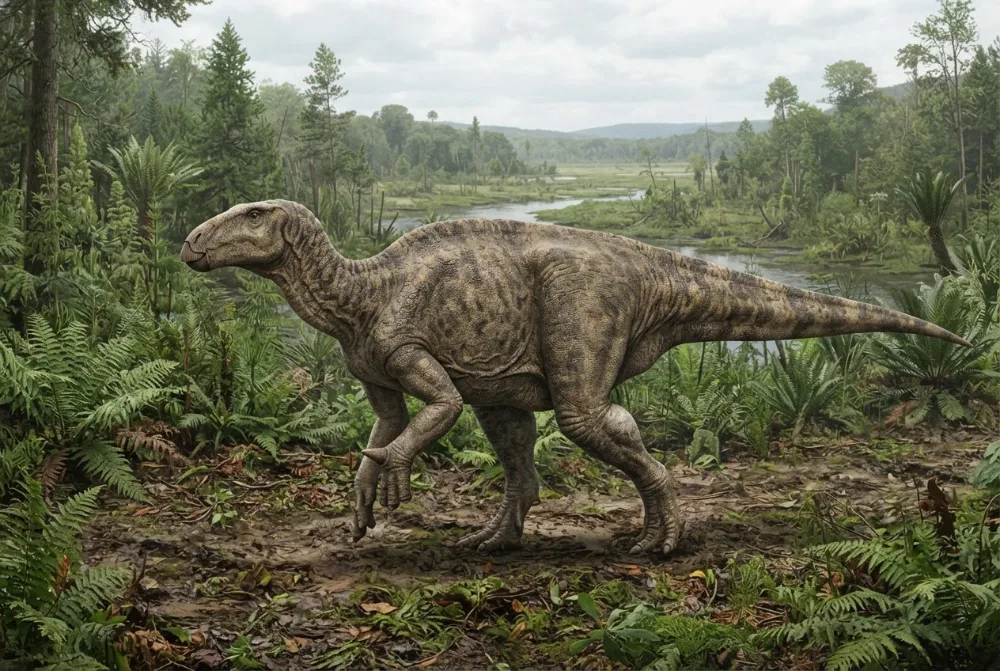
 ne tenten te sɛ kaa 2.5 a wɔde agyina toatoa so🍌ne tenten te sɛ kwadu 61 a wɔde abɔ toatoa so
 ne mu duru bɛyɛ sɛ ɔsono🍉ne mu duru te sɛ watamɛlɔn 1000🎒ne mu duru te sɛ sukuu klaas mũ 6 mu mmofra🐻❄️ne mu duru te sɛ polar bea 11🏃anka ɔbɛtumi atu mmirika mita 100 wɔ sikɛn 15 mu (onipa a ɔyɛ ntɛm sen biara hia 9.6)
Iguanodon kɛseɛ yɛ sɛn sɛ wode toto WO ho a?
Akontaa nko ara wɔ wo browser mu. Yɛnkora biribiara so, na yɛmmfa biribiara nkɔ baabiara.
Na ɛyɛ ntɛm sɛn?


Nsɛm a ɛyɛ anigye
Iguanodon was named in 1825 by Gideon Mantell after he found teeth that looked like iguana teeth.1
Its thumb had a big, sharp spike that scientists think was used for defense against predators.1
Iguanodon had a flexible little finger that could grasp objects, unlike its other fingers which were more like hooves.1
When Iguanodon closed its mouth, the bones in its upper jaw would bow out, making the teeth grind against each other like a chewing motion.1
The front of Iguanodon's mouth had no teeth, just a bony beak covered with a hard material for cropping plants.1
Iguanodon could reach food from ground level up to 4 to 5 metres (13 to 16 feet) high, so it ate both low plants and tree leaves.1
In 1878, many complete Iguanodon skeletons were found in a coal mine in Bernissart, Belgium, which helped scientists understand the dinosaur much better.1
Nsɛm a wɔbisa bebree fa Iguanodon ho
?How big was Iguanodon?
Iguanodon was about 9 to 11 metres (30 to 36 feet) long and weighed around 4.5 metric tons (5 short tons).1
?What did Iguanodon eat?
Iguanodon was a plant-eater. It used its beak to snip leaves and its cheek teeth to grind tough plants like cycads.34
?Did Iguanodon have a thumb spike?
Yes, Iguanodon had a large, sharp spike on each thumb. It may have been used for defense or for breaking into fruits and seeds.35
?Could Iguanodon walk on two legs?
Yes, Iguanodon could walk on two legs or on all fours. It was one of the few dinosaurs that could do both.34
?When did Iguanodon live?
Iguanodon lived during the Early Cretaceous period, about 126 to 122 million years ago.1
?Who discovered Iguanodon?
Iguanodon was named by Gideon Mantell in 1825 after teeth were found in Sussex, England. His wife Mary Ann Mantell is often credited with finding the first teeth.51
?Was Iguanodon a dinosaur?
Yes, Iguanodon was a dinosaur. It was one of the first dinosaurs ever named, after Megalosaurus.1
?How fast could Iguanodon run?
Up to about 24 km/h (15 mph) on two legs, about as fast as a grown-up riding a bike. Most of the time it walked much slower.4
Atosɛm sɛefoɔ
Atosɛm: Iguanodon was a slow, clumsy dinosaur that always walked on four legs.
Nokorɛ: Iguanodon could walk on two legs or all fours, and it was probably quite agile for its size.2
Ma dino ho animdefoɔ
- Nyansahu din
- Iguanodon
- Obi a ɔtoo din
- Mantell 18256
- Kuo
- Ahabandifoɔ a wɔwɔ anomaa ano
- Abusua / kuo kɛseɛ
- Ankylopollexia6
- Nkyekyɛmu
- Ornithischia > Ornithopoda > Iguanodontia6
- Abotan no mfeɛ
- mfeɛ ɔpepem 155 kɔsi 66 (Kimmeridgian / Maastrichtian)6
- Abotan nhyehyɛeɛ
- Arcillas de Morella, Weald Clay, Wessex6
- Aman
- Engiresi, Spania, Gyaaman, Frɛnse, Pɔtugal, Bɛlgyium6
- Fɔsil nkyerɛwee
- 133 wɔ The Paleobiology Database mu6
- Wɔsan frɛ no
- Heterosaurus, Iguanosaurus, Struthopus, Therosaurus (din dada no nso, yɛkan no sɛ aboa korɔ no ara)6
- Nhunumu
- Iguanodon was first named by Gideon Mantell in 1825 based on fossil teeth found in Sussex, England. Later, in 1878, many complete skeletons were discovered in a Belgian coal mine and studied by Louis Dollo.1
- Wɔda so gye ho akyinnye
- Scientists still debate exactly what plants Iguanodon ate. Some think it ate horsetails, cycads, and conifers, while others link it to the spread of flowering plants.1
Baabi a nsɛm no firi
- Iguanodon (en.wikipedia.org)
- Iguanodon | Diet, Habitat & Extinction (britannica.com)
- Iguanodon | National Geographic Kids (kids.nationalgeographic.com)
- enchantedlearning.com (enchantedlearning.com)
- Iguanodon: the teeth that led to a dinosaur discovery | Natural History Museum (nhm.ac.uk)
- Iguanodon in The Paleobiology Database (CC BY 4.0): mfeɛ, mmeaeɛ, abotan nhyehyɛeɛ, nkyekyɛmu.
Asɛm biara a ɛwɔ krataafa yi so wɔ nɔma a ɛkyerɛ baabi a ɛfiri. Sɛ yɛfom biribi a, kafra, yɛyɛ dino dɔfoɔ, yɛnyɛ nyansahu nsɛmma krataa. Ka kyerɛ yɛn wɔ [email protected] na yɛbɛsiesie.
 Ɔkɔm de Rex! Dino Wiki yɛ agya bi adwuma a ɔyɛɛ maa ne babarima a ɔdɔ dino. Ɛyɛ kwa, dawurubɔ biara nni mu, akyidifoɔ biara nni mu. Mpanimfoɔ bɛtumi ama Rex aduane kakra, na aboa ama Dino Wiki atena intanɛt so.Ma Rex aduane
 Tenontosaurus
 Thescelosaurus
 Zalmoxes
 Camptosaurus
 Rhabdodon
 Nanosaurus
 Stegosaurus
 Archaeopteryx
 Giganotosaurus
 Microraptor
 Deinonychus
 Baryonyx