 Woyɛ dino bɛn? Nsɛmmisa agoro
 Dino ko
 Dino mmirikatuo
 Dino agodie nketewa
 Stika nwoma
 Dino TOP nhyehyɛeɛ
 Ma me nwanwa!
Eonatator
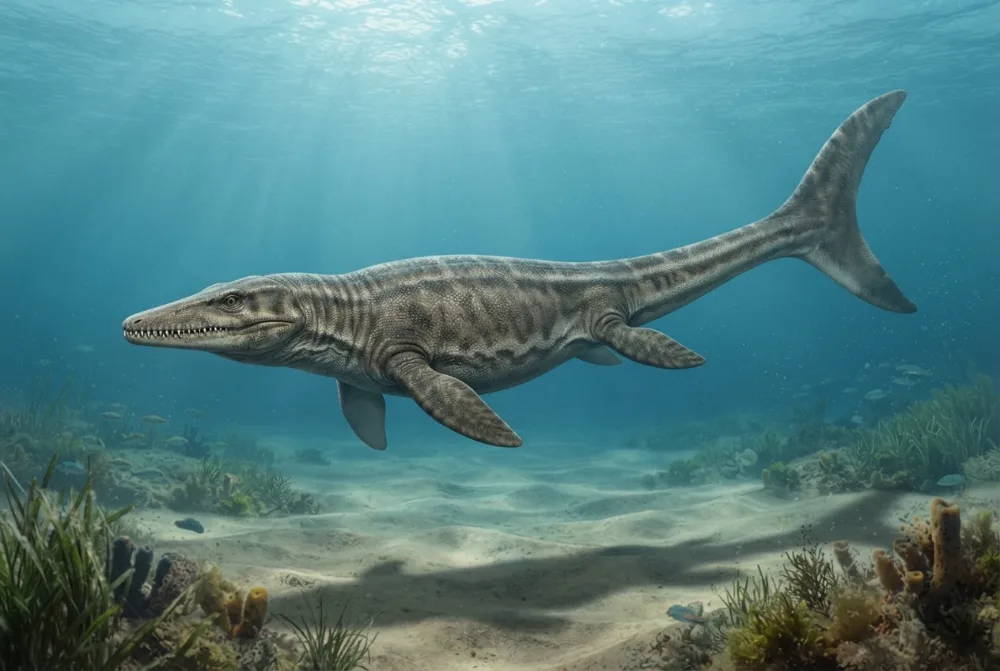
Eonatator was a small, speedy marine lizard that swam in warm Cretaceous seas. It was an early relative of the giant mosasaurs, but much smaller and more agile.1
Berɛ bɛn na ɛtenaa ase?
Na ne kɛseɛ yɛ sɛn?
Na ne tenten yɛ sɛn?
 ne tenten te sɛ nkraman 2.5 firi hwene kɔsi dua🍌ne tenten te sɛ kwadu 14 a wɔde abɔ toatoa so🏊anka ɔbɛtumi aguare nsuguarebea kɛseɛ (50 m) tenten wɔ sikɛn 6 mu
Eonatator kɛseɛ yɛ sɛn sɛ wode toto WO ho a?
Akontaa nko ara wɔ wo browser mu. Yɛnkora biribiara so, na yɛmmfa biribiara nkɔ baabiara.
Na ɛyɛ ntɛm sɛn?


Nsɛm a ɛyɛ anigye
Eonatator's tail made up about 40% of its head and body length, helping it swim fast.1
The first Eonatator fossil was found in the Niobrara Chalk of Kansas in 1918 by Charles Hazelius Sternberg and his son Levi.1
Eonatator was originally thought to be a species of Clidastes or Halisaurus, but scientists gave it its own genus in 2005.1
A second species, Eonatator coellensis, was discovered in Colombia and named after the town of Coello.1
Eonatator had a smooth, triangular bone on top of its skull with a round hole called the parietal foramen.1
Like many mosasaurs, Eonatator gave birth to live young instead of laying eggs.2
Nsɛm a wɔbisa bebree fa Eonatator ho
?How big was Eonatator?
Eonatator was a small mosasaur. The type specimen of Eonatator sternbergii was about 2.6 metres (8.5 ft) long, and a specimen of Eonatator coellensis measured 2.8 metres (9.2 ft) long as preserved, missing part of its tail.1
?What did Eonatator eat?
The sources do not say exactly what Eonatator ate. As a small marine lizard and a mosasaur, it likely ate fish and other small sea creatures, but no specific diet is given.1
?Where was Eonatator found?
Eonatator fossils have been found in North America (Kansas and Alabama), Colombia, and Sweden. The first fossil was discovered in the Niobrara Chalk of Kansas in 1918.1
?Is Eonatator a dinosaur?
No, Eonatator is not a dinosaur. It is a marine lizard belonging to the mosasaur family.1
Ma dino ho animdefoɔ
- Nyansahu din
- Eonatator
- Obi a ɔtoo din
- Bardet et al. 20053
- Kuo
- Mosasɔɔ
- Abusua / kuo kɛseɛ
- Mosasauridae3
- Nkyekyɛmu
- Mosasauroidea3
- Abotan no mfeɛ
- mfeɛ ɔpepem 86 kɔsi 72 (Santonian / Campanian)3
- Abotan nhyehyɛeɛ
- Niobrara, Nivel de Lutitas y Arenas3
- Aman
- Swiidin, Amerika, Kolombia3
- Fɔsil nkyerɛwee
- 9 wɔ The Paleobiology Database mu3
- Nhunumu
- The first Eonatator fossil, a nearly complete skeleton, was found in Kansas in 1918 by Charles Hazelius Sternberg and his son Levi. It was named Eonatator sternbergii by Nathalie Bardet and colleagues in 2005.1
- Wɔda so gye ho akyinnye
- Some scientists think Eonatator might actually belong to the genus Halisaurus, but most now accept it as a separate genus.1
Baabi a nsɛm no firi
- Eonatator (en.wikipedia.org)
- PBDB Taxon (paleobiodb.org)
- Eonatator in The Paleobiology Database (CC BY 4.0): mfeɛ, mmeaeɛ, abotan nhyehyɛeɛ, nkyekyɛmu.
Asɛm biara a ɛwɔ krataafa yi so wɔ nɔma a ɛkyerɛ baabi a ɛfiri. Sɛ yɛfom biribi a, kafra, yɛyɛ dino dɔfoɔ, yɛnyɛ nyansahu nsɛmma krataa. Ka kyerɛ yɛn wɔ [email protected] na yɛbɛsiesie.
 Ɔkɔm de Rex! Dino Wiki yɛ agya bi adwuma a ɔyɛɛ maa ne babarima a ɔdɔ dino. Ɛyɛ kwa, dawurubɔ biara nni mu, akyidifoɔ biara nni mu. Mpanimfoɔ bɛtumi ama Rex aduane kakra, na aboa ama Dino Wiki atena intanɛt so.Ma Rex aduane
 Mosasaurus
 Prognathodon
 Tylosaurus
 Platecarpus
 Clidastes
 Globidens
 Tyrannosaurus
 Triceratops
 Velociraptor
 Spinosaurus
 Ankylosaurus
 Parasaurolophus