 Woyɛ dino bɛn? Nsɛmmisa agoro
 Dino ko
 Dino mmirikatuo
 Dino agodie nketewa
 Stika nwoma
 Dino TOP nhyehyɛeɛ
 Ma me nwanwa!
Keichousaurus
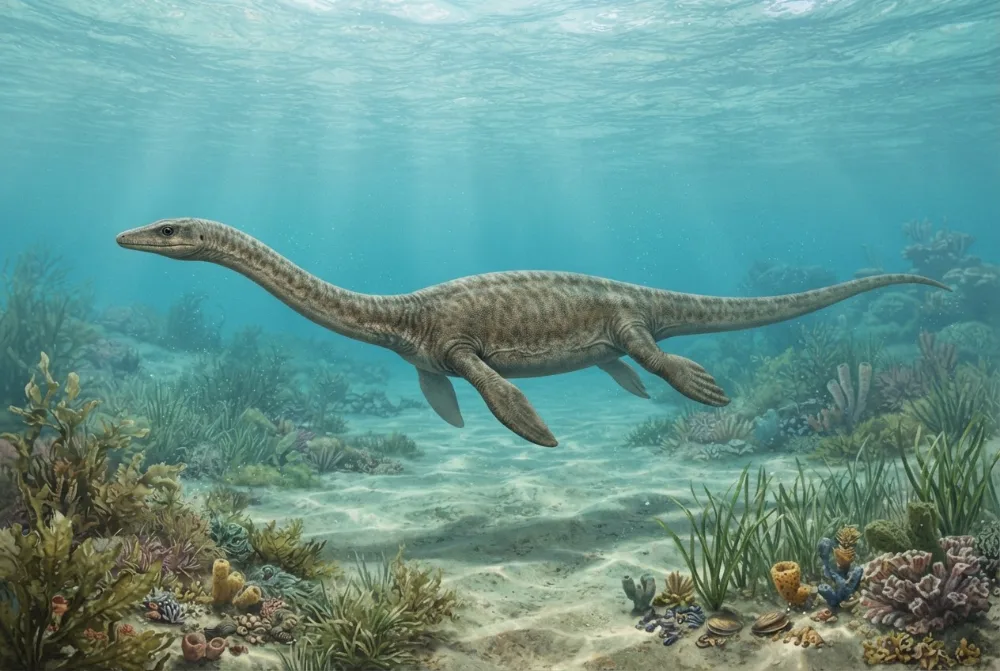
Keichousaurus was a small marine reptile that swam in warm seas during the Triassic Period. It had a long neck, a long tail, and paddle-like limbs to row through the water.1
Berɛ bɛn na ɛtenaa ase?
Na ne kɛseɛ yɛ sɛn?
Na ne tenten yɛ sɛn?
Keichousaurus kɛseɛ yɛ sɛn sɛ wode toto WO ho a?
Akontaa nko ara wɔ wo browser mu. Yɛnkora biribiara so, na yɛmmfa biribiara nkɔ baabiara.
Na ɛyɛ ntɛm sɛn?


Nsɛm a ɛyɛ anigye
Keichousaurus gave birth to live young instead of laying eggs. Baby fossils have been found inside adult females.1
This reptile had very broad ulna bones in its forelimbs, which helped make its paddles more effective for swimming.1
Males grew slightly larger than females. Mature males reached about 16 cm snout-vent length, while females reached about 15 cm.1
Keichousaurus is one of the most common sauropterygian fossils found in China. Many complete skeletons have been collected.1
It had a long, serpentine neck and a small head, similar to other pachypleurosaurs.1
Keichousaurus probably used a rowing motion with its paddle-like limbs to move through the water.1
Nsɛm a wɔbisa bebree fa Keichousaurus ho
?Is Keichousaurus a dinosaur?
No, Keichousaurus is not a dinosaur. It is a marine reptile called a sauropterygian.1
?How big was Keichousaurus?
Keichousaurus was very small. Mature males reached about 16 cm snout-vent length, and females about 15 cm.1
?What did Keichousaurus eat?
It ate fish. It had pointed teeth and backward-curved teeth at the front of its mouth to catch and swallow prey whole.1
?Did Keichousaurus lay eggs?
No. Fossil evidence shows that Keichousaurus gave birth to live young, not eggs. Babies have been found inside adult females.143
?Could Keichousaurus swim?
Yes, it was a good swimmer. It used its paddle-like limbs to row through the water, similar to underwater flight.1
?When did Keichousaurus live?
Keichousaurus lived during the Triassic Period, from about 251 to 227 million years ago.1
Ma dino ho animdefoɔ
- Nyansahu din
- Keichousaurus
- Obi a ɔtoo din
- Young 19585
- Kuo
- Ɛpo mu mmoa a wɔwea
- Abusua / kuo kɛseɛ
- Keichousauridae5
- Nkyekyɛmu
- Sauropterygia5
- Abotan no mfeɛ
- mfeɛ ɔpepem 251 kɔsi 237 ()5
- Abotan nhyehyɛeɛ
- Falang, Jialingjiang, Gejiu5
- Aman
- Kyaena5
- Fɔsil nkyerɛwee
- 7 wɔ The Paleobiology Database mu5
- Nhunumu
- The first fossil of Keichousaurus was found in 1957 in Guizhou Province, China, by Hu Chengzhi. It was named by Chinese paleontologist Young Chung-chien in 1958.1
- Wɔda so gye ho akyinnye
- Scientists are not sure whether Keichousaurus was viviparous (giving birth to live young) or ovoviviparous (eggs hatching inside the mother).3
Baabi a nsɛm no firi
- Keichousaurus (en.wikipedia.org)
- PBDB Taxon (paleobiodb.org)
- Morphology of Keichousaurus hui from the Middle Triassic of Xingyi, Guizhou Province with Comments on Its Reproduction Mode (xbna.pku.edu.cn)
- Triassic marine reptiles gave birth to live young | Nature (nature.com)
- Keichousaurus in The Paleobiology Database (CC BY 4.0): mfeɛ, mmeaeɛ, abotan nhyehyɛeɛ, nkyekyɛmu.
Asɛm biara a ɛwɔ krataafa yi so wɔ nɔma a ɛkyerɛ baabi a ɛfiri. Sɛ yɛfom biribi a, kafra, yɛyɛ dino dɔfoɔ, yɛnyɛ nyansahu nsɛmma krataa. Ka kyerɛ yɛn wɔ [email protected] na yɛbɛsiesie.
 Ɔkɔm de Rex! Dino Wiki yɛ agya bi adwuma a ɔyɛɛ maa ne babarima a ɔdɔ dino. Ɛyɛ kwa, dawurubɔ biara nni mu, akyidifoɔ biara nni mu. Mpanimfoɔ bɛtumi ama Rex aduane kakra, na aboa ama Dino Wiki atena intanɛt so.Ma Rex aduane
 Nothosaurus
 Placodus
 Lariosaurus
 Cyamodus
 Cymatosaurus
 Proneusticosaurus
 Chonespondylus
 Cymbospondylus
 Phalarodon
 Mixosaurus
 Chaohusaurus
 Chensaurus